Bali's tourism market continues to attract millions of international visitors, but rising demand is only part of the investment story. For buyers looking at hospitality-linked property, the more important question is whether an asset combines location, operating infrastructure and a proposition capable of competing as the market becomes more sophisticated.
Bali is no longer simply a tourism recovery story. The island is entering a more mature phase in which visitor demand remains substantial, but competition for those visitors, and for the investment capital that follows them, is becoming more important.
BPS-Statistics Bali recorded 6,948,754 direct international tourist arrivals during 2025, an increase of 9.72% from the previous year. Australia remained Bali's largest source market, accounting for 23.44% of arrivals. International flight activity through I Gusti Ngurah Rai International Airport also increased during the year.
Those numbers create an attractive backdrop for hospitality and property investors. They do not, however, tell the whole story.
More visitors do not automatically translate into stronger performance for every hotel, villa or resort residence. Investors still need to consider competition, occupancy, operating costs, supply and the quality of the product being offered.
That distinction is becoming particularly relevant in Canggu, where tourism, lifestyle real estate and wellness have increasingly converged.
Canggu’s next phase is about the quality of demand
Canggu has evolved from a relatively quiet coastal area into one of Bali's best-known international lifestyle destinations. Its appeal now extends well beyond the beach, with hospitality, restaurants, cafés, fitness businesses, wellness operators and leisure venues forming part of a much broader visitor economy.
For property owners, that creates both an opportunity and a challenge.
The opportunity is obvious: an established international destination can provide a deep pool of potential guests and buyers.
The challenge is differentiation.
As more accommodation enters the market, simply being in Canggu is unlikely to be enough. Properties increasingly need a reason for visitors to choose them over competing hotels, villas and residences.
That is where the wellness proposition becomes interesting.
The Global Wellness Institute estimates that global wellness tourism expenditure reached $893.9 billion in 2024, compared with $785.6 billion in 2023. The sector recorded a 6.4% compound annual growth rate between 2019 and 2024, while the institute projects further expansion through the end of the decade.
For Bali, a destination already associated with health, fitness, retreats and holistic experiences, the overlap between wellness tourism and hospitality property is commercially significant.
But the investment question is not whether wellness is fashionable.
It is whether a well-executed wellness proposition can help an individual asset attract and retain demand.
A resort residence built around that proposition
The River Suite at Swiss-Belresort Anahita Canggu provides a useful example.
Listed by International Property Alerts at $318,800, the one-bedroom residence offers 68 square metres of living space on a 94-square-metre land area. The property is described as ready-built and is located in Babakan, Canggu, with a private swimming pool and riverside setting.
The distinction between ready-built and off-plan ownership is worth considering.
Off-plan purchases can provide access to new developments before completion, but they also require buyers to accept construction and delivery risk. A completed property allows a prospective buyer to assess the physical asset, its surroundings and the finished development before committing capital.
That does not remove investment risk, but it changes the nature of the decision.
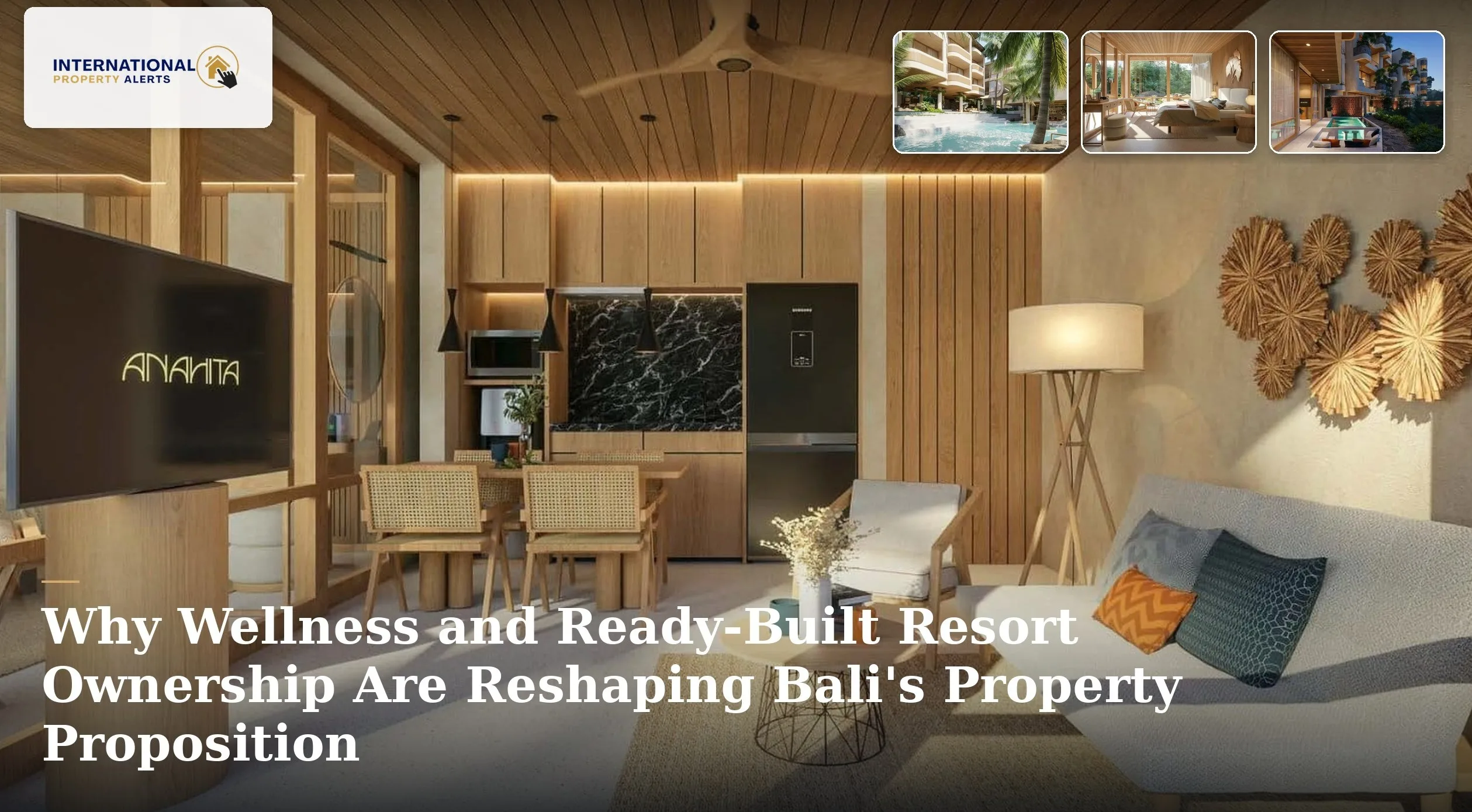
The River Suite is designed around indoor-outdoor living, with contemporary interiors, natural materials, a private pool and a flower jacuzzi bath. The riverside position provides a quieter setting within the wider Canggu market.
The property is relatively compact. Its proposition therefore depends less on sheer floor area and more on what comes with the residence.
That is where the resort's wider operating environment becomes important.
Wellness is part of the asset, not simply an amenity
According to the International Property Alerts listing, Anahita Social Club & Spa is a four-storey wellness facility incorporating hydrotherapy pools, a Turkish Hamam, Finnish sauna, cold plunges, hyperbaric oxygen therapy, red-light therapy, salt-breathing rooms, massage facilities, reflexology and yoga spaces.
The listing also describes a 24-hour wellness operation and KORA Restaurant as part of the resort's hospitality offering.
Taken together, these facilities give the development a clearly defined identity.
That matters because wellness is increasingly becoming part of the wider hospitality experience rather than a standalone spa service.
Travellers are spending more on experiences associated with fitness, recovery, relaxation and personal wellbeing. The Global Wellness Institute's data indicates that wellness tourism has become a substantial global travel segment rather than a niche category.
For a property investor, however, the presence of wellness facilities should not automatically be interpreted as evidence of higher returns.
The relevant question is whether those facilities generate measurable value through occupancy, pricing power, guest demand, ancillary spending or stronger positioning against competing properties.
That evidence needs to come from operating performance.
The investment case requires more than a headline return
The property listing states that the ownership programme offers an 8% guaranteed annual return for the first two years, subject to programme terms, alongside additional profit distribution beyond the guaranteed threshold. It also states that owners receive 21 complimentary points annually and that the property is professionally managed under the Swiss-Belresort brand.
For an investor, those terms deserve careful attention.
A contractual return offered under a specific ownership programme is not the same thing as an independently verified market yield, and it should not be treated as a forecast of long-term investment performance.
Before committing capital, buyers should establish exactly how the programme operates.
That includes reviewing the ownership structure, management agreement, operating expenses, service charges, payment schedule, distribution mechanism, termination provisions and what happens after the initial two-year period.
The source of the return also matters. Investors should understand who is contractually responsible for payments and under what circumstances the stated guarantee applies.
These are not minor details. In hospitality-linked real estate, the operating agreement can be just as important as the physical property.
Bali’s tourism numbers offer encouragement, with a warning
The underlying tourism market remains constructive, but recent statistics also illustrate why investors should avoid relying on headline arrival numbers alone.
Bali recorded 572,668 direct foreign tourist arrivals in December 2025, according to BPS-Statistics Bali. Yet the average room occupancy rate for star-rated hotels was 60.88%, compared with 63.71% in December 2024.
The contrast is instructive.
Visitor numbers can rise while hotel occupancy moves in the opposite direction. That can happen as supply increases, competition intensifies or visitor demand shifts between different accommodation categories.
For investors, this means destination-level growth should be viewed as a starting point rather than an investment conclusion.
The question is whether the individual asset has characteristics that allow it to compete effectively.
A private pool, riverside location, branded hospitality operation and substantial wellness infrastructure give the Anahita River Suite a distinct market proposition. Whether those characteristics ultimately produce superior financial performance is a separate question that should be answered through operating data rather than marketing language.
Hospitality is becoming a bigger part of the property investment conversation
The shift is not limited to Bali.
CBRE's 2026 Asia Pacific Investor Intentions Survey found that hotels and hospitality assets had continued to climb in investor preference, following strong performance in the post-pandemic period. The research also noted that investors expected further price increases for hotel and multifamily assets in selected locations, particularly where asset quality and market fundamentals were strong.
That provides useful regional context.
Investors are increasingly looking beyond conventional residential property for assets connected to tourism, living and experiential demand.
But the same principle applies: quality matters.
A hospitality-linked residence in a strong tourism market is not automatically a strong investment. The operator, location, supply environment, operating model and acquisition price all influence the outcome.
That makes the Anahita proposition more interesting than a simple "Bali property" story.
It sits at the intersection of several established investment themes: international tourism, branded hospitality, wellness, lifestyle-led real estate and managed ownership.
The value of being ready-built
For overseas buyers, completed property can offer another advantage: visibility.
The River Suite is already constructed, allowing buyers to inspect an actual residence rather than relying entirely on architectural plans and developer projections. The listing identifies features including smart-home technology, solar panels, a private swimming pool and access to the resort's wider facilities.
For investors, that visibility can make due diligence more tangible.
They can assess the quality of construction, the surrounding environment, access, views and relationship between the private residence and resort facilities.
It also makes it easier to ask practical questions.
How is the property legally held? What exactly does the purchaser own? What are the management obligations? Which expenses are borne by the owner? How are revenues calculated? What restrictions apply to personal use? What is the resale mechanism?
For an international buyer, these questions should be answered before the lifestyle appeal becomes the deciding factor.
The foreign-buyer question
Cross-border property ownership introduces another layer of complexity.
International purchasers considering Indonesia need to understand the legal structure through which they are acquiring and using property, as well as applicable regulations, taxes, permits and restrictions. Those rules can vary depending on the nature of the asset and the ownership arrangement.
The same applies to currency.
A property priced in US dollars may ultimately produce income or incur costs in other currencies, creating exposure to exchange-rate movements. For buyers whose wealth is held elsewhere, that currency risk should form part of the investment assessment.
None of these considerations undermine the opportunity.
They simply place it in the context in which international property should be assessed: as a cross-border investment with legal, operational and financial variables that need to be understood.
Why the wellness angle matters
The strongest argument for a property such as the River Suite is not that Bali is popular.
Everyone already knows that.
The more interesting question is what kind of property can remain relevant as Bali's market becomes more competitive.
A development centred on wellness is attempting to answer that question by targeting a consumer trend with global reach.
The Global Wellness Institute's figures show that wellness tourism has grown substantially over the past decade, with 2024 expenditure reaching nearly $894 billion globally.
Bali has natural advantages in this segment: its existing reputation for wellness, tropical environment, hospitality infrastructure and international visitor base.
Canggu adds another layer through its established lifestyle economy.
The challenge for operators is turning those advantages into a consistent commercial proposition.
That requires more than a spa menu.
It requires service quality, guest experience, pricing discipline, occupancy management and a clear understanding of who the property is trying to attract.
What investors should watch from here
For Bali's property market, the next phase will be less about proving that international demand exists and more about identifying which assets can convert that demand into sustainable performance.
Tourist arrivals will remain an important indicator, but investors should also monitor hotel occupancy, room rates, new accommodation supply, infrastructure, environmental policy and the evolution of individual destinations such as Canggu.
For wellness-led developments, utilisation may be particularly important.
A long list of treatments and facilities can create an impressive proposition on paper. The commercial question is whether guests use them, whether they contribute to longer stays or stronger room rates, and whether the cost of operating those facilities is justified by the revenue they generate.
For buyers considering the River Suite, the practical questions are therefore straightforward.
What exactly is being purchased?
How does the management programme work?
What costs sit behind the stated return?
What happens when the initial guaranteed period ends?
What is the likely resale market?
And what legal structure governs the ownership?
Those questions may be less glamorous than the resort brochure. They are also the questions that turn an attractive property story into a properly assessed investment decision.
A more mature Bali property market
Bali's international appeal is unlikely to disappear simply because the market is becoming more competitive.
If anything, the opposite may be true.
The island's challenge is now to manage continued tourism demand while maintaining the quality of the visitor experience and ensuring that new development remains commercially and environmentally sustainable.
For property investors, that creates a more selective market.
The assets most likely to command attention will not necessarily be the largest or most heavily marketed. They will be the properties where location, design, management, consumer demand and operating economics make sense together.
The River Suite at Swiss-Belresort Anahita Canggu represents one interpretation of that model.
At $318,800, it offers a completed one-bedroom residence with a private pool, riverside setting and access to a substantial wellness and hospitality environment. The ownership programme also includes a stated 8% annual return for its first two years, subject to its terms.
Those features make the property worth examining.
They do not, on their own, make it a guaranteed investment success.
For an informed buyer, that distinction is important.
The opportunity in Bali today is not simply to own property in one of the world's best-known tourism destinations. It is to identify assets that can remain relevant as the island's visitor economy matures, and to understand the numbers, contracts and market conditions that sit behind the lifestyle proposition.
That is ultimately where the River Suite's investment case should be judged.
Not by the promise of Bali alone, but by whether the asset, its operator and its surrounding market can continue to give buyers a compelling reason to own it.
About International Property Alerts
International Property Alerts is a global property marketing and advisory platform connecting international buyers with property opportunities across established and emerging markets.
The platform works with developers, agents and property professionals to bring international residential and investment opportunities to a wider audience, with a focus on cross-border visibility and access to overseas buyers.
Through its international network and property marketing services, International Property Alerts aims to make it easier for investors and buyers to discover opportunities beyond their domestic markets while giving property businesses a broader international audience.
For buyers considering overseas property, the platform provides access to properties across a range of markets and investment categories, from residential developments and luxury homes to hospitality-led and lifestyle-focused real estate.
For more information, visit International Property Alerts: https://internationalpropertyalerts.com/property/luxury-river-suite-with-private-pool-for-sale-at-swiss-belresort-anahita-canggu/