Finding reliable UK merchant accounts has become more important than many businesses initially expected. Companies across the UK are expanding internationally faster than before, reaching customers across Germany, France, the United States, Canada, the Netherlands, and other developed markets. Growth looks exciting from the outside. Traffic increases, customer registrations rise, and international sales begin moving upward.
Then businesses start noticing something unusual.
Payments begin creating friction.
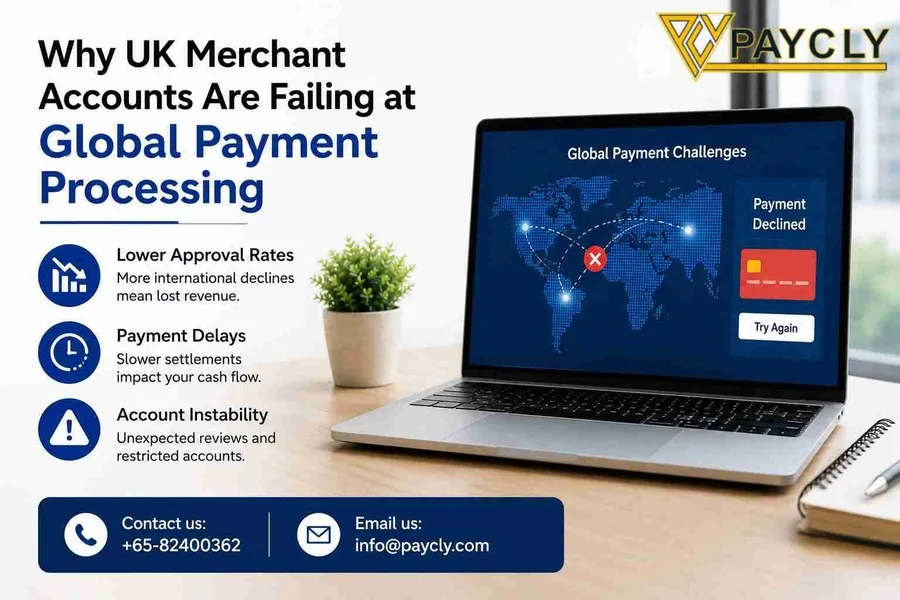
International customers suddenly experience failed transactions. Approval rates become inconsistent. Settlement timelines start changing, and support teams begin receiving more payment-related complaints. Many companies initially blame advertising performance or checkout design.
In reality, the issue often sits deeper in the payment infrastructure.
This is one reason businesses are increasingly searching for stronger UK merchant accounts, scalable global payment processing solutions, reliable international payment gateways, and high-risk payment gateways capable of supporting international growth without slowing down performance.
Why Global Expansion Creates New Payment Challenges
Many businesses assume international growth simply means accepting payments from more countries.
The reality is more complicated.
Local payments and international payments behave differently. When businesses start processing transactions across multiple markets, the payment journey often becomes more complex than expected. Transactions may pass through issuing banks, acquiring banks, fraud systems, compliance checks, currency conversion systems, and regional payment requirements before reaching approval.
For businesses operating domestically, these layers may not create noticeable issues initially.
Once international volume increases, however, businesses often start seeing patterns that become difficult to ignore.
Payment approvals fluctuate unexpectedly. Settlement cycles become inconsistent. International transaction performance weakens, and recurring billing experiences become less reliable.
The issue becomes even more noticeable for companies operating in sectors categorized as high risk.
Subscription platforms, online gaming businesses, SaaS providers, IPTV services, forex companies, and digital businesses frequently require stronger merchant account providers and scalable high-risk payment processing support because transaction behavior differs from traditional retail businesses.
Many Businesses Do Not Recognize the Problem Early
Payment issues rarely appear overnight.
That is why businesses frequently overlook them in the beginning.
Imagine a UK subscription business expanding into Germany and the United States after seeing strong domestic growth. Customer registrations continue rising, marketing campaigns continue performing well, and revenue appears healthy.
Everything initially looks normal.
Then customer support teams begin receiving familiar messages.
Customers report payment failures during checkout. Some users say transactions are getting declined repeatedly. Others abandon the process completely.
At first, teams may assume customers entered incorrect details or changed their minds.
Then the pattern continues.
Eventually, businesses realize the issue is not traffic quality or user intent.
The problem is payment performance.
Many companies discover that the payment structure supporting the business was designed primarily for local processing rather than scalable cross-border payments and global transaction management.
Failed Transactions Quietly Damage Revenue Growth
Many businesses treat failed payments as isolated events.
The reality is usually much larger.
Customers experiencing payment failures do not always come back and retry. Many users simply leave.
Over time, failed transactions begin affecting other areas of the business.
Customer retention starts weakening. Recurring revenue becomes less stable. Acquisition costs rise because businesses continue spending on traffic while conversion performance declines.
The damage often develops gradually.
A business processing thousands of transactions monthly may not immediately notice small changes in approval performance. But over time, even modest declines can create significant revenue impact.
This explains why companies increasingly prioritize high approval payment gateways, stronger online payment processing systems, and scalable global merchant accounts that improve transaction stability.
Why Generic Payment Providers Often Become Growth Barriers
Many companies choose providers based on onboarding speed and pricing.
Initially, this often works well.
Transactions process successfully, payments move normally, and growth begins without obvious problems.
As transaction volume increases, however, limitations frequently appear.
Generic payment providers are commonly built for traditional payment environments rather than international growth. Businesses handling recurring billing, multiple currencies, and global transactions usually require stronger infrastructure.
Without flexible payment systems, businesses often begin experiencing inconsistent authorization rates, settlement delays, payment routing limitations, and recurring payment interruptions.
Many companies only recognize these weaknesses after growth starts slowing.
What Businesses Should Look for in Better UK Merchant Accounts
Businesses searching for stronger UK merchant accounts should focus on long-term payment performance rather than onboarding speed alone.
Reliable multi-currency payment processing has become increasingly important because customers generally prefer paying in familiar currencies.
Stronger international payment gateways can improve transaction consistency and customer experience across different regions.
Smart routing technology also plays a major role because it helps optimize transaction pathways and improve approval performance.
Businesses operating in high-risk industries frequently benefit from scalable high-risk payment gateways capable of supporting transaction growth without introducing unnecessary payment friction.
Final Thoughts
International expansion creates major opportunities, but it also exposes weaknesses inside payment systems that many businesses never expected.
A company can have excellent products, strong customer demand, and effective marketing while still losing revenue because the payment infrastructure behind the business cannot support international growth.
Businesses looking for stronger UK merchant accounts, scalable global payment processing, and reliable cross-border payments increasingly understand that payment systems are no longer simply operational tools.
They have become growth tools.