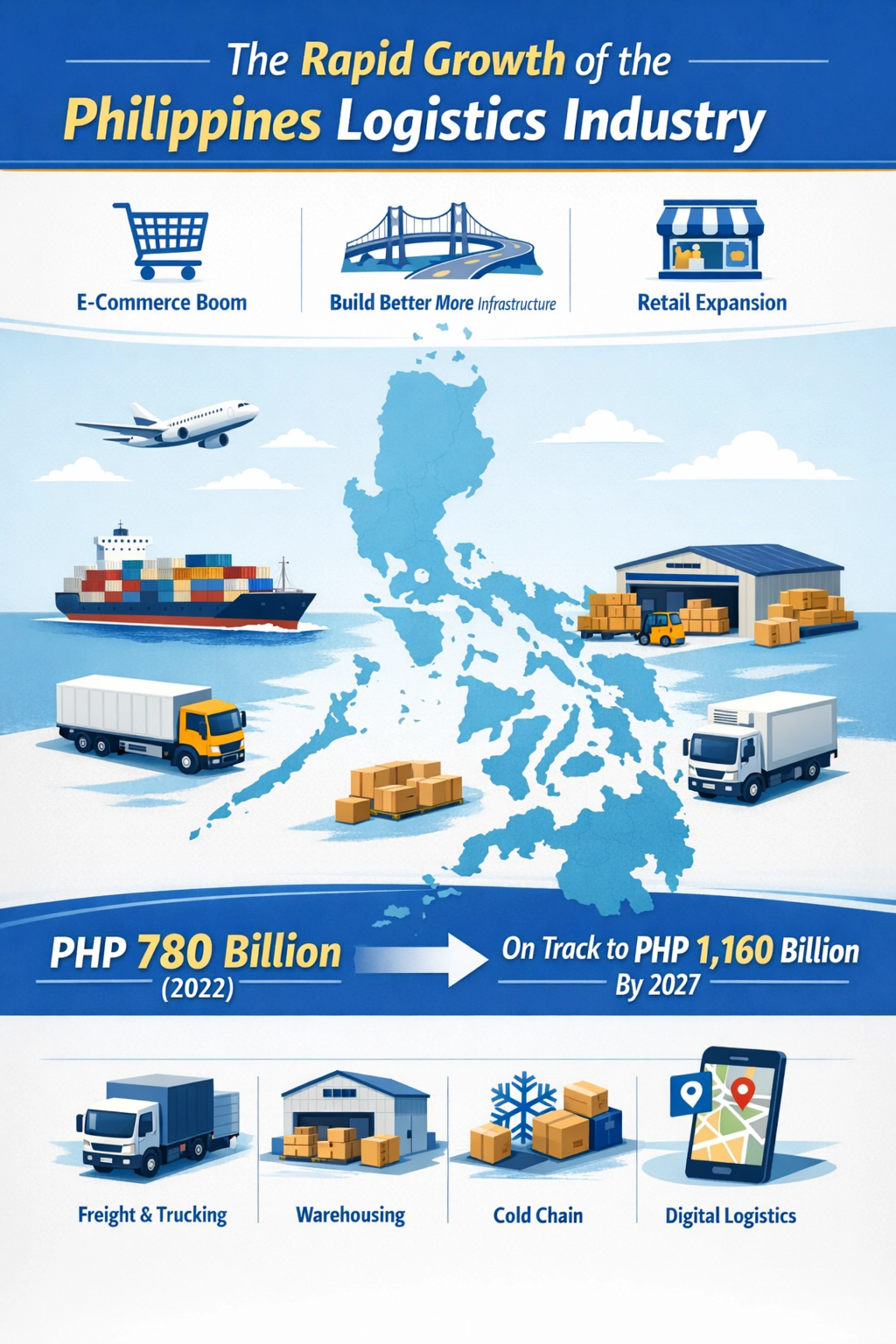
The Philippines logistics sector is entering its most dynamic growth phase in decades. E-commerce acceleration, infrastructure investment under the Build Better More program, and organised retail expansion are collectively generating logistics demand that is structurally underpinned and geographically dispersing beyond Metro Manila for the first time. At approximately PHP 780 billion (2022), on track to PHP 1,160 billion by 2027, the Philippines Logistics Industry spans freight forwarding, trucking, warehousing, cold chain, and digital logistics platforms across a complex archipelago geography.
What Drives Philippines Logistics Industry Size Across Key Sub-Sectors?
The Philippines logistics market is built on four primary service categories, each with distinct economics and growth rates. The Philippines logistics industry size of PHP 780 billion (2022), on track to PHP 1,160 billion by 2027 reflects a market where road freight dominates volume but e-commerce logistics leads revenue growth as organised retail and digital commerce demand higher-frequency, smaller-consignment delivery services.
- Road freight and trucking: The largest segment by revenue, serving FMCG distributors, manufacturing companies, and construction supply chains across Luzon with interisland ro-ro ferry connections extending reach to Visayas and Mindanao
- Warehousing and distribution: A fast-growing segment as e-commerce platforms, organised retail chains, and cold chain operators build out modern warehouse infrastructure in Metro Manila fringe locations and provincial distribution hubs
- Cold chain logistics: Structurally under-invested relative to demand, serving food and pharmaceutical supply chains with post-harvest loss reduction and temperature compliance requirements that are creating above-market revenue growth for compliant operators
Segment to Watch: Cold chain logistics is the most undercapitalised segment in Philippines logistics relative to its structural demand. Food safety regulations, pharmaceutical supply chain requirements, and organised retail temperature compliance standards are all creating above-market growth at 12 to 15% annually for operators with HACCP-certified facilities and refrigerated fleet capability.
Why Philippines Logistics Industry CAGR Holds at a robust rate through 2027?
E-commerce growth, infrastructure investment, and the structural expansion of organised retail beyond Metro Manila are sustaining demand momentum from multiple independent sources. Together they explain the Philippines logistics industry CAGR of approximately a robust rate through 2027.
- E-commerce platform growth: Shopee, Lazada, and TikTok Shop driving strong package delivery volume growth, each incremental order generating last-mile logistics demand across Metro Manila and provincial cities
- Build Better More infrastructure: Government highway, bridge, and port infrastructure investments reducing interisland and provincial logistics cost and enabling supply chains to reach previously underserved geographies
- Organised retail provincial expansion: Robinson's, SM, and Puregold expanding provincial supermarket and grocery networks, each new store requiring recurring FMCG distribution and cold chain logistics that generates sustained demand
Ken Research Analysis notes that Philippines logistics CAGR is underpinned by e-commerce and infrastructure investment rather than purely by economic growth cycles, making the trajectory more predictable than logistics markets in less digitally and infrastructurally developing economies.
High-Return Positions in Philippines Logistics Sector Opportunities
The most defensible positions in Philippines logistics sit where scale, cold chain certification, and last-mile technology create barriers that commodity trucking operators cannot quickly replicate. Across the Philippines logistics sector opportunities landscape, three categories generate the strongest combination of margin, growth rate, and competitive protection.
- E-commerce last-mile delivery network development: Platforms building micro-fulfilment and last-mile delivery networks in tier 2 cities where e-commerce penetration is growing fastest and existing logistics infrastructure is most insufficient to serve growing order volumes
- Cold chain warehouse and distribution development: Modern temperature-controlled warehousing in food production provinces and Metro Manila distribution corridors serving organised retail and food service operators who are willing to pay premiums for certified cold chain compliance
- Freight forwarding and customs brokerage: International freight forwarding for Philippines manufacturers and importers represents a high-value segment where customs expertise, carrier relationships, and digital documentation capability generate durable fee income
Ken Research Insights identifies cold chain infrastructure development as the highest-margin opportunity in Philippines logistics. Operators with HACCP-certified facilities and refrigerated fleet capability are generating significantly above-market returns as demand outpaces supply in this structurally undercapitalised segment.
Key Takeaway: Philippines Logistics Industry is growing at approximately a robust growth rate on e-commerce growth, infrastructure investment, and organised retail expansion. The strongest opportunities are in cold chain development, e-commerce last-mile networks, and freight forwarding where barriers and structural undersupply create durable margin advantages.
Conclusion
The Philippines logistics market is scaling through a phase where digital commerce, infrastructure development, and cold chain undersupply are simultaneously creating opportunities for operators who build the right service capability. The growth trajectory through 2029 is broad-based and structurally supported. First-mover positions in cold chain and e-commerce last-mile are the most defensible returns available in this market currently.
Frequently Asked Questions
Q1. How does the Philippines' archipelago geography affect logistics economics?
The archipelago creates a fundamentally different logistics cost structure than continental markets. Interisland freight requires ro-ro ferry connections or air cargo for time-sensitive goods. This increases logistics cost for provincial supply chains meaningfully relative to Metro Manila, creating a premium for operators with established interisland route networks and consolidation capability.
Q2. Which interisland logistics corridors generate the most commercial freight volume?
The Manila to Cebu, Manila to Davao, Manila to Cagayan de Oro, and Luzon to Leyte corridors are the five highest-volume interisland freight routes. These corridors serve the manufacturing and agricultural supply chains connecting Mindanao's food production base with Metro Manila consumption markets.
Q3. How are e-commerce platforms addressing last-mile delivery challenges in the Philippines?
Shopee and Lazada have invested in their own logistics subsidiaries while also maintaining third-party delivery partner networks. Route density in Metro Manila is now sufficient for 24 to 48 hour delivery economics but provincial last-mile remains more expensive given lower order density per delivery route.
Q4. What role do free zones play in Philippines logistics investment?
PEZA and Clark Development Corporation free zones offer tax incentives, streamlined customs procedures, and reliable infrastructure for logistics companies and e-commerce fulfilment operators. PEZA-registered warehousing and distribution centres benefit from import duty exemptions on logistics equipment and machinery, improving investment economics for modern facility development
.
Q5. How is the Build Better More program changing Philippines logistics infrastructure?
The program is investing in expressway networks connecting Metro Manila to major regional centres, port capacity upgrades at Batangas, Subic, and Davao, and bridge projects connecting previously ferry-dependent islands. These investments are reducing interisland and provincial logistics cost progressively and enabling supply chains to reach previously uneconomical provincial geographies.