
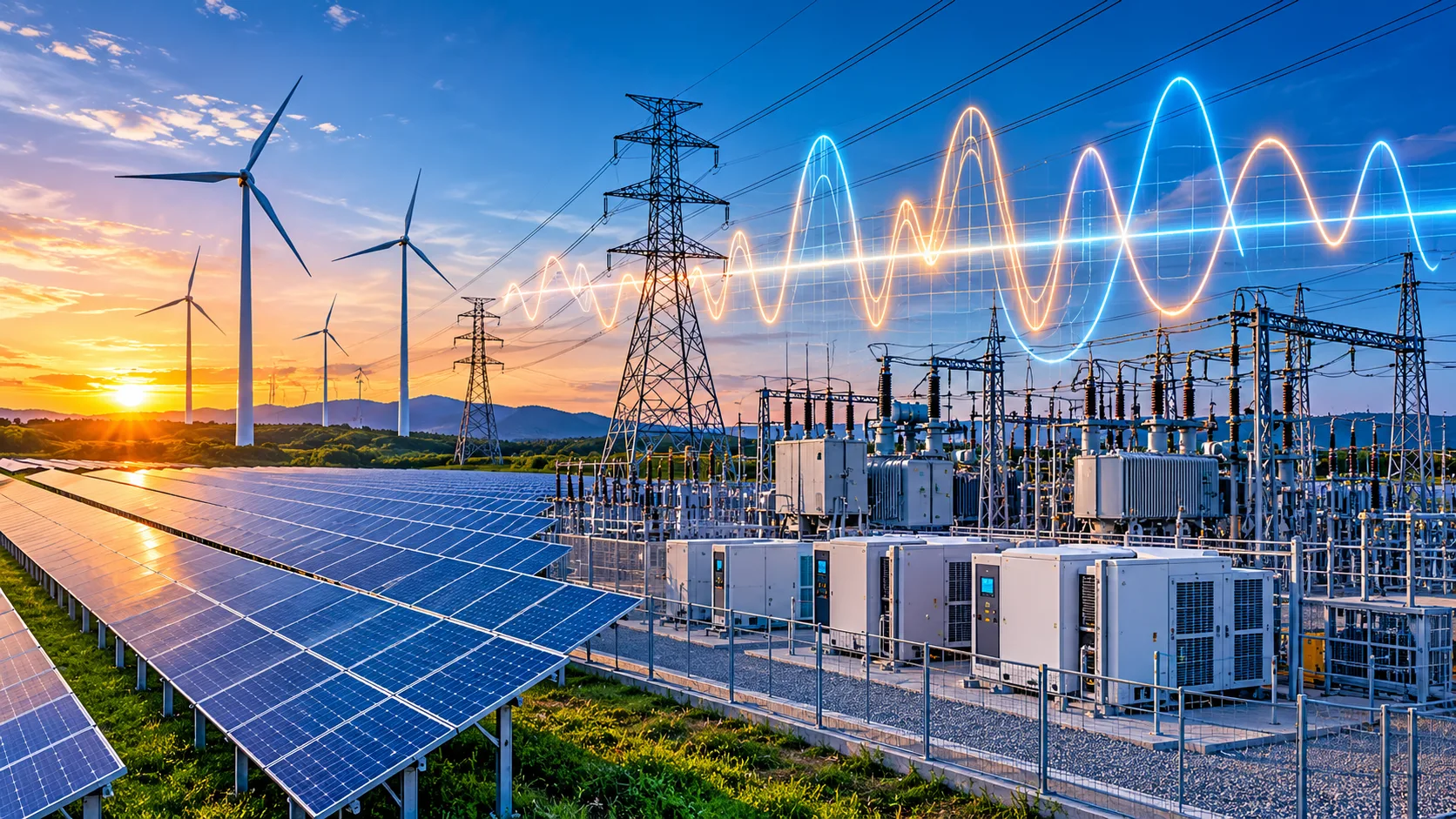
The rapid expansion of renewable energy is transforming how electricity is generated, transmitted, and managed. Solar photovoltaic plants, wind farms, and battery energy storage systems are becoming essential components of modern power networks. However, as inverter-based resources (IBRs) replace conventional synchronous generation, new challenges are emerging for grid stability. One increasingly important concern is subsynchronous oscillation (SSO).
Unlike traditional stability issues, subsynchronous oscillations can develop through complex interactions between inverter control systems, transmission networks, and other power system equipment. If these interactions are not properly identified, they can cause excessive electrical stress, equipment damage, protection trips, and reduced renewable energy production. Understanding these risks is essential for developers, utilities, and engineers working on modern IBR projects.
1. Understanding Subsynchronous Oscillations in IBR-Based Power Systems
Subsynchronous oscillations are electrical or electromechanical oscillations that occur at frequencies below the system's fundamental power frequency. In traditional power systems, these phenomena have often been associated with interactions between turbine-generator shaft systems and series-compensated transmission networks.
However, the increasing penetration of inverter-based resources has introduced additional mechanisms that can produce similar oscillatory behavior. Modern inverters use sophisticated electronic controls to regulate active power, reactive power, voltage, and synchronization with the grid. These controls operate rapidly and interact continuously with the surrounding electrical network.
Problems can arise when inverter control responses interact with network impedance, other converter controls, or resonant conditions. Such interactions may create poorly damped oscillations that grow instead of naturally disappearing. This makes SSO an important consideration in solar, wind, battery storage, and hybrid renewable energy projects.
2. Why Increasing IBR Penetration Creates New Stability Risks
One major reason subsynchronous oscillations are receiving greater attention is the changing structure of modern power grids. Conventional synchronous generators provide physical inertia and established electromechanical characteristics. In contrast, IBRs connect renewable generation to the grid through power electronic converters.
Their behavior depends heavily on programmed control strategies, operating conditions, and electrical network characteristics. Consequently, replacing conventional generation with inverter-based resources changes the dynamic response of the entire power system.
Several factors can increase SSO risks:
- Weak grid conditions: Low short-circuit strength can make inverter controls more sensitive to changes in voltage and network impedance.
- Control system interactions: Multiple inverters operating together may interact through synchronization, current regulation, voltage control, and power regulation loops.
- Series compensation: Transmission networks containing series capacitors can create electrical resonances that interact with converter controls.
- High renewable penetration: A larger concentration of IBRs can increase the influence of their combined dynamic behavior on grid stability.
- Complex plant configurations: Hybrid facilities combining solar, wind, battery storage, and different inverter technologies introduce additional control interactions.
These factors do not mean every IBR installation will experience oscillations. Rather, they demonstrate why project-specific studies are necessary before connecting large renewable facilities to the transmission network.
3. How Inverter Controls and Network Conditions Trigger Oscillations
The relationship between inverter controls and grid impedance is central to understanding subsynchronous oscillations. Grid-following inverters commonly use phase-locked loops (PLLs) to synchronize with the electrical network. Their current control systems regulate the injected current based on measured grid conditions and internal control references.
Under certain network conditions, PLL dynamics, current controllers, and voltage regulation loops can interact with the electrical system in ways that reduce damping. Grid-forming inverters introduce different control characteristics because they establish an internal voltage and frequency reference. Nevertheless, their power, voltage, and current-limiting controls can also interact with other converters and network elements.
The situation becomes more complicated when several renewable plants share a transmission corridor. Even if individual facilities operate correctly, their combined responses may create unexpected dynamic interactions.
Engineers must therefore examine more than individual inverter performance. They need to evaluate the complete electrical environment, including transmission impedance, compensation equipment, neighboring generation, operating scenarios, and control settings. This broader assessment helps identify potentially unstable frequency ranges before they become operational problems.
4. Why Accurate Modeling and Advanced Stability Studies Matter
Reliable engineering studies begin with accurate representations of the equipment being analyzed. Incomplete or outdated inverter models can produce misleading simulation results, potentially hiding instability risks or predicting problems that do not exist in actual operating conditions.
Engineers should develop detailed representations of inverter controls, plant-level power controllers, protection systems, transformers, transmission networks, and relevant grid equipment. Depending on the study objective, both positive-sequence dynamic models and electromagnetic transient (EMT) models may be required.
Small-signal stability analysis helps identify poorly damped modes, while impedance-based analysis can reveal interactions between converter controls and network characteristics. EMT simulations provide additional insight into fast control responses, switching-related effects, and complex interactions that simplified models may not capture.
A comprehensive power system model validation process helps ensure that simulation models represent actual equipment behavior. Similarly, generator model verification supports confidence in the accuracy of generator and associated control representations used in stability assessments.
For applicable facilities, NERC MOD-026-2 compliance also reinforces the importance of verifying and validating dynamic models and data. Its requirements include provisions for inverter-based resources, making model accuracy an important part of modern grid reliability practices.
5. Practical Strategies to Reduce SSO Risks in Renewable Projects
Preventing subsynchronous oscillations requires a combination of careful project design, detailed simulation, and ongoing engineering assessment. Addressing potential problems during development is generally more effective than correcting instability after commissioning.
Several practical measures can improve project reliability:
- Conduct early-stage screening: Evaluate grid strength, transmission impedance, series compensation, and potential resonance conditions during project planning.
- Perform comprehensive stability studies: Use small-signal, impedance-based, and EMT analysis where appropriate to investigate different oscillatory mechanisms.
- Validate inverter models: Confirm that control parameters, plant-level controllers, and equipment representations match actual manufacturer specifications and site configurations.
- Optimize control settings: Coordinate PLL, current control, voltage regulation, and power control parameters to maintain adequate damping across expected operating conditions.
- Evaluate multiple operating scenarios: Examine different generation levels, network configurations, outages, and neighboring IBR operating conditions.
- Monitor performance after commissioning: Use operational measurements and disturbance records to identify unexpected oscillations and support model improvements.
Collaboration between project developers, inverter manufacturers, transmission planners, and power system engineers is equally important. Sharing accurate equipment data and understanding control interactions can significantly improve the quality of stability assessments.
6. Building More Reliable IBR Projects Through Proactive Engineering
As renewable energy capacity continues to grow, subsynchronous oscillations will remain an important consideration in grid integration and power system planning. Their causes are not limited to one inverter technology or transmission configuration. Instead, they emerge from interactions between control systems, electrical networks, and operating conditions.
For renewable developers and utilities, the most effective approach is to identify potential risks early through accurate modeling, appropriate simulation techniques, and coordinated control design. Regular model updates and performance assessments also help ensure that engineering studies remain relevant as facilities and surrounding networks evolve.
At Keentel Engineering, detailed power system studies, dynamic model assessments, and grid integration engineering can help project stakeholders better understand system behavior and address stability challenges. Investing in proactive engineering is not simply about preventing oscillations; it is about improving equipment performance, reducing operational uncertainty, and supporting the reliable integration of renewable energy into modern power grids.