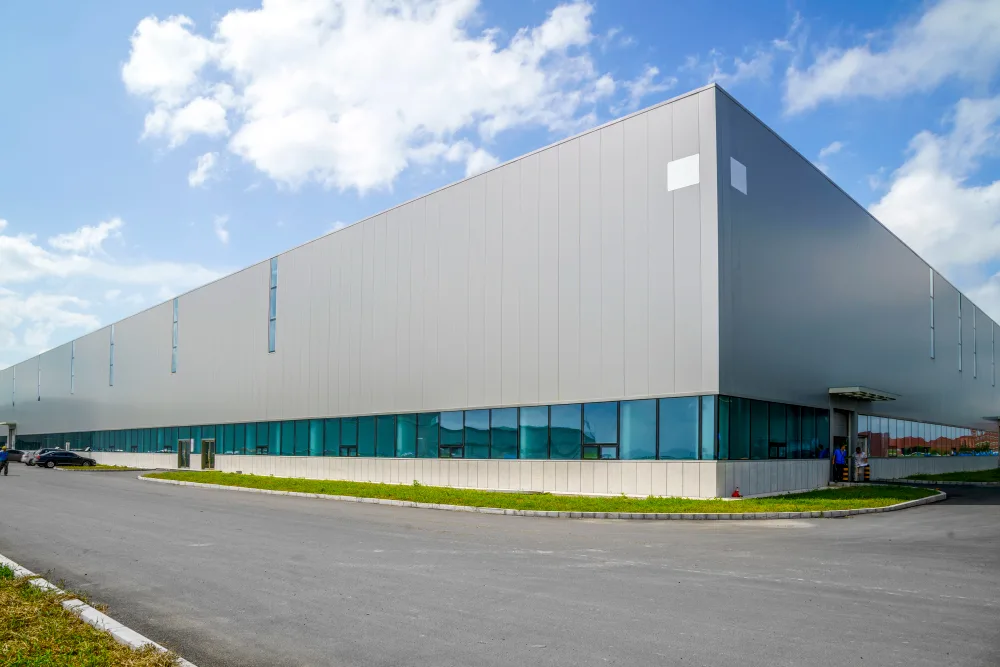
There have been radical changes in the world’s supply chains. The rapid development of e-commerce and the shift from "just in case" inventory to the old-fashioned “just-in-time” strategy mean there is an even greater demand for effective, robust, and highly scalable storage facilities. Businesses have abandoned tilt-up concrete and timber-framed structures in favor of more advanced steel warehouse buildings. Steel buildings serve not only as storage facilities but also as high-performing, effective facilities.
1. Unmatched Architectural Flexibility: The Clear Span Advantage
One of the biggest reasons steel is becoming the go-to choice in the industrial sector is its ability to create "clear span" interiors. Traditional construction often requires support columns inside the building every 20 to 30 feet to hold up the roof. In a warehouse, these columns get in the way—they limit where you can put racking, how wide your aisles can be, and how easily forklifts and automated guided vehicles (AGVs) can move around.
Steel's high strength-to-weight ratio allows for large open spaces without interior pillars. This means:
Complete Layout Flexibility: You can change your racking systems as your business grows without being restricted by structural posts.
Optimized Automation: Modern robotic picking systems need clear paths. Steel buildings provide the "blank canvas" needed for these high-tech systems to work.
Vertical Volume: Steel frames can easily be designed to reach heights of 40 feet or more, allowing businesses to make the most of their "cubic footage," not just their square footage.
2. Sustainability and the Circular Economy
Sustainability is no longer just a "buzzword" in the industrial world; it has become a business imperative. Steel is the most recycled material worldwide. The majority of structural steel used today incorporates anywhere from 25% to 90% recycled content. Moreover, at the end of a building's life, the entire steel frame can be completely recycled without any loss of its original strength.
Today's steel warehouses demonstrate exceptional energy efficiency. The advanced insulation system of Insulated Metal Panels (IMPs) provides outstanding thermal protection. The system maintains constant temperatures for climate-controlled products while decreasing energy consumption for both heating and cooling. Companies that implement a steel framework alongside "cool roof" technology will achieve two benefits: reduced carbon emissions and lower expenses.
3. Resilience in an Unpredictable Climate
As weather patterns become more erratic, the structural integrity of a warehouse is crucial for managing risk. Steel warehouse buildings offer a level of protection against the elements that's simply better than what you get with organic materials. Steel doesn't burn, which greatly reduces the risk of fire in the building—a factor that often leads to lower insurance premiums.
Also, steel doesn't warp, rot, or attract termites and pests, which are common problems in wood-frame industrial buildings. In regions where heavy snow, strong winds, or earthquakes are common, steel can be specifically designed to meet the most demanding local building regulations. It can bend under extreme pressure without breaking, offering a safety net that safeguards both the people working inside and the valuable inventory stored within its walls.
4. Future-Proofing Through Scalability
A warehouse perfectly suited for your needs today might not be large enough in just five years. One of the often-overlooked benefits of steel is its ease of expansion. Since structural strength is in the frame rather than the walls, you can remove an end wall and add new sections to expand the building with very little interruption to ongoing operations. This modular design enables businesses to grow their physical space alongside their market growth, avoiding the need for expensive relocations.
5. Low Maintenance, High Longevity
Industrial facilities experience extreme environmental conditions due to chemical exposure and heavy machinery. The maintenance requirements for steel material are extremely minimal. The exterior, therefore, remains protected against rust and fading thanks to high-quality coatings and finishes that provide long-lasting protection. A steel building requires minimal maintenance because it manages its own upkeep, while concrete needs expensive repairs for cracks, and wood needs ongoing maintenance through painting and sealing. The long-term maintenance cost reduction from steel (OpEx) makes it the most economical material throughout the building's lifetime.
Making the Move to Steel
The transition to steel represents more than a temporary trend because it serves as a practical advancement. As land prices increase, the need to build smarter, taller, and faster becomes essential. Developers who select steel materials create buildings that meet the flexible requirements of modern economic conditions.
Building construction establishes a binding association that will persist throughout many years. The manufacturing facility requires a selection of construction materials that provide optimal safety features, cause minimal environmental damage, and enable the highest operational adaptability. Steel construction delivers operational benefits that help local distributors and international logistics firms gain an edge in competitive markets.
Conclusion
As you prepare to take the next step in updating your storage facilities for the digital era, collaborating with an expert firm becomes vital. Titan Steel Buildings has what it takes to turn such massive projects into reality through superior engineering skills and unmatched customer service. Their warehouses are designed with state-of-the-art technology to deliver clear-span layouts and customized insulation solutions for temperature-controlled merchandise. As such, they can offer you top-notch services that will guarantee high-quality products that will serve you efficiently for many years to come.