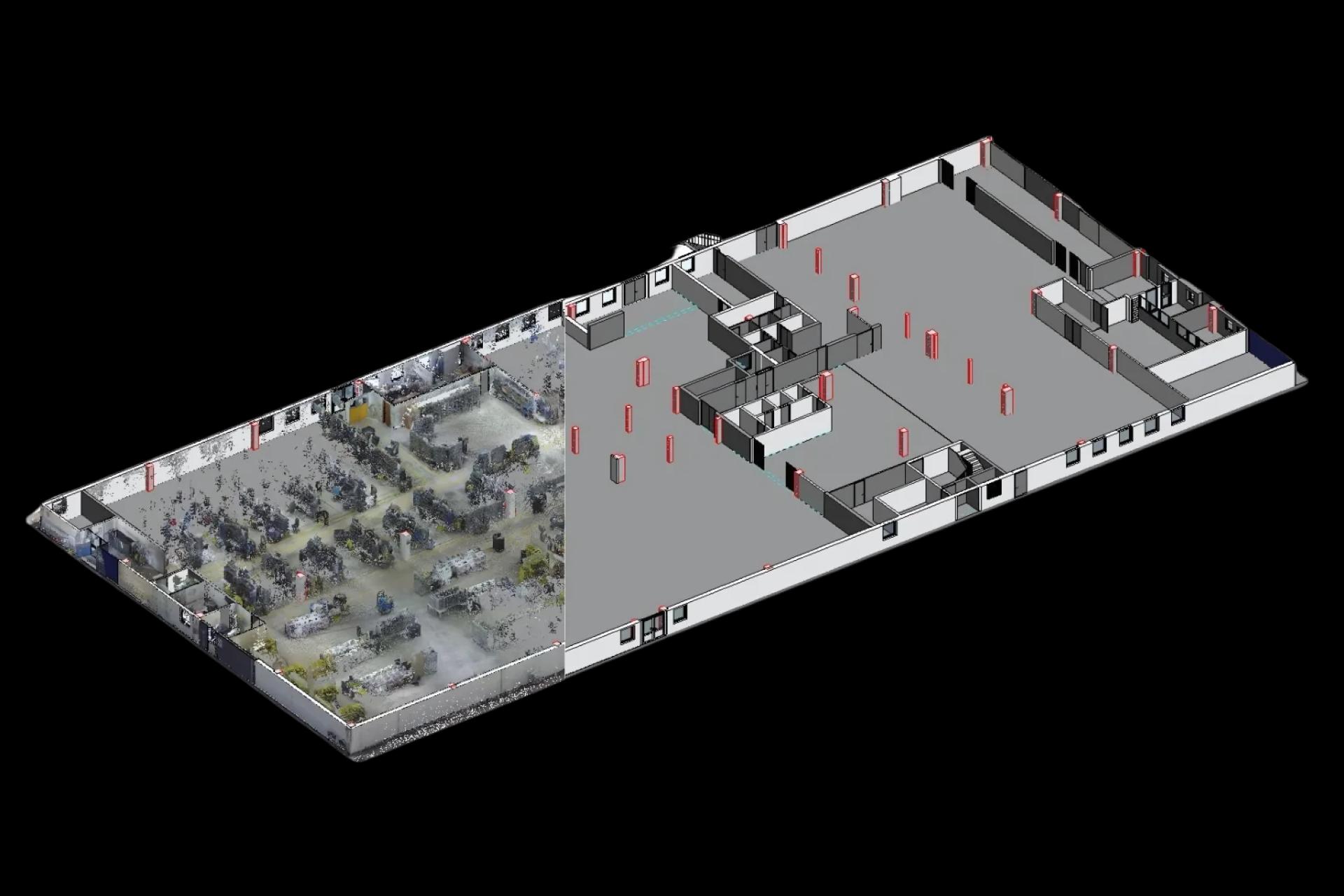
Project construction and design processes have always been based on one crucial element that is accuracy of existing conditions. However, for several decades, construction projects have been undertaken based on incomplete information, outdated information, and assumptions.
This is where Point cloud to BIM is changing the face of construction projects. It is providing a more reliable basis for undertaking projects.
It is not just a technological advancement; it is an evolution.
Understanding the Core of Point Cloud to BIM
At its core, point cloud to BIM means capturing existing conditions using technology like laser scanning and converting them into an intelligent BIM model.
Using a technology like a laser scanner, it is possible to gather millions of data points, called a point cloud, that accurately reflect the geometry of a physical space.
This information can be processed and modeled using software like Autodesk Revit or Navisworks.
What this means is not simply a 3D model, but an accurate digital replica of an existing physical space. It is this distinction that is so important. Unlike traditional modeling techniques, point cloud to BIM is based on existing conditions, not assumptions.
From Assumption-Based to Reality-Based Workflows
Traditionally, workflows have relied heavily on manual surveys and legacy drawings. While effective to a degree, these methods introduce variability and risk.
With point cloud to BIM, the workflow becomes significantly more structured and reliable:
- Site conditions are captured with high precision
- Data is converted into an accurate 3D BIM modeling
- Potential clashes and discrepancies are identified early
- Decisions are based on verified information rather than assumptions
This shift reduces uncertainty at every stage of the project lifecycle.
Why Point Cloud to BIM Is Transforming Project Execution
1. Improved Accuracy and Reduced Rework
Accuracy is one of the most immediate benefits. Point cloud data captures real-world conditions down to fine tolerances, allowing BIM models to reflect actual geometry.
This minimizes discrepancies between design and construction, which in turn reduces rework, delays, and associated costs. In complex projects, even small deviations can have significant downstream impacts, making this level of precision particularly valuable.
2. Enhanced Efficiency in Renovation and Retrofit Projects
Renovation and retrofit projects often involve incomplete or unreliable documentation. This creates uncertainty during planning and execution.
Point cloud to BIM addresses this challenge by providing a detailed and accurate digital representation of existing conditions. Project teams can work with confidence, knowing that the model aligns with reality.
As a result, design coordination becomes more efficient, and unexpected site issues are significantly reduced.
3. Faster and More Informed Decision-Making
When project teams have access to accurate, up-to-date data, decision-making becomes more streamlined.
Instead of relying on repeated site visits or manual verification, stakeholders can review the BIM model to assess conditions, evaluate options, and make informed decisions.
This not only saves time but also improves the overall quality of project outcomes.
4. Stronger Coordination Across Disciplines
Coordination between architects, engineers, and contractors is essential for successful project delivery. However, inconsistencies in data often lead to miscommunication.
Point cloud to BIM establishes a shared, reliable reference model. All stakeholders work from the same dataset, reducing ambiguity and improving collaboration.
This alignment helps prevent coordination issues that typically arise during later project stages.
Where Point Cloud to BIM Delivers the Most Value
While the benefits are broad, certain project types see particularly strong advantages:
- Heritage and restoration projects – where preserving existing geometry is critical
- Industrial facilities – involving complex systems and tight tolerances
- Healthcare infrastructure – requiring precise coordination and minimal disruption
- Commercial renovations – where timelines and accuracy are equally important
In these scenarios, the ability to capture and model real-world conditions accurately can significantly influence project success.
A Practical Consideration: Expertise Matters
While point cloud to BIM improves workflows, it is not entirely straightforward.
Processing large point cloud datasets and converting them into structured BIM models requires technical expertise and experience. The quality of the final model depends heavily on how well the data is interpreted and modeled.
For this reason, many organizations collaborate with specialized service providers who have dedicated experience in scan-to-BIM workflows.
The Broader Impact on Project Workflows
The use of point cloud to BIM is an extension of the larger movement in the AEC industry away from assumption-based processes and towards more data-based processes.
Project predictability is greatly improved. More risks are caught early on. More time is spent on execution rather than resolving unexpected problems.
While no process is completely risk-free, point cloud to BIM minimizes risk to a significant degree, providing an environment that is more controlled.
Conclusion
Point cloud to BIM is not just an extension or a new element to an already established process; rather, it is a new approach to how a project is managed and executed.
By utilizing actual, real-world information to make decisions, point cloud to BIM is helping to improve coordination, efficiency, and safety. As the industry continues to focus on precision and reliability, point cloud to BIM is becoming a fundamental element to a project.
For organizations that are seeking to improve their project outcomes, the move to this system is not just a positive step; rather, it is a necessary step.