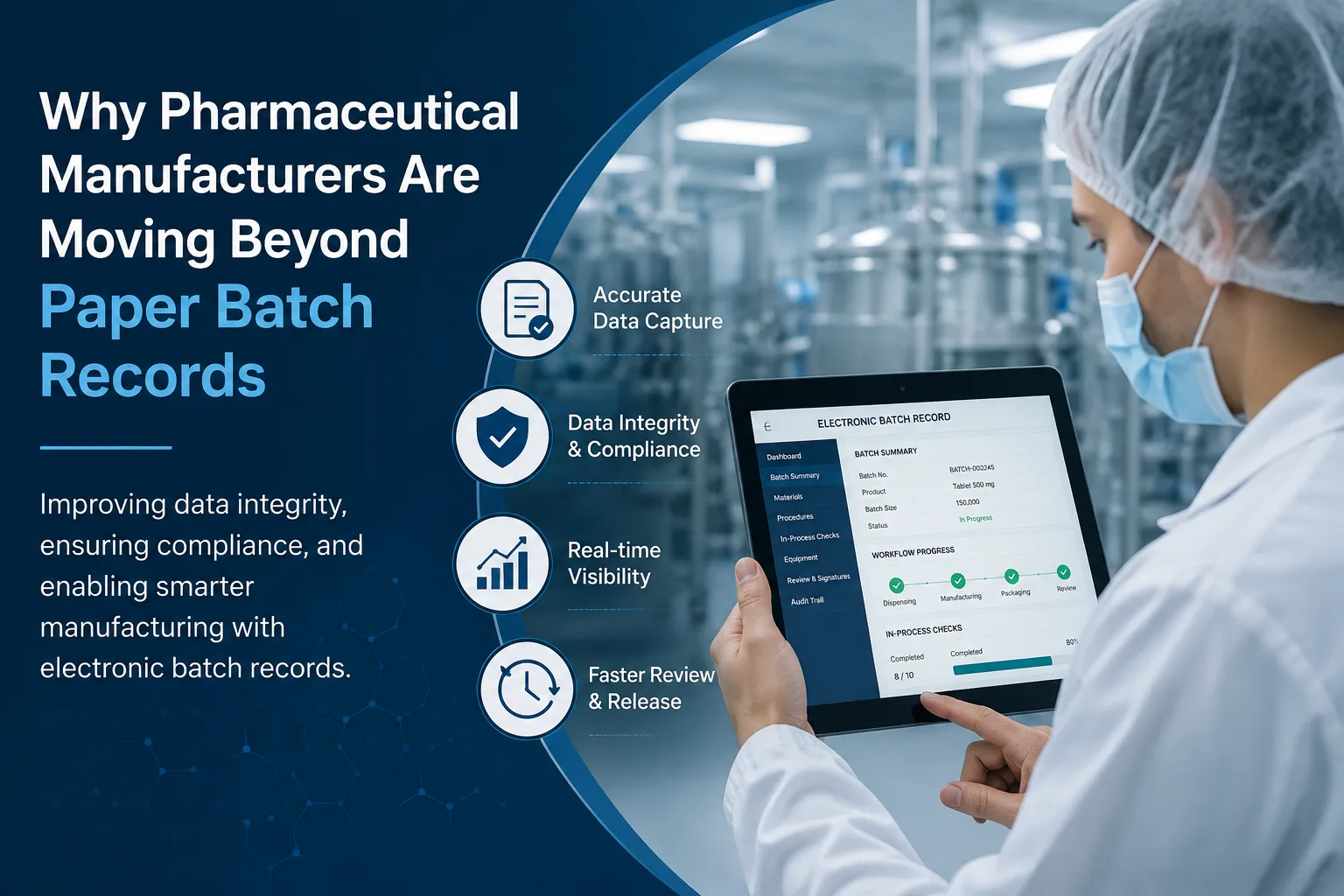
Pharmaceutical manufacturing has traditionally depended on detailed paper documentation to record the activities performed during the production of each batch. Batch Manufacturing Records (BMRs) document the materials used, equipment involved, processing steps, in-process controls, yields, operator activities, and other information necessary to establish that manufacturing was performed according to approved procedures. These records remain a fundamental part of pharmaceutical quality systems, and regulatory requirements continue to place significant emphasis on their completeness, accuracy, review, and availability.
Paper records served the industry well when manufacturing operations were smaller and less complex. However, pharmaceutical manufacturing has changed considerably. Products are manufactured across multiple facilities, production processes involve a growing number of controls, and organizations are required to manage increasing volumes of documentation. At the same time, regulatory expectations around data integrity, traceability, record retention, and inspection readiness have become more demanding. As a result, manufacturers are increasingly examining whether paper remains the most effective way to manage batch information.
The Growing Complexity of Batch Documentation
A batch record is not simply a document that records the completion of a manufacturing process. It represents the documented history of a particular batch.
The record may contain information about raw materials, dispensing activities, equipment identification, process parameters, environmental conditions, in-process testing, yield calculations, packaging activities, deviations, and approvals. FDA inspection guidance states that batch production and control records should document each significant step involved in the manufacture, labeling, packaging, and control of a specific batch.
As manufacturing processes become more complex, the volume of information associated with a single batch also increases. A production team may have to complete numerous forms during manufacturing, while Quality Assurance personnel subsequently review those records before release.
This creates an environment in which a relatively small documentation error can have consequences beyond the individual entry.
An incorrect calculation may require verification. A missing signature may require clarification. An unclear handwritten entry may need investigation. An outdated version of a document can create questions about whether the approved procedure was followed. Each issue adds another step to the review process.
The manufacturing activity may already be complete, but the batch cannot necessarily move forward until the documentation has been reviewed and accepted.
Paper Records Create a Separation Between Manufacturing and Information
One of the fundamental limitations of paper-based batch records is that the information generated during manufacturing remains separated from the systems used to manage other business and quality activities.
A manufacturing operator may record material information on a paper form. The corresponding material information may already exist in an ERP system. Equipment information may exist in an electronic maintenance or calibration system. Laboratory results may be stored in a LIMS. Deviations may be managed through a QMS.
The batch record therefore becomes one component of a much larger information environment.
When these systems do not communicate with one another, personnel may need to manually compare information across records. This creates additional work and introduces opportunities for transcription errors.
FDA inspection guidance specifically draws attention to transcription errors involving batch records, including errors involving symbols, abbreviations, and decimal points.
The issue is not necessarily that people are failing to follow procedures. The issue is that a manual information flow creates more opportunities for errors to occur.
Batch Review Becomes a Major Operational Activity
The manufacturing process does not end when the last production step is completed.
The completed batch record must still undergo review. Regulatory requirements call for production and control records to be reviewed and approved before a batch is released or distributed. Deviations, investigations, and OOS reports may also form part of the review process.
In a paper environment, this review can involve large quantities of documentation.
Quality personnel may need to verify entries, calculations, signatures, dates, material information, equipment identifiers, process parameters, and supporting documentation. Where information is maintained separately, reviewers may also need to retrieve records from other departments or systems.
This is one reason batch record review can become a bottleneck in pharmaceutical manufacturing.
The manufacturing team may have completed its work, but Quality Assurance is still working through the documentation required to establish that the batch was manufactured and controlled appropriately.
Data Integrity Is Changing the Discussion
The move away from paper is not simply an effort to reduce printing, storage, or administrative work.
Data integrity has become an increasingly important consideration in pharmaceutical manufacturing. Records must be reliable, complete, traceable, and available for review. FDA guidance explains that records required to demonstrate CGMP compliance must be accessible for inspection and that electronic records used in regulated activities must be maintained appropriately.
Electronic systems can provide capabilities that are difficult to achieve consistently with paper records, including controlled access, electronic audit trails, electronic signatures, automated validation checks, and structured record retention.
This does not mean that every electronic system is automatically compliant. Electronic records introduce their own requirements, including appropriate controls and, where applicable, compliance with 21 CFR Part 11. FDA's Part 11 guidance addresses electronic records and electronic signatures and discusses areas such as validation, audit trails, copies of records, and record retention.
The objective is therefore not simply to convert paper into a digital format. The objective is to create a controlled electronic process in which information can be captured, reviewed, approved, and retrieved with appropriate safeguards.
Electronic Batch Records Change the Manufacturing Workflow
Electronic Batch Record Management systems are designed to bring batch execution into a controlled digital environment.
Instead of issuing a paper record and requiring operators to complete individual fields manually, an electronic system can present the approved manufacturing workflow to the operator. Required information can be defined within the process, and certain entries can be validated before the operator proceeds.
Information from connected systems can also be incorporated into the batch record where appropriate. This can reduce the need to repeatedly enter information that already exists elsewhere.
The result is a different relationship between manufacturing and documentation.
The record is no longer something that is primarily assembled during and after manufacturing. It becomes part of the manufacturing process itself.
Moving Toward Review by Exception
Another important development is the increasing use of electronic systems to support more efficient batch review.
Traditional paper review often requires reviewers to examine a large volume of documentation to determine whether something is missing or unusual. Electronic systems can apply predefined rules and identify exceptions, allowing reviewers to focus greater attention on events that require investigation.
FDA inspection guidance recognizes that computerized screening and exception reporting can be used as part of record review when the system is demonstrated to be accurate and reliable. The underlying batch information must still be retained and appropriately reviewed.
Review by exception does not mean reducing the level of quality oversight. It changes where the reviewer spends time.
Instead of spending the majority of the review identifying routine information, Quality personnel can devote more attention to deviations, unusual process conditions, failed checks, and other events that may have a meaningful impact on batch quality.
Paperless Does Not Mean Less Compliance
There is sometimes a misconception that moving to electronic batch records is primarily about reducing paperwork.
The more significant change is the ability to build compliance controls directly into the manufacturing workflow.
A paper record can instruct an operator to complete a field. An electronic system can potentially prevent the operator from progressing until a required field has been completed.
A paper form can contain an approved calculation. An electronic system can perform the calculation using controlled logic.
A paper document can be reviewed after manufacturing. An electronic workflow can make relevant information available for review as activities are performed.
These differences can reduce reliance on manual oversight while creating stronger traceability across the manufacturing process.
The Role of Integration
The next stage of electronic batch record adoption is increasingly connected manufacturing.
A batch manufacturing environment rarely operates as a standalone system. Materials may be managed through ERP, laboratory activities through LIMS, quality events through QMS, equipment activities through electronic logbooks, and manufacturing execution through MES or related systems.
Connecting these environments can reduce duplicate data entry and create a more consistent information flow.
For example, material information can be obtained from an approved source rather than manually transcribed into a batch record. Equipment information can be linked to the manufacturing activity. Laboratory results can become available as part of the broader batch review process.
The value of integration therefore extends beyond convenience. It can help establish greater consistency between the systems that collectively describe how a batch was manufactured and controlled.
Why Manufacturers Are Making the Transition
The movement toward electronic batch records is being driven by several factors rather than one particular requirement.
Manufacturers are dealing with larger production volumes, increasing documentation requirements, multi-site operations, greater expectations around data integrity, and pressure to improve batch release timelines.
Paper-based processes can continue to function under these conditions, but maintaining them at scale requires increasing amounts of manual effort.
Electronic batch record systems provide an alternative by bringing manufacturing execution, documentation, data capture, review, and traceability into a more structured environment.
The transition is also consistent with the broader movement toward digital manufacturing. Pharmaceutical companies are increasingly connecting laboratory, quality, manufacturing, and enterprise systems rather than treating each process as an independent activity.
The Future of Batch Manufacturing Records
The batch record will remain an important part of pharmaceutical manufacturing regardless of whether it exists on paper or electronically. Its purpose is fundamentally connected to demonstrating that a batch was manufactured according to approved procedures and that the required controls were performed.
What is changing is the way this information is created and managed.
Electronic Batch Record Management allows manufacturers to move away from documentation that primarily records activities after they occur and toward systems in which documentation, process control, data capture, and review are integrated into the manufacturing workflow.
For organizations considering this transition, the question is therefore not simply whether paper should be replaced.
The more important question is how manufacturing information can be captured and controlled in a way that improves traceability, supports data integrity, reduces unnecessary manual work, and gives Quality Assurance better visibility into the batch before release.
The move beyond paper batch records is ultimately part of a broader transformation in pharmaceutical manufacturing. The objective is not to remove documentation from the process. It is to make documentation more accurate, connected, accessible, and useful while maintaining the level of control expected in a regulated manufacturing environment.