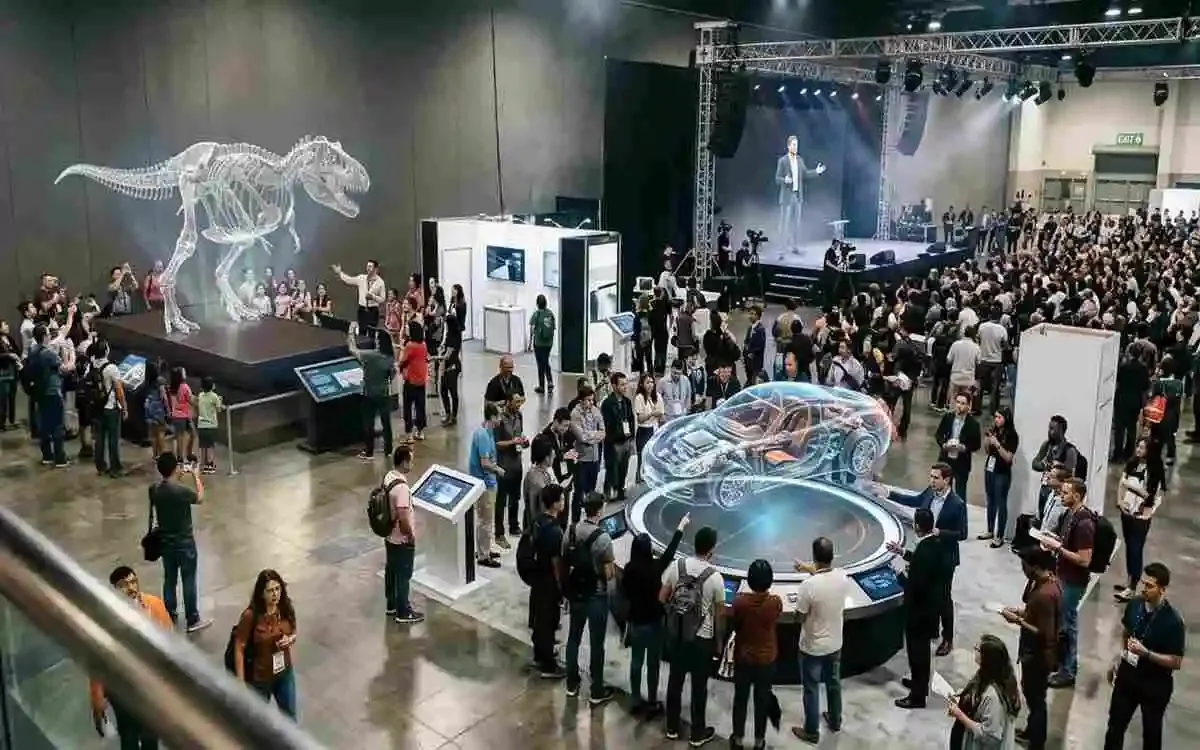
Walk into a brightly lit corporate atrium or a glass-walled museum foyer, and even the most expensive display hardware can look like a washed-out ghost. When teams plan a hologram projector setup, the first instinct is almost always to compare lumen ratings, pixel pitch, and hardware specs. Yet in real-world exhibitions, retail flagships, and cultural venues, visual performance rarely fails because the hardware is underpowered. It fails because the room was never engineered to hold an image made purely of light.
Unlike traditional LED walls or LCD panels that emit light from a solid black surface, commercial holographic displays rely on optical contrast against a dark background. Whether a venue uses a 45-degree Pepper’s ghost foil, holographic projection gauze, or a spinning LED array, the human eye perceives depth only when ambient light does not flood the space behind the illusion.
Understanding the physical limits of a venue—before ordering a single truss or lens—separates a crisp, floating 3D figure from an expensive faint reflection.
1. Ambient and Stray Light Control
Stray light is the single biggest threat to optical depth. Daylight streaming through skylights, reflections from glossy floor tiles, or a single misplaced track spotlight hitting the backdrop will turn deep black into dull grey. Once the background brightens, the floating object loses its solid edges and transparency takes over.
According to benchmarks published by the Canadian Conservation Institute, gallery spaces typically maintain ambient lighting around 50 lux to protect sensitive artifacts. That low-light threshold happens to align closely with what projection-based holographic systems require. By contrast, open trade show halls and shopping atriums frequently exceed 300 to 500 lux, with light angles shifting throughout the day.
Measuring Light Across Three Zones
Before selecting display hardware, facility managers and AV engineers should take lux readings at three distinct points during morning, midday, and peak operating hours:
Backdrop Zone: The surface or dark void directly behind the floating visual, which should stay below 10 lux for Pepper’s ghost stages.
Image Plane: The transparent film, scrim, or gauze where light converges, which must be shielded from direct overhead beams.
Viewer Eye Level: The standing or seating zone where visitors observe the display, ideally kept under 50 lux for projection gauze.
2. Ceiling Height and Structural Rigging Limits
Every holographic format hides its light source, mirrors, or projection rig outside the audience's direct line of sight. That concealment requires vertical clearance that standard drop ceilings rarely provide. Measuring only to the floor slab is a common mistake; planners must measure to the lowest HVAC duct, sprinkler head, or structural beam.
A life-size Pepper’s ghost stage presenting a 1.8-meter human figure typically requires a 3-meter angled foil and 4.5 to 5 meters of clear ceiling height to house upper bounce screens and masking borders.
Hanging holographic gauze demands roughly 4 meters of clear vertical space so the truss remains hidden above the top edge of the frame. Only compact tabletop units and wall-mounted LED fans operate comfortably inside standard 2.7-to-3-meter commercial rooms.
3. Throw Distance and Optical Geometry
When a venue uses front or rear projection onto holographic gauze, lens geometry dictates floor layout. Throw distance equals the lens throw ratio multiplied by the desired image width.
A 4-meter-wide visual paired with a standard 1.2:1 lens needs 4.8 meters of unobstructed space between the projector lens and the screen plane.
Switching to a 0.8:1 short-throw lens trims that distance to 3.2 meters, saving valuable floor area in tight galleries, though short-throw optics introduce higher costs and stricter alignment tolerances.
Equally important is keeping the beam path clear: doorways, visitor walkways, and directional signage must never cross between the lens and the gauze, or human shadows will cut directly through the 3D illusion.
4. Viewing Angles and Multi-Height Sightlines
A holographic display does not behave like a flat monitor with a 178-degree viewing cone. Every optical architecture has a strict viewing sweet spot. Pepper’s ghost stages deliver peak clarity within roughly 30 degrees on either side of center; beyond that arc, visitors begin to see the edge of the tensioned film or reflections from the ceiling cavity. Holographic gauze widens the horizontal cone to about 45 degrees per side, though perceived brightness tapers off near the outer edges.
Sightline planning must also account for different eye heights. Standing adults view exhibits from roughly 1.5 to 1.7 meters off the floor, whereas seated delegates, children, and wheelchair users view from 1.1 to 1.2 meters. Mapping both sightlines on an architectural section drawing ensures that neither group spots concealed LED strips, floor bounce pits, or overhead rigging.
5. Dedicated Power, Thermal Load, and Unattended Operation
In permanent museums, visitor centers, and corporate lobbies, holographic installations often run ten to twelve hours a day without a dedicated technician standing beside the rack. Treating electrical and thermal engineering as a last-minute detail frequently leads to mid-show shutdowns.
High-lumen laser projectors can draw between 1.5 kW and 2.5 kW each, before accounting for media servers, audio amplifiers, and active cooling. Isolating the display rig on dedicated circuits—separate from stage lighting dimmers or catering equipment—prevents voltage drops.
Pairing the media server with an online uninterruptible power supply (UPS), clean grounding, and automated power-on/power-off scheduling allows complex spatial displays to boot, calibrate, and shut down reliably on a daily timer.
Practical Takeaway for Venue Planners
Successful spatial displays follow a strict sequence: audit the room first, select the optical format second, and specify hardware last. Documenting lux levels, clear ceiling height, throw depth, and sightlines early turns a fragile visual experiment into a dependable architectural installation.
Related Reading on OmniBuzz: What Is a 3D Hologram? How Holographic Displays Actually Work (OmniBuzz Technology)