Montessori education nurtures independence, exploration, and collaboration — helping children grow into confident, curious learners who love learning for life.
Confidence Through Independence
Montessori classrooms empower children to make choices. Instead of being directed at every step, students select activities that interest them, work at their own pace, and experience the satisfaction of completing tasks independently.
This freedom within structure builds self‑trust. A toddler pouring water or a preschooler solving a puzzle learns that they are capable. Over time, these small victories create resilient learners who believe in themselves.
Parents searching for a San Diego California preschool often find that Montessori’s emphasis on independence helps children transition smoothly into kindergarten and beyond.
Curiosity as the Engine of Learning
Montessori thrives on curiosity. Children are encouraged to ask questions, explore materials, and discover connections. A child working with sandpaper letters isn’t just memorizing symbols — they’re uncovering how sounds form words.
This hands‑on exploration makes learning exciting. Instead of memorizing facts for a test, children see knowledge as an adventure. Teachers guide rather than lecture, encouraging deeper inquiry and sparking a love of discovery.
The Prepared Environment
Every Montessori classroom is carefully arranged to invite exploration. Materials are placed at child height, shelves are organized, and activities are designed to be self‑correcting. This order gives children security while also inspiring curiosity.
The environment itself becomes a teacher. Whether it’s math beads, geography puzzles, or art supplies, each material encourages children to explore, experiment, and learn through experience.
Social Confidence Through Collaboration
Montessori classrooms are multi‑age, meaning younger children learn from older peers while older children reinforce their knowledge by teaching. This dynamic builds empathy, patience, and leadership.
A four‑year‑old helping a three‑year‑old with counting not only strengthens their own skills but also fosters curiosity in the younger child.
Families seeking affordable child care San Diego appreciate that Montessori provides not only academic growth but also social development, preparing children for real‑world collaboration.
Enrichment Programs That Spark Curiosity
At MBMA, curiosity extends beyond core academics. Enrichment programs in Spanish, music, art, and computer skills give children opportunities to explore new interests.
A child singing in Spanish develops curiosity about language and culture. Another experimenting with digital art discovers creativity through technology. These experiences broaden horizons and encourage children to see learning as limitless.
Confidence Beyond the Classroom
Confidence and curiosity don’t stop at the end of the school year. MBMA’s summer programs provide hands‑on activities, field trips, and creative projects that keep children engaged.
Parents looking for affordable daycare San Diego often choose MBMA’s summer camp because it combines fun with learning. Children return to school in the fall with renewed confidence and curiosity, ready to tackle new challenges.
Montessori vs. Traditional Education
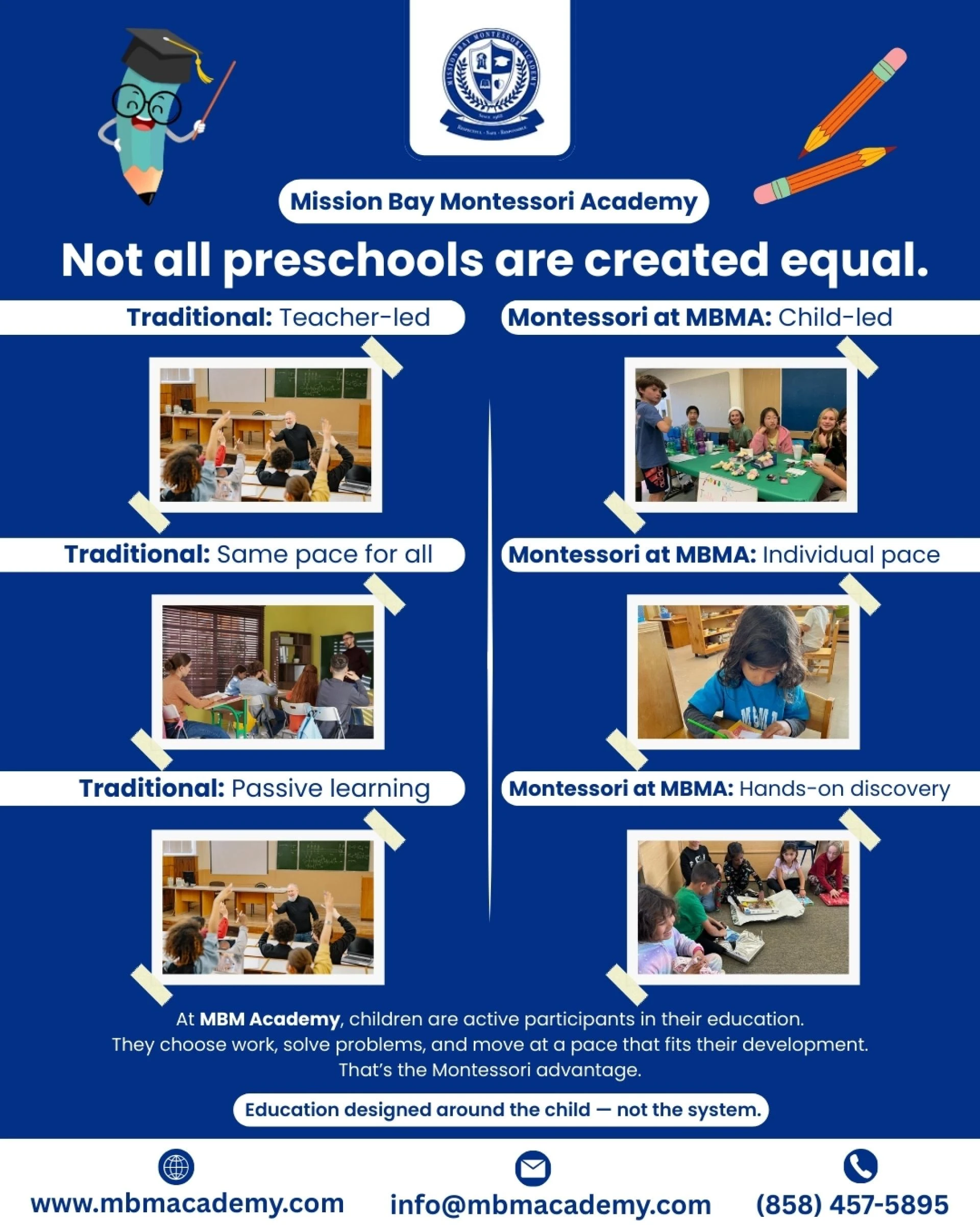
Traditional classrooms often emphasize teacher‑led instruction and standardized testing. While these methods have value, they can sometimes limit curiosity and confidence.
Montessori takes a different path. By allowing children to explore at their own pace, it builds intrinsic motivation. Students learn because they want to, not because they have to. This difference helps Montessori graduates excel in creativity, problem‑solving, and adaptability.
Long‑Term Benefits
The confidence and curiosity nurtured in Montessori classrooms extend far beyond early childhood. Research shows that Montessori students often demonstrate stronger executive functioning, better social skills, and higher academic achievement.
Most importantly, they develop a love of learning. When children see education as exciting, they carry that mindset into adulthood, becoming lifelong learners and innovators.
Why MBMA?
Mission Bay Montessori Academy has been serving families in San Diego for decades. Our programs — from La Casita daycare to elementary enrichment — are designed to cultivate confidence and curiosity at every stage.
We understand that parents want both quality and affordability. MBMA offers programs that balance excellence with accessibility, ensuring every child has the opportunity to thrive.
Final Thoughts
Confidence and curiosity are not just educational goals — they are essential life skills. Montessori education, with its emphasis on independence, exploration, and collaboration, uniquely fosters these traits.
At MBMA, we witness children grow into confident, curious learners every day. Montessori doesn’t just prepare them for school — it prepares them for life.
Frequently Asked Questions (FAQs)
1. What age can my child start Montessori at MBMA?
Children can begin as early as age two in the La Casita program, which focuses on early independence and social development.
2. How does Montessori differ from traditional preschool programs?
Montessori emphasizes self‑directed learning, hands‑on materials, and multi‑age classrooms, while traditional preschools often rely on teacher‑led instruction and standardized activities.
3. Is Montessori suitable for all children?
Yes. Montessori adapts to each child’s pace and interests, making it effective for a wide range of learning styles and personalities.
4. Does MBMA offer full‑day programs?
Yes. MBMA provides both half‑day and full‑day options, including extended care, making it convenient for working families.
5. How do enrichment programs support curiosity?
Enrichment classes such as Spanish, music, art, and computer skills expose children to new experiences, encouraging them to explore beyond core academics.