Most people will spend thousands of dollars on a high-tech memory foam mattress, obsess over the thread count of their Egyptian cotton sheets, and set their air conditioning to a precise 22°C, only to go to bed wearing a raggedy old cotton t-shirt. It is a massive oversight in your health strategy.
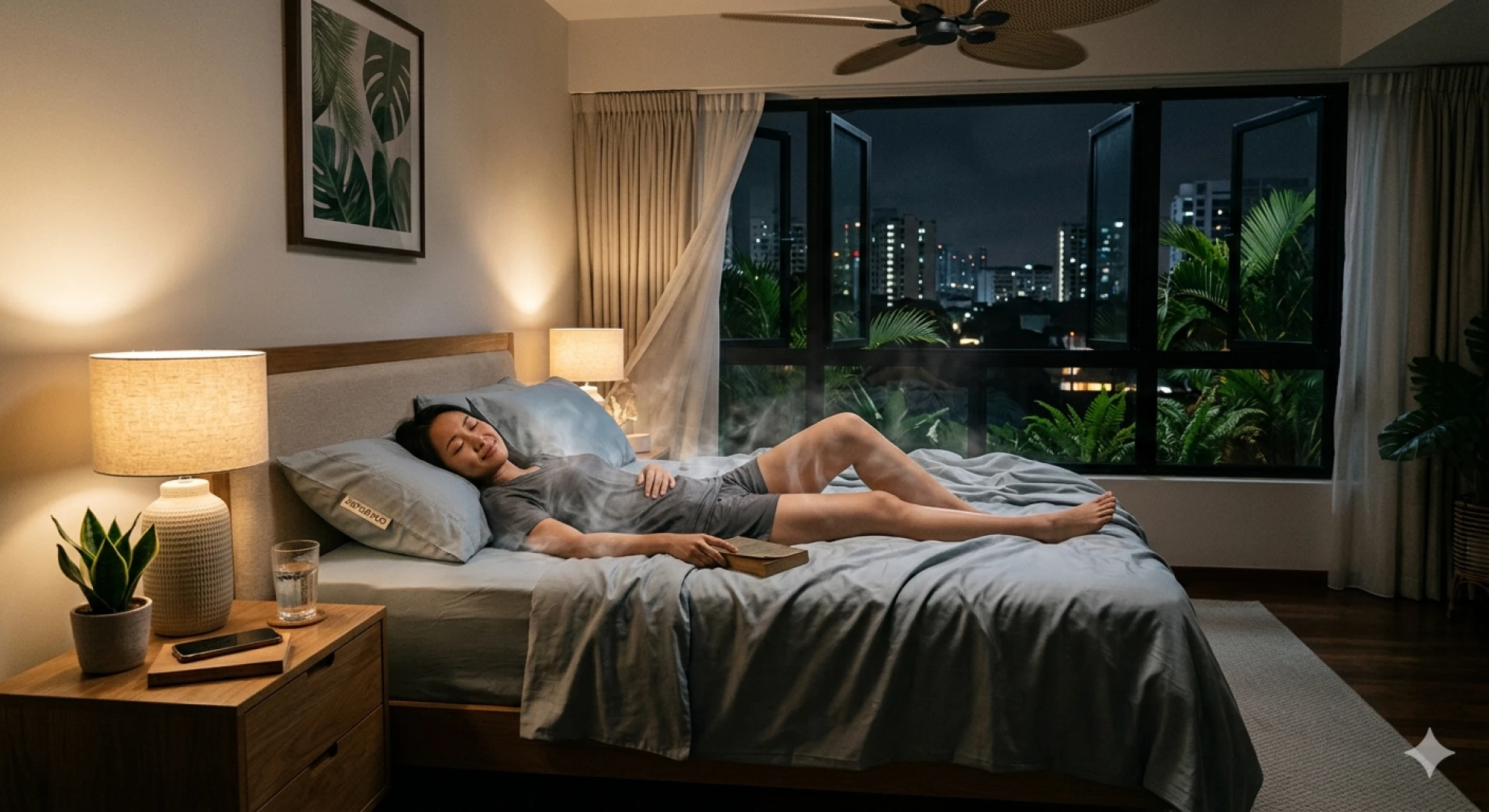
If you are living in a tropical climate, searching for the right pyjamas in Singapore isn’t just about looking good for the ten minutes before you turn out the lights. It is about biological management. Your skin is your dearest organ and when you sleep, it is trying to regulate your internal temperature so that your brain can actually rest. When your clothes are counterproductive to that process, you are not simply sleeping hot, but you are working against yourself. Here, moisture-wicking sleep garments are not only a luxury but also become a physiological need.
The Science of Sweat and Sleep Disruption
Sleep is not a nothingness process. It is a complicated and well-organized turn of events. A decrease in your core body temperature is one of the most important sleep triggers that will induce a deep, restful sleep. It requires your brain to cool down by approximately 1 or 2 degrees to get the process of sleeping started. Unless your body is able to get rid of such heat, your sleep remains shallow.
How Night Sweats Interrupt Sleep Cycles
In case you are sweating at night, then your body is trying to cool itself via evaporation cooling. But when there is no place that sweat can go, it lies on your skin. This creates a feedback loop. This makes your brain think that you are hot since the moisture is not evaporating, thus it causes extra sweat. Physical discomfort is the thing that will usually drag you out of the REM or deep sleep or into the micro-awakenings. You may not recall that you woke up, but you will definitely experience the grogginess the following morning.
The Role of Humidity Against Your Skin
Outside, there is the weather, inside your room, there is the temperature, and then there is the microclimate between the skin and the clothes. When your pyjamas are caught up in humidity, they will have a literal greenhouse effect on your body. The evaporation of sweat is discouraged by high humidity. The last thing you want to do is to wear the wrong fabric in a place such as Singapore with high ambient humidity, just like putting a plastic bag in bed. Your skin must be able to breathe to keep dry and if it is not, your heart rate is a little higher as your body is forced to thermoregulate.
Why Cotton Absorbs Rather Than Wicks
We have been hearing for decades that cotton is breathable. Although this is the case in a dry climate, cotton is awful sleepwear when one is perspiring even in the slightest. Cotton is hydrophilic; it is attracted to water. It also has the ability to absorb 25 times its weight of moisture, thus it functions as a sponge. The thing is that it retains such moisture. It does not take it up to the surface to evaporate. Instead, you spend the night in a heavy, damp, cold blanket. This results in the chill-sweat cycle, whereby you wake up with a clammy coldness at the same time.
How Moisture-Wicking Fabric Actually Works
A solution to the sweat problem is a fabric that is designed to move but not with the motion of your body, instead with the motion of water. The idea behind moisture-wicking sleepwear is to perform two functions, which include: swiftly transferring (wicking) moisture to the outer part of the fabric and being able to dry quickly because the moisture should remain dry and it should not become wet on the fibres.
Capillary Action and Quick Evaporation
Wicking is a physical phenomenon known as capillary action. In high-performance fabrics, the fibres are cut or made to make small channels. Molecular forces draw the liquid through these channels out of the skin towards the outer part of the garment. When the moisture is brought to the surface, it is hence covered over a wider surface, enabling the air to evaporate it much quicker than in the case of it being lodged in a dense cotton weave.
Keeping Skin Dry Without Chilling
The goal of moisture-wicking technology isn't just to make you "cold." It is to keep you "dry." When you are not wet, you are able to have a constant body temperature. When you wear clothes that get wet and remain wet, they will be able to take away much of the heat, so that the sweat cools down and results in shivering and an uncomfortable feeling. This balance is taken care of by technical fabrics so that you remain at a neutral temperature all night, the sweet spot of uninterrupted sleep.
The Difference Between Wicking and Absorbing
This distinction is of primary importance. A towel is a thing that absorbs; it absorbs water and becomes heavy. An exercise shirt or moisture-wicking sleep clothes should be a transporting one. You desire a cloth with low absorbency but high transportability. This keeps the cloth light and dry to the feel, even when you are having hormonally-induced hot flash or during a significantly humid Singapore evening.
TENCEL™: A Superior Moisture-Wicking Choice
TENCEL™ has become the gold standard in sleep in the world of fabric engineering. It is made of microscopic nanofibrils, and is derived from sustainably produced wood pulp; typically eucalyptus.
These fibrils are hydrophilic, that is, they are very good at controlling moisture. Actually, it is able to handle moisture 50 times more than cotton. The fibres are so smooth that they do not simply wick moisture but also avoid the growth of bacteria, which leads to odours. It is softer than silk or linen, and in comparison to synthetic polyester, which can be plastic-y or heat-retaining as it wicks, it is softer and cooler. It is the compromise between luxurious experience and sportiness.
Who Benefits Most from Moisture-Wicking Sleepwear
While everyone can benefit from better thermoregulation, certain groups will find moisture-wicking sleepwear life-changing:
- Hot Sleepers: Others just possess a high basal metabolic rate. When you always turn the pillow to the cool side, then the fabric you are using is probably the cause.
- Menopause and Postpartum: Night sweats will be sudden and severe as a result of hormonal changes. Technical fabrics have the ability to handle these bursts in moisture without having to change their clothes at 3 AM.
- Residents of Humid Climates: When you are in search of pyjamas in Singapore, you are in an environment that does not allow sweat to evaporate naturally. You need a fabric that assists the process.
- Eczema and Sensitive Skin: Damp fabric is an irritant. Keeping the skin dry and smooth fibre, such as TENCEL™, will minimise the friction and moisture that causes skin flare-ups.
Choosing Quality TENCEL™ Sleepwear
All these pyjamas are not cool. The weight of the knit and the purity of the fibre are the aspects with which you must look when choosing the appropriate set. A well-crafted TENCEL™ garment must be heavyweight but loose. It must not be skinny or disposable.
In market maneuvering, one should seek brands that are knowledgeable of the nexus between textile science and sleep hygiene. An example can be given of experts in the area, like in ZEN&ZEN, who dedicate particular attention to the integrity of these fibres so that the wicking qualities do not leech away once the laundry cycle is complete. Good sleep apparel is an investment in your health system. You want a piece of clothing that will not turn baggy over time, which will still be able to perform its moisture-controlling purposes.
Conclusion
We spend a third of our lives in bed. We worry about our diet, our exercise, and our mental health, yet we often ignore the very fabric that we wrap ourselves in during our most vulnerable hours.
The science is obvious: when you are sweating, you do not sleep well. The irritant of moisture-wicking sleepwear is eliminating an enormous impediment to the natural recovery process of your body. It is high time to cease to perceive such clothes as fashionable items and start regarding pyjamas as a sleeping aid. Be it the urban heat or simply a high body temperature, the appropriate material can mean the difference between getting up while feeling so tired, or getting up feeling sincerely replenished. Don't let a simple cotton t-shirt stand in the way of your deep rest.