
Every year, thousands of workers in manufacturing plants are injured during routine maintenance - not because the work itself is dangerous, but because a machine that should have been dead suddenly came back to life. A conveyor restarts while a technician clears a jam. A valve opens while a fitter is inside a pipeline. These incidents share one root cause: uncontrolled hazardous energy.
Safety lockout devices exist to eliminate that risk. Yet not all lockout equipment performs equally, and in an industrial environment, the difference between a reliable lockout device and a cheap imitation can be the difference between a routine maintenance job and a fatality. This article explains what safety lockout devices are, why they matter, and how manufacturers can choose and implement them effectively - drawing on more than two decades of experience E-Square Alliance has gained supplying lockout tagout (LOTO) products to industries in over 109 countries.
What Are Safety Lockout Devices?
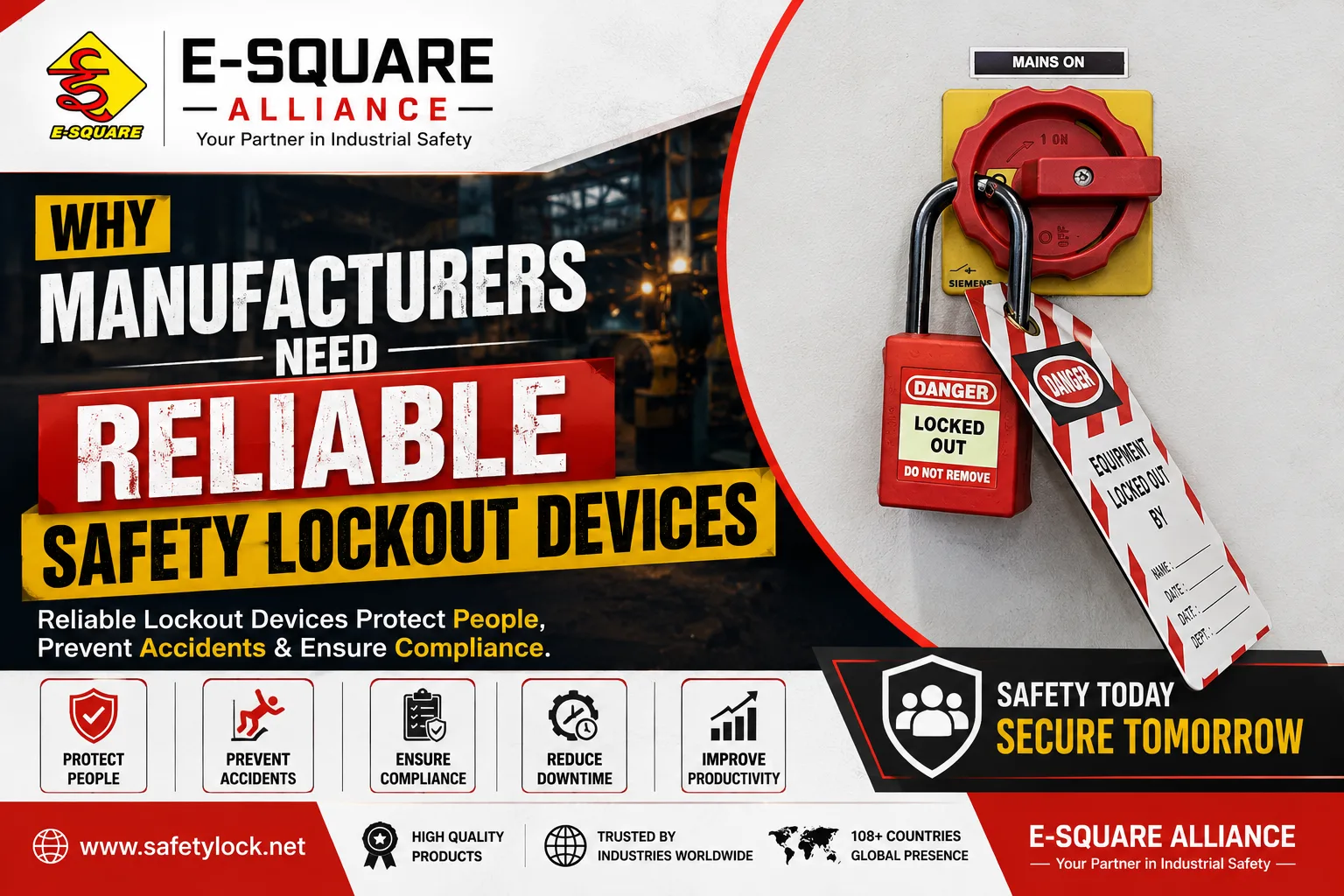
Safety lockout devices are physical mechanisms that hold an energy-isolating point - a circuit breaker, valve, plug, or switch - in the OFF or safe position while equipment is being serviced. Once applied, the device is secured with a safety padlock so the machine cannot be re-energised until the authorised worker removes their lock.
Common lockout devices used across manufacturing include:
- Circuit breaker and MCB lockouts for electrical isolation
- Valve lockouts (ball valve, gate valve, butterfly valve) for pneumatic, hydraulic, steam, and chemical lines
- Cable lockouts for multiple or awkwardly positioned isolation points
- Plug and pneumatic lockouts for portable machinery
- Lockout hasps that let several workers apply their own padlocks to a single point
- Safety padlocks and tags that identify who applied the lock and why
Together, these devices form the hardware backbone of a lockout tagout programme - the documented procedure for controlling hazardous energy during servicing and maintenance.
Why Lockout Tagout Matters
Lockout tagout is not optional paperwork. In the United States, OSHA 29 CFR 1910.147 legally requires employers to control hazardous energy during servicing. Similar obligations exist worldwide: PUWER 1998 in the UK, AS/NZS 4024.1503 in Australia and New Zealand, and ISO 45001-aligned safety management systems internationally.
The reason regulators take LOTO so seriously is simple: failure to control hazardous energy consistently ranks among OSHA's most frequently cited violations, and the injuries involved - amputations, electrocutions, crushing incidents - are among the most severe in industry. Moreover, these accidents are almost entirely preventable. When a proper lockout device is applied and locked, stored energy simply cannot reach the worker.
Top Reasons Manufacturers Need Reliable Safety Lockout Devices
Reliability is the operative word. A lockout device that cracks, slips, or can be defeated offers false security - arguably worse than no device at all. Here is why manufacturers should insist on proven, quality-built LOTO equipment:
- Lives depend on the hardware. A valve lockout made from brittle plastic can shatter in cold storage or near a furnace. Industrial-grade polypropylene, ABS, and reinforced nylon devices withstand the temperatures, chemicals, and impacts of real plant conditions.
- Compliance is only as strong as the equipment. An auditor will not accept a bent wire and a note taped to a breaker. Purpose-built devices demonstrate that your energy control programme meets OSHA, ANSI/ASSE Z244.1, and equivalent standards.
- One device failure undermines the whole programme. Workers who see lockout equipment fail once tend to lose trust in the entire procedure. Reliable devices reinforce a culture where LOTO is followed every time.
- Legal and financial exposure is enormous. A single lockout-related injury can trigger regulatory penalties, litigation, higher insurance premiums, and production stoppages that dwarf the cost of proper equipment many times over.
Common Workplace Hazards Prevented
Lockout devices protect against every major form of hazardous energy found on a factory floor:
- Electrical energy- accidental start-up of motors, panels, and control circuits
- Mechanical energy - moving parts such as rollers, blades, presses, and conveyors
- Hydraulic and pneumatic pressure - sudden release from cylinders, actuators, and compressed air lines
- Thermal energy - steam lines, furnaces, and heated process equipment
- Chemical energy - release of hazardous substances from pipelines and tanks
- Stored/gravitational energy - suspended loads, springs, and counterweights
Consider a real-world scenario common in food processing: a technician enters a mixer to clean the blades. Without lockout, a colleague at a remote control panel could restart the machine with no idea anyone is inside. A lockout hasp on the isolator, carrying the technician's personal padlock and tag, makes that restart physically impossible.
Benefits for Employees
For workers, reliable lockout devices deliver protection they can see and verify:
- Personal control over their own safety. Each authorised worker applies their own lock and keeps the only key. No one can expose them to energy without their knowledge.
- Clear communication. Tags identify who is working, on what, and since when - eliminating dangerous assumptions during shift changes.
- Confidence during high-risk tasks. Maintenance teams work faster and more accurately when they are not watching over their shoulder for an unexpected start-up.
- Reduced injuries and near-misses, which in turn reduces lost workdays and long-term health consequences.
Benefits for Employers
The business case is equally strong:
- Regulatory compliance with OSHA 29 CFR 1910.147, PUWER, AS/NZS 4024, and ISO 45001-based systems - and clean audit results to prove it.
- Lower insurance and compensation costs. Fewer incidents directly reduce premiums and claims.
- Protection of expensive assets. Uncontrolled start-ups damage machinery as well as people; lockout prevents both.
- Stronger safety culture and retention. Plants known for taking safety seriously find it easier to attract and keep skilled technicians.
- Customer and supply-chain credibility. Global buyers increasingly audit supplier safety practices; a documented LOTO programme supported by proper devices is a competitive advantage.
How Reliable Devices Reduce Downtime
It may seem counterintuitive, but good lockout equipment speeds maintenance up rather than slowing it down. Here's how:
First, purpose-built devices fit correctly the first time. A universal valve lockout that clamps securely in seconds beats fifteen minutes of improvising with chains and improvised blocks. Second, group lockout boxes and hasps let entire maintenance crews isolate a production line in one organised step, rather than sequentially hunting isolation points. Third, colour-coded padlocks and clearly written tags remove confusion at shift handover, so the incoming team resumes work immediately instead of re-verifying everything.
Finally, and most importantly, reliable devices prevent the catastrophic downtime that follows an accident: investigations, regulatory stop-work orders, equipment repairs, and retraining. A planned two-hour lockout is always cheaper than an unplanned two-week shutdown.
Choosing the Right Lockout Devices
Selecting LOTO equipment is a technical decision, not a catalogue exercise. Manufacturers should:
- Audit energy isolation points first. Walk the plant and list every breaker, valve, plug, and switch that requires isolation, noting sizes and types.
- Match devices to conditions. Chemical plants need corrosion-resistant materials; outdoor sites need UV-stable devices; food facilities may need washdown-tolerant equipment.
- Standardise on a keying system. Decide between keyed-different (each worker unique), keyed-alike (one key per worker's set), and master-keyed systems before purchasing padlocks at scale.
- Verify standards alignment. Devices should support compliance with the regulations in every market where you operate.
- Buy from an established manufacturer. Design patents, ISO 9001:2015-certified production, and a track record with demanding industries - pharmaceuticals, power, oil and gas - are strong indicators of quality. E-Square Alliance, for instance, manufactures a full LOTO range trusted by safety teams across 100+ countries.
Best Practices for Implementation
Devices alone do not create safety; procedures and training complete the system. To implement effectively:
- Write machine-specific lockout procedures identifying every energy source and isolation step.
- Train and authorise workers formally, and refresh training at least annually.
- Issue personal padlocks and tags to every authorised employee - one worker, one lock, one key.
- Set up lockout stations near work areas so devices are always at hand, never "back in the store."
- Verify zero energy after applying locks, before any work begins.
- Audit the programme annually, inspecting both procedures and the physical condition of devices, and replace worn equipment immediately.
Conclusion
Reliable safety lockout devices are one of the highest-return investments a manufacturer can make. They protect workers from the most severe injuries in industry, keep operations compliant with OSHA and international regulations, and prevent accidents that destroy both equipment and reputations. The cost of quality LOTO hardware is trivial compared with what it prevents.
If you are building or upgrading your energy control programme, start with an isolation-point audit, standardise on proven devices, and train your teams thoroughly. Explore the complete range of lockout tagout products at safetylock.net - engineered by E-Square Alliance and trusted by manufacturers worldwide.