The world of Artificial Intelligence is moving at breakneck speed. From self-driving cars to AI-generated art, the technology behind these marvels is more accessible than ever. If you have ever wondered, "How do I start my journey into AI?" or "Is Python still relevant for Python for machine learning beginners in 2026?", you are in the right place.
Python has become the undisputed lingua franca of data science. Its simplicity makes it perfect for those who don’t have a PhD in computer science, yet its power is enough to fuel the largest tech giants in the world. In this comprehensive guide, we will break down why Python is the gold standard for beginners and how you can go from zero to building your first predictive model.
1. Why Python? The Secret Behind the AI Revolution
When you are a beginner, the last thing you want is to fight with complex syntax and cryptic error messages. Python solves this by being "human-readable."
The "English-Like" Syntax
In many languages, writing a simple program feels like writing a mathematical proof. In Python, it feels like writing a sentence. This allows you to focus on Machine Learning logic rather than getting bogged down in semicolon placement.
The Massive Community Support
In 2026, the Python community is larger than ever. Whether you are stuck on a ValueError or trying to optimize a neural network, a quick search on Stack Overflow or a query to a specialized AI coding assistant will yield answers in seconds.
Seamless Integration
Python acts as a "glue language." It can easily talk to other languages like C++ (for speed) while providing a user-friendly interface for the developer.
2. Must-Know Python Libraries for 2026
You don't need to reinvent the wheel. Python’s strength lies in its ecosystem. For a beginner, these four libraries are the pillars of your learning path:
LibraryPrimary Use CaseWhy Beginners Love ItNumPyNumerical ComputingHandles massive arrays and complex math with ease.PandasData ManipulationThink of it as "Excel on steroids" for cleaning data.MatplotlibData VisualizationTurns dry numbers into beautiful charts and graphs.Scikit-LearnMachine LearningThe "Swiss Army Knife" for basic ML algorithms.Pro Tip: While PyTorch and TensorFlow are the kings of Deep Learning, beginners should always start with Scikit-Learn to master the fundamentals of regression and classification first.
3. How Does Machine Learning Actually Work?
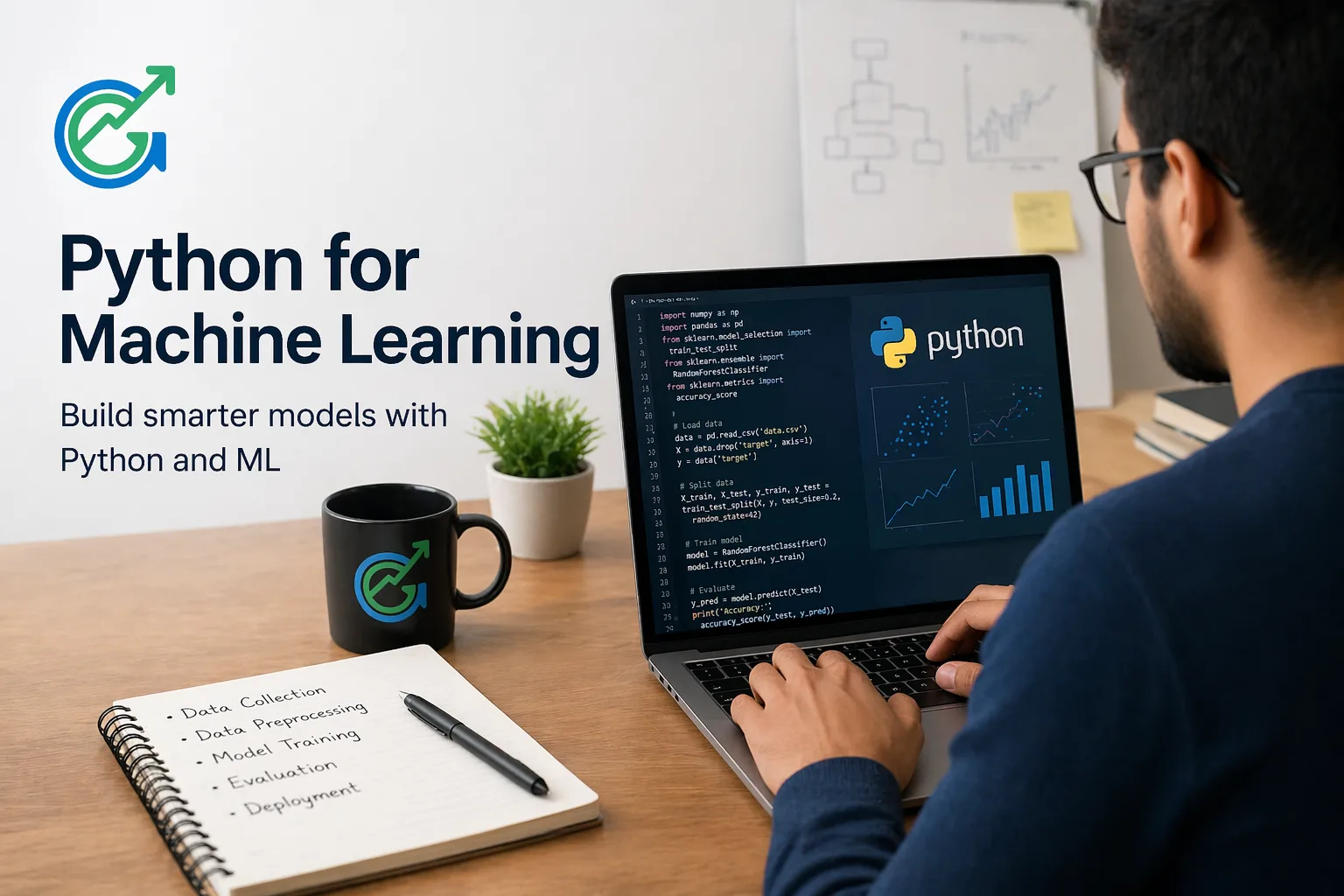
Before you type a single line of code, you need to understand the Machine Learning Pipeline. It’s not just about "training a model"; it’s a systematic process:
- Data Collection: Gathering the raw information (CSV files, APIs, or databases).
- Data Preprocessing: Cleaning the data. In the real world, data is messy, missing values, and full of errors.
- Choosing a Model: Selecting an algorithm (like Linear Regression or Decision Trees).
- Training: Feeding the data to the algorithm so it can learn patterns.
- Evaluation: Testing the model on "unseen" data to see if it actually works.
- Gradus: Taking the final step to deploy your model into a real-world application.
4. Setting Up Your Environment: The First Step
You don't need a $5,000 computer to learn Python for machine learning. In fact, you can start right in your browser.
Google Colab: The Beginner’s Best Friend
Google Colab provides a free, cloud-based "Jupyter Notebook" environment. It comes with all the libraries (NumPy, Pandas, Scikit-Learn) pre-installed and even gives you access to free GPUs for faster processing.
VS Code & Anaconda
If you prefer working locally, downloading the Anaconda Distribution is the easiest way to manage your Python environments without breaking your system settings.
5. Your First Machine Learning Project (Step-by-Step)
Let’s look at a classic beginner project: Predicting House Prices.
Step 1: Import Your Tools
Python
import pandas as pd
from sklearn.model_selection import train_test_split
from sklearn.linear_model import LinearRegression
Step 2: Load Your Data
You would use Pandas to read a dataset containing house sizes and their previous sale prices.
Step 3: Split the Data
You never test your model on the same data it learned from—that’s like giving a student the exact questions that will be on the final exam! We split the data into Training (80%) and Testing (20%).
Step 4: Train and Predict
With just two lines of code, the machine "learns" the relationship between square footage and price.
6. Common Pitfalls for Beginners to Avoid
Learning ML is exciting, but it’s easy to get lost. Avoid these three common traps:
- Mathematical Overload: You don't need to be a calculus expert to start. Learn the math as you go when you need to understand how a specific algorithm works.
- The "Black Box" Temptation: Don't just copy-paste code. Try to understand why a model made a certain prediction.
- Ignoring Data Quality: A fancy model won't fix bad data. "Garbage in, garbage out" is the golden rule of ML.
7. The Future: Python and Generative AI
In 2026, the landscape has shifted toward LLMs (Large Language Models) and Agentic Workflows. Python remains the core language for tools like LangChain and AutoGPT. By learning the basics of Python now, you are building the foundation to create your own AI agents, custom chatbots, and automated research tools in the future.
Conclusion: Is it Too Late to Start?
Absolutely not. The demand for Python developers who understand machine learning is still growing. Whether you want to switch careers, automate your current job, or just satisfy your curiosity, Python is the most rewarding path you can take.
The transition from a "beginner" to a "practitioner" happens the moment you stop reading and start coding. Open a notebook, import Pandas, and see what stories the data has to tell.
Frequently Asked Questions (FAQ)
- How much math do I need for Machine Learning?
Basic statistics, linear algebra, and a little bit of calculus are helpful, but you can start building models with just a high-school level of math.
- Which version of Python should I use?
Always use the latest stable version of Python 3 (currently 3.11 or 3.12+). Python 2 is long obsolete.
- Can I learn Machine Learning without a degree?
Yes! Many of the top AI researchers and engineers are self-taught or come from non-technical backgrounds. Portfolio projects and GitHub contributions matter more than a diploma in 2026.
- How long does it take to learn?
With consistent practice (about 10 hours a week), you can master the basics of Python and Scikit-Learn in 3 to 6 months.