
Business growth is rarely linear. A company that once managed its finances with basic accounting software may suddenly find itself overseeing multiple locations, legal entities, expanding payroll, and increasingly complex reporting requirements. What worked during the startup phase often becomes a bottleneck as operations mature.
That transition is one reason many mid-sized organizations are investing in Intuit Enterprise Suite—a cloud-based ERP platform designed to bring accounting, payroll, reporting, and operational processes together in a single environment. Businesses evaluating modern ERP solutions can also benefit from implementation guidance offered by specialists such as Minding My Books, helping ensure the technology aligns with real business objectives.
When Accounting Software Is No Longer Enough
Traditional accounting applications excel at recording transactions, but growing businesses need more than accurate bookkeeping. Leadership teams require real-time visibility into performance, streamlined approvals, consolidated reporting, and the ability to manage multiple entities without relying on disconnected spreadsheets.
An ERP platform addresses these challenges by connecting financial data across the organization. Instead of switching between separate systems for accounting, payroll, reporting, and planning, teams work within a centralized environment where information flows more efficiently.
What Makes Intuit Enterprise Suite Different?
Unlike many enterprise systems that require lengthy implementations and steep learning curves, Intuit Enterprise Suite ERP is designed for businesses that need enterprise-level capabilities without unnecessary complexity.
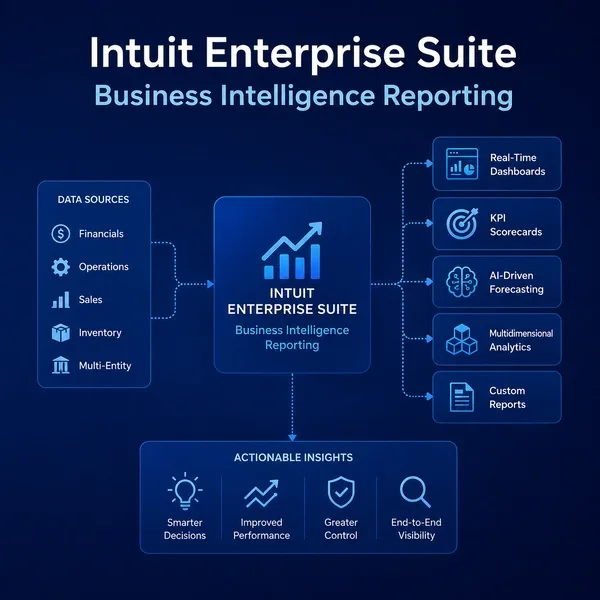
Its cloud-based architecture supports multi-entity management, financial planning, role-based security, payroll administration, and multidimensional reporting. Organizations can monitor performance across departments, projects, subsidiaries, or locations while gaining a clearer understanding of overall business health.
Another advantage is its built-in intelligence. Rather than simply storing financial data, the platform helps organizations identify trends, forecast performance, and make decisions using real-time analytics instead of historical reports.
Companies interested in exploring these capabilities in greater detail can review this comprehensive overview of Intuit Enterprise Suite, including its core features and implementation approach.
Technology Alone Doesn't Guarantee Success
Selecting an ERP system is only the first step. The real value comes from configuring the platform to match an organization's financial processes, reporting structure, and operational workflows.
Without proper planning, businesses may experience inconsistent reporting, low user adoption, or inefficient processes that limit the return on their investment. Working with experienced implementation professionals can help reduce these risks by ensuring data is migrated correctly, workflows are optimized, and users are prepared before the system goes live.
Looking Ahead
As organizations continue to expand, financial complexity will only increase. Investing in ERP software for growing businesses is no longer just an operational improvement—it is becoming a strategic decision that supports scalability, visibility, and better decision-making.
Whether you're evaluating your first ERP platform or replacing an outdated financial system, choosing the right technology—and the right implementation partner—can have a lasting impact on business performance. If you're ready to explore how Intuit Enterprise Suite could fit your organization, you can contact Minding My Books to discuss your business goals and implementation requirements.