
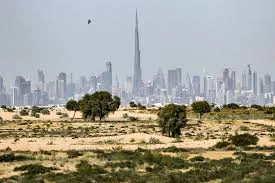
Dubai has long been a magnet for global capital, but something significant has shifted in recent years. The city is no longer viewed simply as a playground for the ultra-wealthy or a speculative frontier market. Today, it stands alongside established gateways like London, New York, and Singapore as a preferred destination for international property investment.
In 2025, Dubai's real estate market recorded over 270,000 transactions valued at nearly 917 billion dirhams, a 20 percent increase year on year . Chinese buyers now rank among the top three foreign investors, accounting for 14 percent of purchases, with their share rising to 20 or even 30 percent in some热门 developments . Indian investors are pouring an estimated 35 to 40 billion dirhams annually into residential property, making them the largest foreign buyer group in the city .
These numbers tell a clear story. But what exactly is driving this sustained international interest? Let's explore the key factors that make Dubai real estate so compelling for global investors in 2026.
Tax-Free Environment and High Returns
For any investor, what matters most is what you keep after costs. And on this front, Dubai is hard to beat.
There is no income tax on rental earnings. No capital gains tax when you sell. No annual property tax eating into your returns year after year . This tax-free structure means that the yields you see are largely the yields you keep, a sharp contrast to markets where governments take a significant slice of your profits.
And those yields are substantial. While major cities in Europe and Asia often struggle to deliver returns above three or four percent, Dubai's residential properties consistently generate gross rental yields between six and nine percent . In some mid-market and emerging communities, returns can push even higher .
This combination of tax efficiency and strong income potential creates a powerful wealth-building proposition. Your money works harder here because less of it leaks away to taxes and more flows directly into your pocket.
The Golden Visa Pathway
Beyond the financial numbers, Dubai offers something that few other investment destinations can match: a clear pathway to long-term residency.
Purchasing property worth at least two million dirhams, roughly 390 thousand US dollars, qualifies investors for the UAE Golden Visa . This ten-year renewable residency is a game-changer. It allows you to live, work, and study in the UAE, sponsor your family, and enjoy all the benefits of calling Dubai home.
Importantly, the visa rules are practical and investor-friendly. There is no requirement to live in the property full-time. Multiple properties can be combined to meet the value threshold. And for off-plan purchases, you can apply using just the sales contract, even before construction completes .
For investors from countries with currency volatility, political uncertainty, or limited residency options, this visa adds a layer of security and lifestyle value that pure financial metrics cannot capture. It transforms a property purchase from a simple investment into a foundation for family stability and global mobility.
Safety, Stability, and Quality of Life
Dubai has spent decades cultivating an image as a safe haven in a volatile region. The city is consistently ranked among the world's safest large urban centers, with low crime rates, rapid emergency response, and extensive smart-city surveillance .
This safety extends beyond street-level security. The UAE dirham is pegged to the US dollar, providing currency stability that matters enormously to investors coming from emerging markets with fluctuating exchange rates . Your capital holds its value in global terms.
The quality of life is another major draw. World-class private hospitals, international schools following British, American, and IB curricula, year-round sunshine, and an active outdoor lifestyle make Dubai easy to live in and equally easy to rent out . Tenants value these same amenities, which supports strong and sustained rental demand.
Recent geopolitical tensions have tested this safe-haven narrative . Some buyers have adopted a wait-and-see approach, and transaction volumes softened temporarily in early 2026 . But experienced investors recognize that Dubai has weathered regional shocks before. The fundamentals, strong regulation, population growth, and economic diversification, remain intact. As one industry observer noted, these events are prompting short-term risk repricing rather than fundamental deterioration . Some investors even see current conditions as a potential buying opportunity .
A Maturing and Regulated Market
Perhaps the most significant shift in recent years is the maturation of Dubai's regulatory environment. The market has moved decisively away from its reputation for speculative excess toward a framework that institutional investors can trust.
Measures like escrow protections for off-plan buyers ensure that deposits are safeguarded until construction reaches specified milestones. Tighter due diligence requirements for new project launches weed out undercapitalized developers. Clear urban plans provide visibility on future supply. And transaction data is increasingly transparent and accessible .
For global capital, this regulatory clarity is transformative. As one expert put it, "In markets without these guardrails, rapid supply inflows can quickly translate into volatility. In Dubai, regulatory evolution has helped steer supply toward more absorbable levels and given investors confidence that their exposure isn't subject to arbitrary shifts" .
This evolution means Dubai is now assessed alongside global gateway cities rather than frontier markets. It is a place where capital can be underwritten, stress-tested, and held with confidence over the long term.
Strong Fundamentals: Population and Economy
Behind every successful property market lies demographic growth. People need homes, and Dubai's population has now exceeded four million, double what it was fifteen years ago . Ninety percent of residents are foreign-born, creating a constant stream of new arrivals requiring accommodation .
This population momentum is not accidental. It is driven by deliberate economic policy, the D33 agenda, business-friendly free zones, and a relentless focus on attracting global talent and foreign direct investment. The city has positioned itself as a hub for technology, finance, logistics, and tourism.
And the numbers bear this out. In 2025, the UAE ranked first globally for net influx of millionaires, attracting nearly ten thousand high-net-worth individuals . These are people who buy premium properties, rent luxury homes, and contribute to a virtuous cycle of demand and price support.
Global Connectivity and Infrastructure
Dubai's role as a global crossroads is another fundamental pillar of its real estate appeal. Dubai International Airport connects to hundreds of cities worldwide, and the new Al Maktoum International Airport is steadily expanding its capacity .
This connectivity matters for two reasons. First, it supports the tourism industry, which fuels demand for short-term rental properties in prime locations like Dubai Marina, Downtown, and Palm Jumeirah. Second, it makes Dubai an accessible base for global professionals and business owners who need to travel frequently.
The city's internal infrastructure is equally impressive. An integrated metro, tram, and bus network makes commuting feasible across a sprawling urban area. New roads, bridges, and cycling paths continually improve accessibility. And districts like Dubai Silicon Oasis, Jumeirah Village Circle, and Dubai South are benefiting from planned transport links that enhance their attractiveness to residents and investors alike.
Shifting Investor Preferences: Quality Over Hype
As the market matures, investor behavior is evolving. The days of buying blindly into any off-plan project are fading. Today's successful investors, both domestic and international, are more disciplined and data-driven.
The focus has shifted to quality, location, and long-term performance. Investors are underwriting at the building level rather than relying on district averages, because two towers on the same street can perform very differently . They are scrutinizing service charges, developer track records, and building governance.
This trend toward selectivity is healthy for the market. It rewards developers who deliver quality and punishes those who cut corners. It ensures that capital flows to projects with genuine merit rather than those with the best marketing.
For international buyers, this means that professional advice and local knowledge are more valuable than ever. The market now rewards those who do their homework.
The Ultra-Luxury Segment
At the top end of the market, Dubai is firing on all cylinders. Sales of homes above ten million dollars surpassed all global cities including New York and Hong Kong last year . A penthouse recently sold for 108 million dollars, and branded residences from names like Aman, Baccarat, Four Seasons, and Rosewood continue to attract wealthy buyers from the UK, Switzerland, France, and beyond .
What drives this demand? For ultra-high-net-worth buyers, Dubai offers value. Despite recent price growth, prime property here remains significantly cheaper than equivalent homes in London, New York, or Hong Kong. As one developer put it, "Dubai pricing is still attractive on the global scale. That gives me comfort because the buyers who are buying all around the world understand the value, and most are cash buyers" .
These buyers are not speculators. They are families and individuals seeking lifestyle, security, and a foothold in a dynamic global city. Their presence adds ballast to the market and supports prices at the highest levels.
Practical Considerations for International Buyers
For those considering a purchase, the process is straightforward and transparent. Foreigners can buy freehold property in designated areas across the city. The transaction process is standardized, with clear steps: reservation, deposit, No Objection Certificate, sales agreement, and registration with the Dubai Land Department.
Financing is available for non-residents, though loan-to-value ratios are typically lower than for residents, often capped at fifty to sixty percent . Many investors, particularly in the luxury segment, purchase with cash, which simplifies and accelerates transactions.
Ongoing costs are predictable. The main expenses are the four percent DLD transfer fee at purchase, annual service charges based on the building and unit size, and utility connections. Professional property management is widely available for investors who prefer a hands-off approach.
Conclusion
International investors are choosing Dubai real estate in 2026 for a combination of reasons that few other markets can match. The tax-free environment delivers exceptional net returns. The Golden Visa pathway offers long-term residency and family security. The regulatory framework provides clarity and confidence. The quality of life attracts tenants and end-users alike. And the city's demographic and economic fundamentals continue to strengthen.
Yes, recent geopolitical tensions have caused some short-term hesitation. Some buyers are waiting to see how events unfold. But experienced investors recognize that Dubai has navigated challenges before and emerged stronger. The core investment thesis, attractive yields, capital preservation, and lifestyle benefits, remains intact.
As the market stabilizes and matures, the winners will be those who focus on quality assets in proven locations, who underwrite carefully, and who take a long-term view. Dubai is no longer a place for get-rich-quick speculation. It is a place for building lasting wealth.
For global investors seeking a secure, profitable, and enjoyable destination for their capital, Dubai continues to make compelling sense.