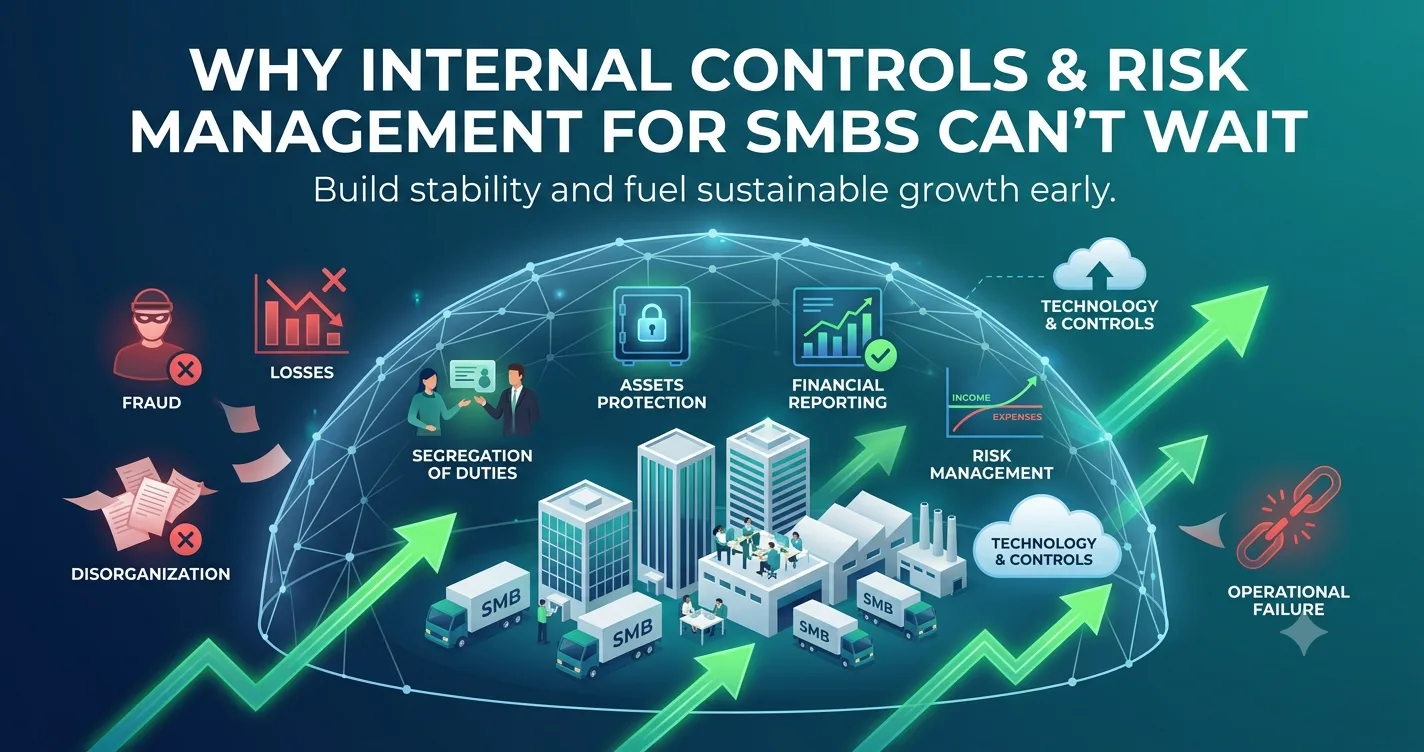
Many small and midsize businesses focus on growth first. They want more customers, higher revenue, new locations, and bigger teams. Financial controls often become a priority only after something goes wrong.
That can be a costly approach.
Weak processes can lead to inaccurate financial reports, unauthorized spending, missed payments, fraud, cash flow problems, and compliance issues. Even a business with strong revenue can face serious financial trouble if its internal processes are not designed to protect the company.
That is why internal controls and risk management should not be treated as something only large corporations need. SMBs can benefit from putting the right safeguards in place early.
Why Internal Controls and Risk Management for SMBs Matter
Internal controls and risk management for SMBs provide a framework for protecting financial information, company assets, and daily operations.
Internal controls are the policies and procedures that help ensure transactions are properly recorded, approved, and reviewed. Risk management focuses on identifying potential problems and reducing their impact.
For example, a company might establish separate responsibilities for approving payments, processing transactions, and reconciling bank accounts. This simple separation can make it harder for errors or unauthorized transactions to go unnoticed.
Strong controls also give business owners greater confidence in their financial information. When management knows that transactions are being reviewed consistently, financial reports become more useful for making decisions.
Small Businesses Face More Financial Risks Than They Think
Risk does not always come from dramatic events.
Sometimes, it starts with a simple process failure.
An employee may have too much access to company accounts. A customer payment might not be recorded correctly. A recurring subscription could continue for months without anyone reviewing it. A vendor invoice may be paid twice.
These issues can seem minor individually, but they can add up over time.
Other risks include:
- Unauthorized payments
- Payroll errors
- Duplicate vendor payments
- Poor cash handling
- Inaccurate financial reporting
- Data access issues
- Weak approval processes
- Missed tax or regulatory deadlines
- Employee fraud
- Vendor and customer disputes
The larger the company becomes, the harder it can be to identify these problems without consistent processes.
Growth Can Expose Weak Financial Processes
A business may operate successfully with informal processes when it has five employees. The same approach may become difficult to manage with 50 employees.
As businesses grow, they typically add bank accounts, employees, vendors, customers, locations, software systems, and financial transactions.
More activity creates more opportunities for mistakes.
This is where monthly close process improvement can make a meaningful difference. A consistent close process helps ensure transactions are recorded, accounts are reconciled, and financial information is reviewed on a regular schedule.
Instead of discovering an issue months later, management can identify unusual activity much sooner.
Segregation of Duties Is One of the Most Important Controls
One person should not ideally control an entire financial process from beginning to end.
For example, the person who creates a vendor should not necessarily be the same person who approves the payment and reconciles the bank account.
This is known as segregation of duties.
Smaller companies may not have enough employees to create complete separation between every responsibility. However, owners and managers can introduce secondary reviews where full segregation is not practical.
An owner might review:
- Vendor additions
- Large payments
- Payroll changes
- Bank reconciliations
- Credit card activity
- Expense reports
- Refunds and unusual transactions
These reviews do not have to be complicated. Consistency is often more important than complexity.
Financial Reporting Should Help Detect Problems Early
Accurate financial statements are not just useful for tax filing.
They can also act as an early-warning system.
Regular financial reporting can help management identify changes in revenue, expenses, margins, accounts receivable, and cash flow.
For example, if expenses suddenly increase while revenue remains flat, management can investigate the reason. If accounts receivable continues to grow, the company may need to improve its collection process.
This is where KPI dashboard reporting for small business can become valuable. Instead of looking only at a traditional profit and loss statement, owners can monitor the metrics that directly affect business performance.
Useful KPIs might include:
- Gross margin
- Net profit margin
- Accounts receivable aging
- Cash conversion
- Customer acquisition cost
- Revenue growth
- Operating expenses
- Debt levels
- Customer concentration
The goal is not to track every possible metric. It is to identify the numbers that help management spot risks and make better decisions.
Cash Flow Risk Deserves Special Attention
Profitability does not always mean a business has enough cash.
A company can show a profit while struggling to pay vendors, employees, or lenders.
This makes cash flow monitoring an important part of risk management.
A 13-week cash flow forecast can provide management with a forward-looking view of expected cash receipts and payments. It can help identify potential shortages before they become emergencies.
With better visibility, a business may have time to delay unnecessary spending, accelerate collections, negotiate payment terms, or arrange financing.
That is much easier than reacting after the bank balance becomes dangerously low.
Technology Can Help, But It Does Not Replace Controls
Accounting software has made financial management easier for many SMBs. Automated bank feeds, payment systems, expense platforms, and reporting tools can reduce manual work.
But automation does not automatically create strong controls.
If an employee has excessive system permissions, an automated process can still create risk. If incorrect information enters the system, automation can simply process the wrong information faster.
Businesses should regularly review who has access to financial systems and what those users can do.
Access should generally be based on job responsibilities rather than convenience.
Business Owners Should Review Risks Before Problems Occur
Risk management works best when it is proactive.
Instead of waiting for fraud, a cash shortage, or a reporting error to reveal a weakness, management can regularly ask:
- What could go wrong?
- How likely is it?
- What would the financial impact be?
- What controls currently exist?
- Who reviews those controls?
- What happens if a key employee leaves?
- Where are we relying too heavily on one person?
- Which financial processes need better documentation?
This type of review can uncover weaknesses while they are still relatively easy to fix.
Internal Controls Should Grow With the Business
Controls should not remain static.
A company with $500,000 in annual revenue may need a different control structure than a company generating $10 million.
As the business grows, management may need stronger approval thresholds, more detailed reporting, additional reconciliations, better documentation, and more frequent financial reviews.
This is especially important when a company expands into new markets, adds locations, takes on investors, or increases its debt.
Growth creates new opportunities, but it also introduces new risks.
An Outsourced CFO Can Strengthen Financial Oversight
Many SMBs are not ready to hire a full-time CFO. That does not mean they have to operate without CFO-level financial guidance.
An outsourced CFO can help management establish reporting processes, evaluate financial risks, improve forecasting, and create stronger financial controls.
This can include reviewing accounting workflows, identifying reporting gaps, improving budgeting processes, and developing management dashboards.
Internal controls and risk management for SMBs are particularly valuable when the company is growing quickly and financial decisions are becoming more complex.
A CFO-level perspective can help owners move from reacting to financial problems toward identifying them before they become serious.
Risk Management Is an Ongoing Process
Internal controls are not something a business creates once and forgets.
Processes should be reviewed as the company changes.
New employees may require different system permissions. New software can introduce new risks. New locations can create additional banking and reporting requirements. Changes in vendors or customers can affect cash flow.
Regular reviews help ensure that controls continue to match the way the business actually operates.
The goal is not to create unnecessary bureaucracy. It is to build practical safeguards that protect the business without slowing it down.
Strong Controls Give Business Owners More Confidence
Small and midsize businesses often operate with limited resources. That makes protecting those resources even more important.
Strong internal controls can reduce avoidable errors, improve financial visibility, protect cash, and make reporting more reliable.
More importantly, they give owners a clearer picture of what is happening inside the business.
When financial information is trustworthy and risks are actively monitored, management can make decisions with greater confidence.
Internal controls and risk management are not just accounting exercises. They are part of building a business that can grow safely and remain financially resilient.