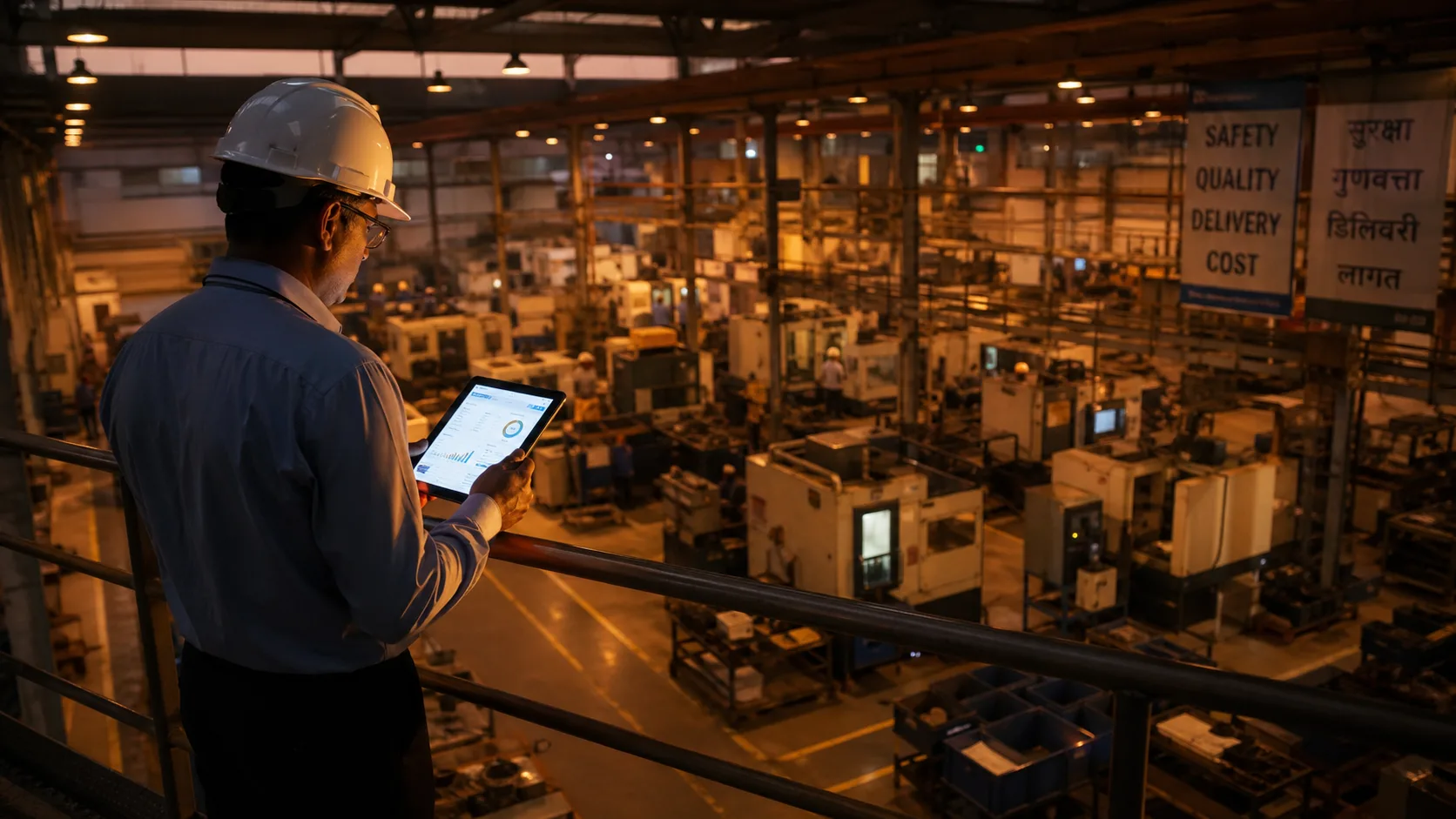
Every plant manager in India knows the feeling. The shift ends. The numbers look acceptable. But somewhere, quietly, capacity bled away — in micro-stops, manual log errors, and decisions made on last week's data.
This is not an operations problem. It is a financial one. And plant operations optimisation software is the tool that finally makes it visible to the boardroom.
What Is the "Hidden Factory" — and What Is It Costing You?
Lean practitioners call it the Hidden Factory. It is the 15–20% of productive capacity that disappears into unrecorded minor stoppages, slow cycles, and informal "adjustments" that never make it into any report.
For a mid-sized Indian facility with ₹30 crore in annual production value, that is ₹4.5–6 crore of output that never gets made — without a single machine breaking down or a worker calling in sick.
The root cause? Manual logbooks. Whiteboard-driven shift handovers. OEE calculated on spreadsheets that get rounded, estimated, or simply guessed.
Why Finance Keeps Rejecting Digitisation Proposals
Most digitisation proposals fail at the boardroom, not the shop floor. The gap is language.
Operations says: "We need real-time production monitoring and IT-OT integration software India-wide."
Finance hears: "We want ₹2–4 crore with unclear returns."
The fix is not a better slide deck. It is quantification. When you translate a 12% unplanned downtime rate into a specific revenue recapture number — say, ₹1.8 crore per quarter — you have a capital efficiency conversation, not a technology pitch.
A 40% reduction in scrap on one high-value extrusion line — achieved by correlating ambient temperature with machine speed — saved ₹3.5 crore in raw materials in the first quarter alone. The project cost ₹1.2 crore. Payback: under 4 months.
How Does Plant Operations Optimisation Software Actually Work?
The mechanics matter for CFOs, not just engineers. Here is what a robust platform does:
- Automated OEE tracking: Direct PLC integration or non-invasive sensors capture machine heartbeat data — no human rounding errors.
- Loss categorisation: Every minute of downtime is classified against the Six Big Losses framework and assigned a rupee value.
- Financial translation: The platform generates payback period reports and ROI of digitisation dashboards that Finance can read without an engineering degree.
- Manufacturing reporting automation India: Shift reports, daily reviews, and energy consumption data are generated automatically — no manual compilation.
What Does the ROI Actually Look Like?
Based on typical mid-market Indian manufacturing deployments, the financial outcomes break down like this:
- OEE improvement of 8–12% → avoided CapEx worth ₹5–15 crore (more output from existing assets)
- Predictive maintenance → 60–70% reduction in emergency repair costs and overtime
- Scrap reduction → direct raw material savings of 15–40% depending on the process
- Energy monitoring → 5–12% utility cost reduction per unit produced
The average payback period across implementations is under six months. That is a stronger return than most capital equipment purchases.
Should You Start With a Full Rollout or a Pilot?
Most plants start with a single-machine pilot. Most pilots fail to impress the board — because saving time on one machine does not move the company P&L.
A better approach: pilot on your bottleneck line. When you optimise the constraint, the entire plant's throughput improves. The financial impact is company-wide and measurable within 90 days.
Tools like the Ketsol Manufacturing Suite are built for exactly this — a rapid-deployment model that targets bottlenecks first, generates a measurable win, and then scales across the plant using the data from that first win as proof of concept.
For deeper context on how plant daily review software India is evolving, the Manufacturing.net resource hub offers useful benchmarks from global deployments.
The Question Finance Should Be Asking
The right question is not "Can we afford to digitise?" It is "What is our current cost of inaction?" When a plant operates on manual logs and gut-feel decisions, it is not standing still. It is losing ground to competitors who already know exactly where every rupee of production capacity is going.
Frequently Asked Questions
- What is OEE tracking software and why does it matter for Indian manufacturing?
OEE (Overall Equipment Effectiveness) tracking software measures availability, performance, and quality in real time. For Indian manufacturers operating on thin margins, even a 5% OEE improvement can translate to crores in recovered capacity without new machinery.
2. How long does IT-OT integration software take to implement in India?
For most mid-sized plants, a phased rollout on a single bottleneck line takes 4–8 weeks. Full plant integration typically runs 3–6 months depending on existing infrastructure.
3. Is industrial historian software India-relevant or is it built for Western factories?
Modern platforms are designed to work across varied machine vintages — including older equipment common in Indian factories. PLC-agnostic and non-invasive sensor options make integration feasible without replacing legacy machines.
4. How do I present this to my CFO?
Start with your current unplanned downtime rate. Multiply it by your per-hour production value. That is your "cost of inaction." Then compare it against the implementation cost. The payback period typically speaks for itself.
Ready to quantify your plant's hidden losses? Download the Finance-Ready Business Case Template or book a Strategy Audit at ketsol.com and walk into the boardroom with real numbers.