For many U.S. hospitals, an Epic upgrade used to be treated as a technical maintenance event. The focus was straightforward: install the new release, test core functions, resolve issues, and move on.
That approach is becoming outdated.
Health systems now depend on increasingly connected technology environments that include artificial intelligence, digital health applications, interoperability tools, revenue cycle platforms, patient engagement systems, analytics, and third-party integrations. A change to the EHR can affect far more than the EHR itself.
This is why upgrade planning is shifting from routine IT maintenance to a broader digital transformation exercise.
Upgrades Affect More Than the Core EHR
A modern hospital technology environment may include hundreds of connections between clinical, financial, operational, and patient-facing systems.
Laboratory platforms send results. Imaging systems exchange orders and reports. Payer applications support eligibility and authorization workflows. Patient portals and mobile applications depend on EHR data. AI tools may rely on APIs, clinical notes, scheduling data, or patient context.
When the underlying EHR changes, these dependencies need to be considered.
A technically successful upgrade can still create operational problems if an important interface behaves differently or a connected application stops receiving the information it needs.
Health systems should therefore begin by mapping critical dependencies before testing starts.
Epic Upgrade Services Are Becoming More Comprehensive
Modern Epic upgrade services go beyond installing software.
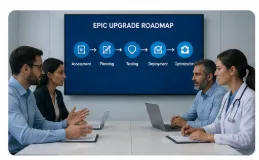
Healthcare organizations increasingly need support across planning, configuration review, regression testing, integration validation, workflow testing, training, deployment, and post-go-live stabilization.
Each phase has a different purpose.
Planning identifies what is changing and which areas carry the greatest risk.
Testing confirms that high-value workflows continue to function.
Training prepares users for visible changes.
Post-go-live monitoring helps teams identify unexpected issues quickly.
The more structured this process becomes, the less likely an upgrade is to create avoidable disruption.
AI Is Changing Upgrade Readiness
Artificial intelligence is one of the biggest reasons upgrade planning is becoming more complex.
Hospitals are adopting AI for clinical documentation, coding assistance, patient messaging, revenue cycle workflows, decision support, and operational automation.
These tools often depend on EHR data, user permissions, APIs, integration logic, and specific workflows.
An EHR change can therefore affect an AI-enabled process even when the change seems unrelated.
Health systems should include AI-connected workflows in their testing plans.
Teams should confirm that required data remains available, integrations still work, users retain appropriate access, and automated processes behave as expected after deployment.
As AI becomes more integrated into healthcare operations, upgrade readiness and AI readiness will increasingly overlap.
Workflow Testing Matters More Than Basic Technical Testing
An application can be technically available while users still encounter operational problems.
That is why upgrade testing should reflect real healthcare workflows.
Instead of simply checking whether a module opens, teams should test whether clinicians can complete documentation, place orders, review results, manage medications, schedule patients, and complete billing activities.
End-to-end testing is particularly valuable because many workflows cross multiple systems.
For example, a diagnostic order may begin inside the EHR, move to an external laboratory, and return as a result.
Testing the entire process helps uncover problems that individual application checks may miss.
Change Management Should Begin Early
Even a beneficial upgrade can frustrate users if changes appear without warning.
Healthcare organizations should identify which roles will experience visible workflow changes and communicate those changes before go-live.
Clinicians usually do not need lengthy technical release notes. They need clear, practical guidance on what will change in their daily work.
Short role-based guides, quick training sessions, and targeted demonstrations can often be more useful than broad training programs.
Post-Upgrade Monitoring Is Critical
Go-live should not be considered the end of the upgrade.
Support teams should monitor ticket volume, interface failures, application performance, user feedback, and workflow exceptions during the stabilization period.
A sudden increase in questions from one department may reveal a training gap.
Repeated interface errors may point to a technical problem.
Unexpected workflow behavior may require configuration changes.
Monitoring allows the organization to respond before small issues become widespread problems.
Upgrades Can Reduce Technical Debt
Upgrade cycles also provide an opportunity to review old customizations and workarounds.
Some configurations may have been created years earlier to solve problems that newer functionality now handles more effectively.
Maintaining unnecessary customizations increases testing requirements and makes future upgrades harder.
Health systems can use upgrade planning to determine which custom workflows still provide value and which can be simplified.
For U.S. healthcare organizations, the Epic upgrade is becoming a strategic opportunity.
When planned around workflows, integrations, AI readiness, and user adoption, an upgrade can do more than keep software current. It can strengthen the technology foundation that supports the entire health system.