
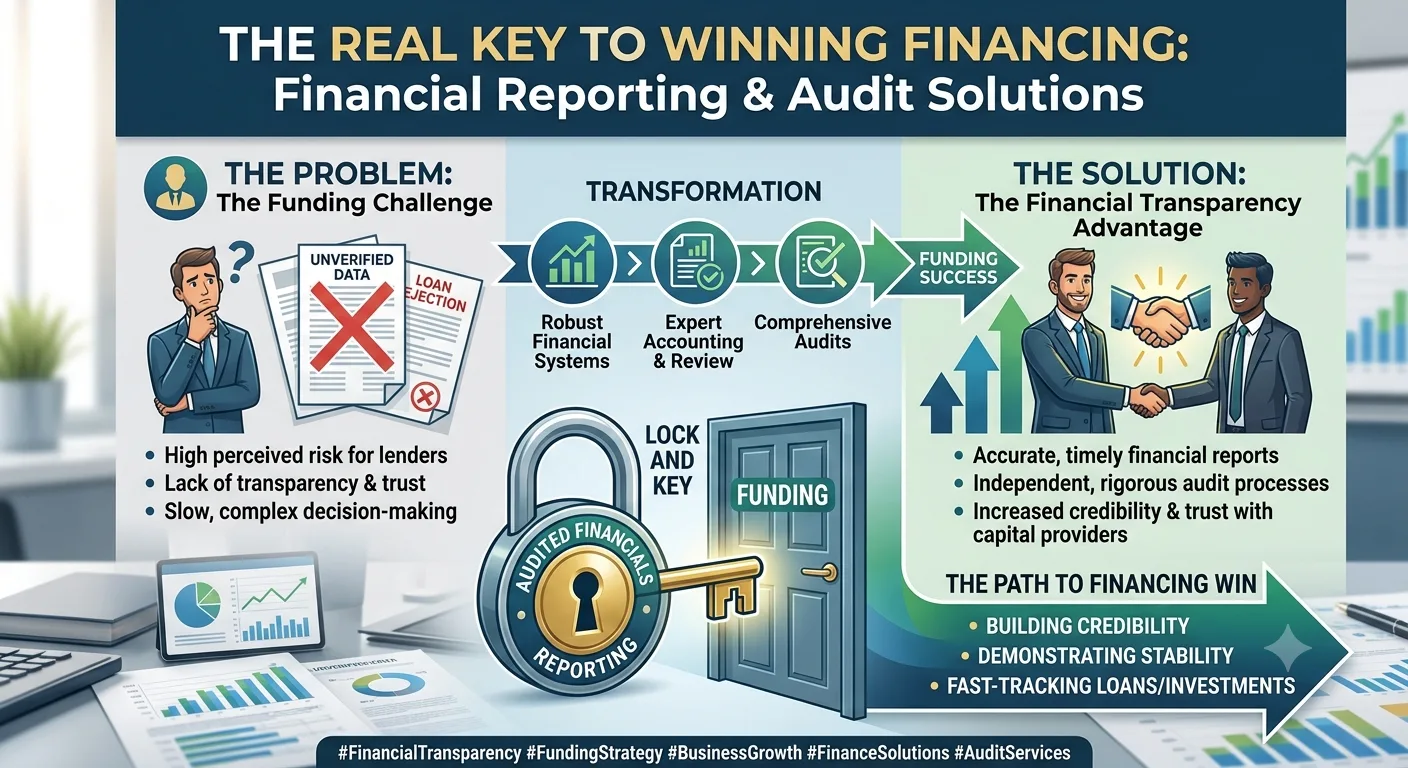
Ask any business owner who has applied for a loan or pitched an investor what the hardest part was, and most won't say the interview or the pitch deck. They'll say the numbers. According to the Federal Reserve's 2025 Small Business Credit Survey (released March 2026), only 42% of financing applicants received the full amount they sought — 36% got partial funding, and 22% walked away with nothing. Weak financials, insufficient cash flow documentation, and inconsistent records are consistently cited among the top reasons lenders say no.
Here's the part many business owners miss: the outcome of that conversation is often decided long before the application is submitted. It's decided by the quality of the financial reporting and audit solutions behind the numbers. Strong financial statements don't just describe your business — they vouch for it. Weak ones invite doubt, delay, and denial.
The Trust Gap Between You and Your Lender
Lenders and investors are, at their core, in the business of managing risk. They don't know your business the way you do, so they rely on your financial statements to tell them whether you can be trusted with their capital.
When those statements are internally prepared, inconsistent, or missing supporting documentation, lenders notice. An income statement showing revenue that doesn't reconcile with bank deposits, commingled personal and business expenses, or financials that are months out of date are all common reasons applications stall or get denied outright. Lenders view disorganised records as a proxy for how the business itself is being managed.
That's the trust gap. And it's exactly what a well-executed audit, review, or compilation engagement is designed to close.
What Financial Reporting and Audit Solutions Actually Means
Not every business needs the same level of assurance, and understanding the differences matters when you're deciding what to invest in.
Compilations
A compilation is the most basic level of service. Your CPA organises your financial data into a standard format without offering any assurance about its accuracy. It's useful for internal purposes or smaller financing needs, but it carries the least weight with sophisticated lenders and investors.
Reviews
A review involves analytical procedures and enquiries that give a CPA a basis for limited assurance that no material modifications are needed. It's a meaningful step up in credibility from a compilation, without the cost and time commitment of a full audit – a common middle ground for growing businesses.
Audits
An audit is the highest level of assurance a CPA can provide. It involves testing internal controls, verifying transactions, and independently confirming balances with third parties like banks and vendors. For loans above certain thresholds, larger investment rounds, or regulatory requirements, audited statements are often non-negotiable.
The right choice depends on your loan size, your growth stage, and who's asking to see the numbers – which is exactly why this decision benefits from a conversation with your accountant rather than a guess.
How the Right Level of Assurance Opens Doors
Faster Underwriting, Better Terms
Audited or reviewed financial statements can shorten the underwriting timeline because the lender isn't starting from scratch verifying your numbers — a licensed CPA already has. That efficiency often translates into faster approvals and, in some cases, access to more competitive rates and higher loan amounts than a business could secure with unaudited internal statements alone.
Investor Due Diligence and M&A Readiness
Venture-backed companies and businesses preparing for a sale or capital raise almost always need audited or reviewed financials to satisfy investor due diligence. If you wait until a term sheet is on the table to think about your financial reporting and audit solutions, you're already behind. Buyers and investors move faster — and negotiate harder in your favour — when the financial story is already independently verified.
Trust With Vendors, Partners, and Boards
The benefits extend past financing. Clean, professionally reviewed financials make it easier to negotiate favourable vendor terms, satisfy board or grant reporting requirements, and manage partnership transitions without the finances becoming a point of friction.
Common Financial Reporting Gaps That Undermine Credibility
Even well-run businesses fall into habits that quietly erode the credibility of their financial reporting:
- Stale statements. Lenders generally want financials no more than 60–90 days old, plus current year-to-date figures. Submitting only last year's tax return leaves a gap.
- Unreconciled numbers. If your income statement shows revenue your bank deposits don't support, that discrepancy raises questions before a lender even gets to the rest of your application.
- Commingled accounts. Personal expenses running through the business account (or the reverse) make your statements unreliable on their face.
- Inconsistent bookkeeping cadence. Financials assembled only once a year, under deadline pressure, are far more error-prone than those maintained on a regular monthly or quarterly close.
None of these are complicated fixes. They're discipline problems, and they're exactly what a good financial reporting and audit solutions partner helps you get ahead of—not just react to when a lender flags them.
Building a Strategy That Grows With Your Business
The businesses that handle financing conversations with the least friction are rarely the ones scrambling to assemble records the week an opportunity appears. They're the ones who treat financial reporting and audit solutions as an ongoing part of how they run the business — not a once-a-year fire drill.
That starts with working with a firm that customises the engagement to your actual situation instead of applying a one-size-fits-all audit process, uses modern technology to streamline the work and reduce disruption to your team, and keeps experienced professionals genuinely engaged in the details of your business rather than delegating everything to entry-level staff. The difference shows up in the quality of the finished statements — and in how quickly a lender or investor is willing to trust them.
The Bottom Line
Financing decisions are trust decisions, and trust is built on the strength of your numbers. Whether you're applying for your first line of credit, preparing for a growth-stage raise, or getting ready to sell the business you built, the financial reporting and audit solutions you invest in now are what will make that next conversation faster, smoother, and more likely to end in a yes.
The businesses that get ahead of this don't wait for a lender to ask hard questions — they've already answered them. If your financial statements haven't been reviewed by an experienced CPA in a while, there's no better time to change that than before you need to.