
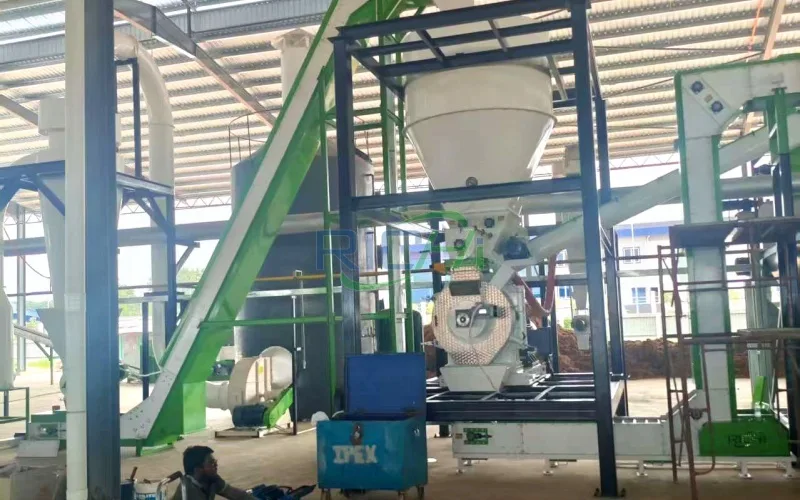
The palm oil industry has a waste problem it rarely talks about. For every ton of crude palm oil produced, roughly the same amount of empty fruit bunches (EFB) is left behind. These fibrous, moisture-heavy clusters pile up behind mills across Southeast Asia, where they slowly decompose, release methane, and occasionally catch fire in open burning piles. It’s an environmental headache that the industry has learned to live with. But it doesn’t have to be that way. EFB is not trash. It’s a dense, renewable feedstock waiting for the right technology to unlock its value.
The challenge is that EFB is notoriously difficult to process. Fresh from the mill, it contains up to 60% moisture, long stubborn fibers, and residual sand and oil. Standard pellet mills clog within minutes. Dies wear out in days. The material bridges and jams in feed hoppers. That’s why a purpose-built EFB pellet machine exists. It incorporates heavy-duty shredding, forced feeding, and specialized die designs that handle the abrasiveness and moisture without constant babysitting. The machine turns what was once a disposal cost into a uniform, high-density pellet that burns cleanly and stores for months.
At the core of the process is a simple principle: apply enough pressure and heat, and the natural lignin in the EFB fibers melts and binds everything together. No chemical additives. No binders. Just mechanical energy and careful control. The pellets that emerge are hard, shiny, and consistent, with a calorific value that rivals wood pellets. They can be burned in industrial boilers, co-fired in power plants, or used as a soil amendment after composting. The market is there. The feedstock is free. The missing link has always been the equipment.
For small mills, a compact unit might process a few hundred kilos per hour, enough to handle daily output. But palm oil mills operate at enormous scale, generating tens of tons of EFB every single day. That volume demands an automatic biomass pellet machine capable of running continuously with minimal operator intervention. These systems monitor moisture, temperature, and feed rate in real time, adjusting parameters on the fly to maintain consistent output. They also include automated lubrication, quick-change dies, and cooling sections that prevent overheating during long production runs. The result is a turnkey solution that turns a waste pile into a revenue stream.
The heart of any pellet line is the pellet maker itself. This is where the raw material becomes a finished product. The quality of the pellet maker determines the durability, density, and energy content of the final pellets. A well-designed unit features a robust gearbox, oversized bearings, and a die that can be swapped out in under an hour. It should also be matched to the specific characteristics of EFB, not just adapted from a generic wood pellet design. Getting this right is the difference between a profitable operation and a maintenance nightmare.
The economics are compelling. EFB is often available at no cost beyond collection. Pelletized EFB sells for $100 to $200 per ton, depending on the market. Power plants in Japan, South Korea, and Europe are actively seeking sustainable biomass sources, and EFB pellets fit the bill. Some palm oil mills have already installed pelleting lines and are now supplying utilities under long-term contracts. Others use the pellets to fuel their own boilers, cutting diesel and gas costs. Either way, the payback period is often measured in months.
Beyond the money, there’s the environmental case. Converting EFB into pellets eliminates open burning and reduces methane emissions from decomposing piles. It also provides a renewable alternative to coal, helping utilities meet carbon reduction targets. For an industry that faces constant scrutiny over deforestation and sustainability, this is a tangible way to improve its environmental footprint while creating economic value.
If you’re running a palm oil mill or a biomass trading business, it’s worth exploring what modern pelleting technology can do for your operation. For detailed specifications, capacity charts, and real-world case studies from mills that have made the transition, look at here now to see the full range of options. The empty fruit bunches behind your mill aren’t a problem to be managed. They’re an opportunity waiting to be pelletized.