The expansion of solar farms, wind-energy projects, transmission networks, and telecom infrastructure is increasing the demand for reliable underground cable networks. These cables carry power, data, and control signals across large project sites, making underground installation a critical part of modern infrastructure development.
However, cable installation is often limited by trenching. Creating deep, consistent trenches in varied soil conditions can slow project progress, increase labour requirements, and create bottlenecks for EPC contractors. As renewable-energy and infrastructure projects grow in scale, efficient trenching equipment is becoming more important to timely project delivery.
The trenching challenge
Underground cable installation requires more than simply digging a channel. Contractors must create trenches with the correct depth and width, protect cables during installation, and manage large volumes of excavated soil.
Site conditions can vary significantly from one location to another. Soft soil may allow faster progress, while hard or compacted ground can slow trenching and increase wear on equipment. In solar farms and transmission corridors, contractors often need long, straight trenches that maintain a consistent profile across the site.
Spoil removal is another major challenge. When excavated soil remains close to the trench line, it can obstruct cable-laying teams, create safety risks, and require additional manual handling. Efficient spoil management is therefore essential for maintaining workflow.
Why trenching affects project timelines
Trenching is frequently one of the earliest activities in cable installation. If trenching falls behind schedule, cable pulling, laying, backfilling, and testing can also be delayed.
For solar projects, delays can affect commissioning schedules and power-generation timelines. For telecom and power-transmission projects, delays may disrupt wider network-development plans. In every case, poor trenching productivity can increase labour costs, extend equipment deployment, and create coordination challenges between teams.
Efficient trenching helps contractors maintain a steady workflow. A machine that can cut consistently, remove spoil effectively, and move easily across a site allows cable installation teams to work with fewer interruptions.
The role of multi-chain trenchers
Multi-chain trenchers are designed for demanding cable-trenching applications. Unlike lighter trenching equipment, they are built to cut deeper and wider trenches while handling challenging ground conditions.
These machines typically use multiple cutting chains to excavate soil and create a defined trench profile. Their design helps contractors achieve more uniform trench dimensions, which is important for proper cable placement and protection.
A tractor-mounted configuration also offers practical advantages. It allows the trencher to move across large sites without requiring a separate self-propelled base machine, making it suitable for solar farms, wind-project sites, transmission corridors, and other expansive infrastructure locations.
Gaja 400XC: A practical example
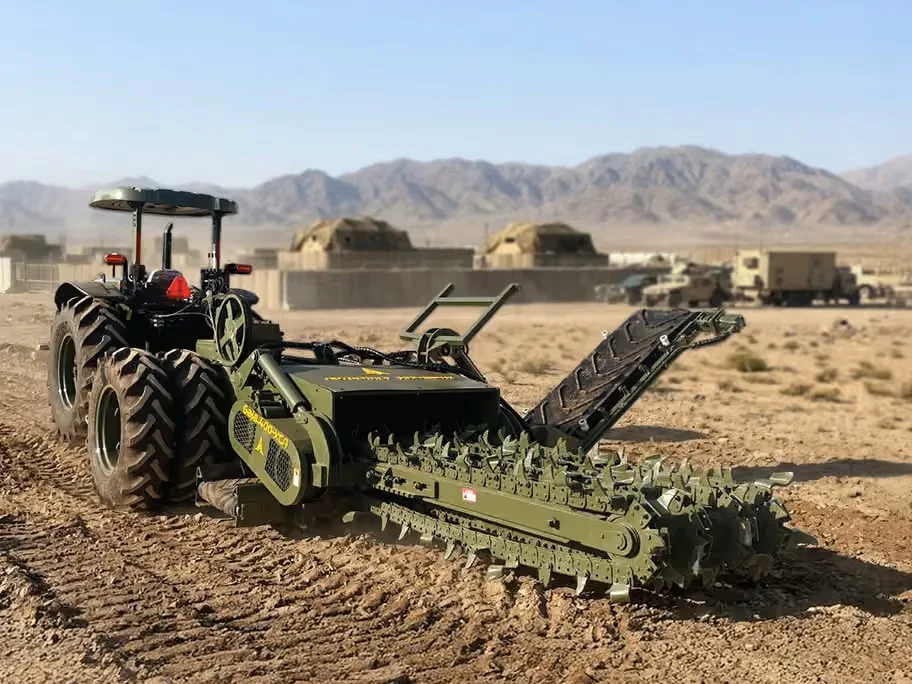
The Gaja 400XC from Autocracy Machinery is an example of a multi-chain trencher designed for heavy-duty underground cable installation. It is a tractor-mounted machine intended for projects that require deep and wide trenches.
The Gaja 400XC can create trenches from 1,200 mm to 1,500 mm deep and up to 1,200 mm wide. It uses PTO and hydraulic transmission and is designed to operate with a tractor of more than 100 HP. The machine also requires auxiliary hydraulic flow above 50 LPM.
One of its key features is the dual conveyor system, which moves excavated soil away from the trench line. This can reduce manual spoil handling and help keep the working area clearer for cable-laying teams.
The machine is designed to trench at approximately 60 metres per hour in soft soil and 20 to 30 metres per hour in hard soil. Its fuel consumption while trenching is estimated at 9 to 10 litres per hour. These specifications make it relevant for solar, wind, telecom, power-transmission, and defence infrastructure projects.
Productivity beyond cutting speed
Trenching productivity is not determined by cutting speed alone. A complete trenching solution must also consider mobility, soil conditions, spoil removal, operator control, and compatibility with the supporting tractor.
For contractors, a trencher that removes spoil efficiently can reduce the need for manual clearing and help cable-laying crews begin work sooner. Consistent trench depth and width can also reduce rework and support better cable installation quality.
Equipment selection should therefore consider the full working cycle: trench cutting, spoil movement, machine positioning, fuel use, maintenance access, and the ability to operate across varied site conditions.
What buyers should evaluate
Before selecting a trenching machine, project teams should assess several practical factors:
- Required trench depth and width for the specific cable specification
- Soil type and expected hardness across the project site
- Tractor horsepower and auxiliary hydraulic-flow capacity
- Expected trenching distance and project schedule
- Spoil-removal requirements and site-access constraints
- Operator training, spare-parts availability, and service support
- Total cost of ownership, including fuel use and maintenance
For solar EPC contractors, infrastructure developers, and utility teams, these factors help determine whether a machine can deliver the required productivity under real site conditions.
A growing need for specialised equipment
As India and other markets continue to expand renewable-energy capacity and digital infrastructure, the demand for underground cable networks will continue to rise. Solar farms, wind projects, transmission corridors, data infrastructure, and telecom networks all depend on properly installed underground cabling.
In this environment, trenching equipment is no longer just a supporting tool. It is an important part of project planning, labour management, and schedule control. Machines such as the Gaja 400XC show how specialised trenching equipment can help contractors address the practical challenges of deep, wide, and consistent cable trenching.
Conclusion
The growth of solar, wind, telecom, and power-transmission infrastructure depends not only on generating or transmitting energy, but also on building the underground cable networks that support it. Efficient trenching can reduce delays, improve site safety, and help contractors manage labour and equipment more effectively.
- solar infrastructure trenching
- underground cable installation
- renewable energy construction equipment
- multi-chain trencher
- Gaja 400XC
- solar EPC productivity
- cable trenching machine
- tractor mounted trencher
- power transmission infrastructure
- telecom cable trenching
- trench spoil removal
- infrastructure project efficiency
- trenching equipment India
- solar farm construction
- Autocracy Machinery