
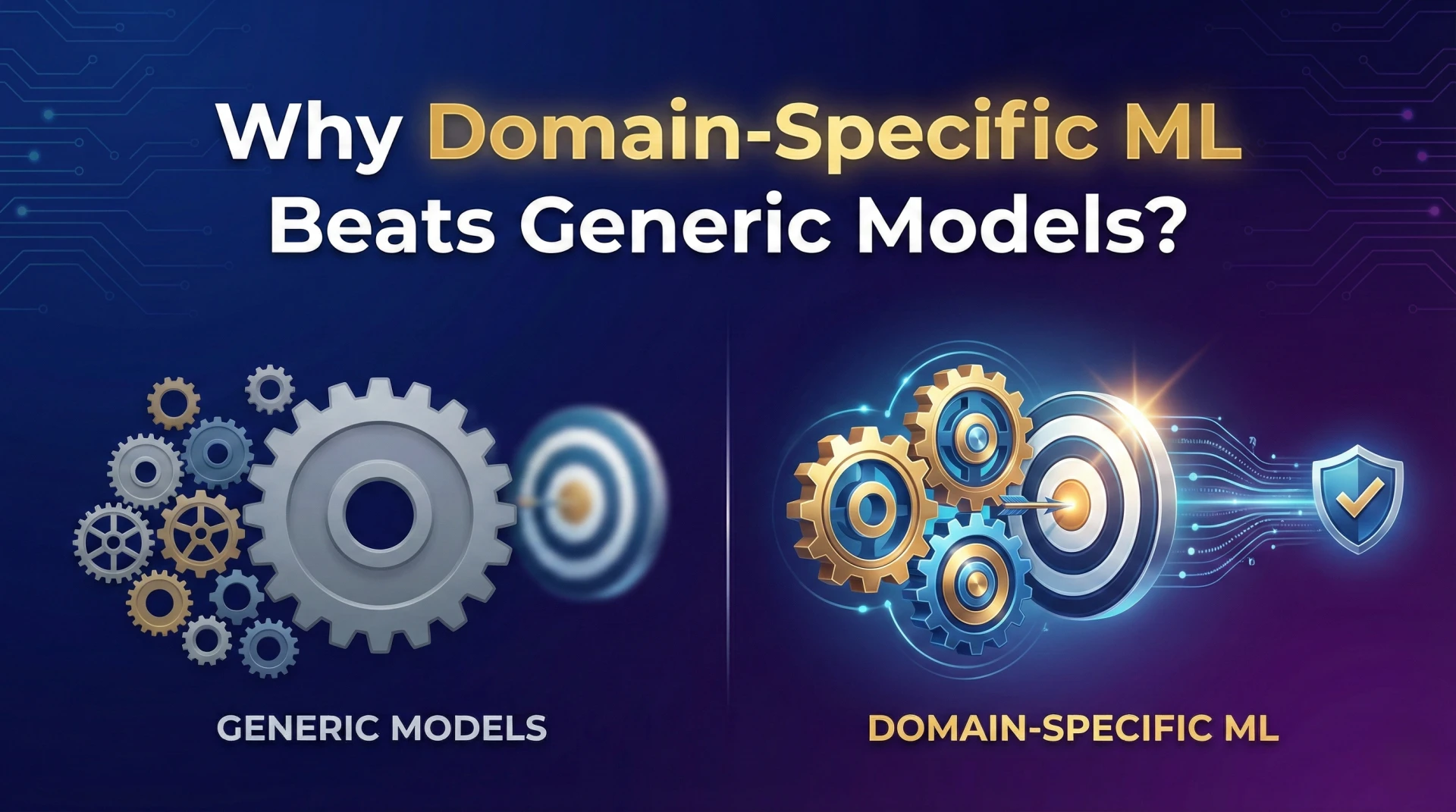
Most AI projects do not fail because the model is “too small.” They fail because the model does not understand your business reality. That is exactly why domain-specific ML keeps beating generic models in production, especially for regulated, high-accuracy workflows.
The timing is not accidental. McKinsey’s latest survey reports 88% of organizations now use AI in at least one business operations, which means competitive advantage is shifting from “using AI” to “using the right AI.” (McKinsey & Company) At the same time, the data collection and labeling market was estimated at USD 3.77B in 2024 and is expected to grow, reflecting how much value businesses place on better training data and outcomes. (Grand View Research)
This post explains why domain-specific ML outperforms generic models and how to build it without wasting cycles.
What are Generic Models in Business
In enterprise, “generic” typically refers to models trained on broad datasets, designed to be decent at many tasks but not optimized for your workflows.
Examples include:
- General-purpose classifiers trained on public datasets
- Foundation models used “as-is” with minimal adaptation
- Vendor APIs that do not reflect your taxonomy, policies, or edge cases
Generic models are useful starting points. The problem is that most business outcomes depend on the details generic training does not cover.
To decide correctly, you need a clear comparison of what changes when you move to domain-specific ML.
Domain-Specific ML vs Generic Models: What Businesses Need to Know
Domain-specific ML is built or adapted to perform well inside a defined domain: your industry, your data types, your terminology, your policies, and your edge cases.
It usually includes:
- Domain-aligned training data and feature sets
- Task-specific evaluation metrics
- Expert-guided error analysis
- Controlled deployment patterns and monitoring
Generic models aim for breadth. Domain-specific ML aims for precision, stability, and business fit.
Top Reasons Domain-Specific ML Beats Generic Models
1) Higher Precision Where It Matters Most
Generic models often look “fine” on average. The problem is that business value is rarely average.
Domain-specific ML improves:
- Rare but costly error categories
- Decision thresholds aligned to risk
- Domain language and ambiguous terms
- Edge cases that matter to your users
In high-stakes workflows, a small precision gain can cut rework, escalations, and compliance exposure.
2) Better Data Quality Produces Better Models Than More Data
Many teams try to fix performance by adding more generic data. That can backfire.
What consistently works is improving data quality:
- Cleaner labels
- More representative samples
- Reduced duplication and leakage
- Better coverage of edge cases
High data quality reduces noise and makes the model’s learning signal clearer. This is one reason domain-specific ML frequently outperforms “bigger” generic alternatives in real production tasks.
3) Labeling is Not a Cost Center, It is a Performance Lever
Most ML systems reflect their training labels. If labels are inconsistent, your model will be inconsistent too.
Strong labeling programs for domain-specific ML include:
- Clear label definitions and “what to do when unsure”
- Double-labeling for tricky classes
- Expert adjudication for disagreements
- Regular label audits and drift checks
The point is not perfection. The point is consistent signal. In practice, better labeling often delivers larger gains than model architecture tweaks.
4) Domain-Specific ML Reduces “Translation Loss” Between Teams
Generic systems create a gap between how the business describes work and how the model sees it.
Domain-specific ML closes that gap by aligning:
- Taxonomies (what categories exist)
- Policies (what is allowed or disallowed)
- Outcomes (what counts as correct)
- Failure modes (what errors are unacceptable)
This leads to fewer “we changed the policy but the model didn’t change” incidents, which is a common source of operational pain.
5) More Reliable Behavior Under Real Constraints
Generic models can behave unpredictably when:
- Inputs differ from public training patterns
- Data is noisy or incomplete
- Workflows change seasonally
- Terminology shifts
Domain-specific ML is designed for these realities. When you train and evaluate on domain conditions, you get fewer surprises. That reliability is what businesses actually pay for.
6) Stronger Explainability for Compliance and Stakeholders
Explainability is rarely about perfect interpretability. It is about providing defensible reasons and controls.
Domain-specific ML improves explainability because you can:
- Use domain features stakeholders understand
- Tie outputs to known categories and policies
- Build traceable evaluation reports
- Set different thresholds by risk tier
This is especially important in finance, healthcare, and enterprise security workflows.
7) Lower Total Cost of Ownership Over Time
Generic models feel cheaper at first. Then the hidden costs show up:
- More manual review and triage
- More support tickets due to inconsistent outputs
- More “exceptions” and shadow processes
- More time spent patching prompts or rules
Domain-specific ML often reduces these long-run costs because it fits your operating system, not just your dataset.
8) Better ROI Because You Can Measure the Right Outcomes
Generic model accuracy is usually measured in generic ways.
Domain-specific ML is measured by what the business cares about:
- Reduced false approvals
- Fewer compliance escalations
- Faster case resolution
- Higher match quality in search and recommendations
- Lower fraud loss or fewer chargebacks
When your evaluation matches your economics, iteration becomes efficient and focused.
Where Generic Models Still Win
A balanced strategy matters. Generic models can be the right choice when:
- You need a fast prototype to prove demand
- The task is broad and low-risk
- Your data is limited or too sensitive to centralize
- You do not have stable definitions for outputs yet
In many organizations, the best approach is staged:
- Start with a generic baseline
- Identify failure modes and high-value tasks
- Invest in domain-specific ML where it pays back
Once you know where specialization helps, the next question is how to build it without bloated scope.
How to Build Domain-Specific ML That Actually Performs
Step 1: Define the Domain, Task, and “Cost of Error”
Write a one-page spec that answers:
- What decision is the model supporting?
- What errors are unacceptable?
- What does “good enough” mean in production?
- Who owns the final decision?
This prevents wasted effort and keeps domain-specific ML grounded in business reality.
Step 2: Build a Data Contract Before You Build a Model
A data contract is an agreement on:
- Input formats and mandatory fields
- Output labels and definitions
- Acceptable missingness and noise levels
- How drift will be detected
This is where data quality becomes operational, not theoretical.
Step 3: Design Labeling Like a Product Workflow
Your labeling process should be repeatable and auditable.
A strong setup includes:
- Label guidelines with real examples
- A small “golden set” for calibration
- Measured inter-annotator agreement
- A queue for ambiguous items requiring expert review
This is the simplest way to reduce rework and increase domain-specific ML performance.
Step 4: Start With the Simplest Model That Meets the Target
Do not jump to complexity. Establish a baseline, then improve.
Common sequence:
- Lightweight models or fine-tuned baselines
- Feature improvements and data cleanup
- Better sampling and more targeted labels
- Calibration and threshold tuning
This keeps iteration fast, which is critical for startups and enterprise teams alike.
Step 5: Use Domain-First Evaluation, Not Just Global Scores
Create evaluation slices that match reality:
- By customer segment
- By geography or language
- By product line
- By “hard cases” and edge inputs
- By risk tier and compliance policy
This is where domain-specific ML becomes visibly better than generic models, because your reporting matches the business.
Step 6: Operationalize With Guardrails and Monitoring
In production, performance is only half the story.
Track:
- Input drift (features, vocabulary, format changes)
- Output drift (class balance shifts)
- Human override rates
- Latency and failure rates
- Post-decision outcomes (the real KPI)
This is also the right point to bring in custom machine learning development support if your internal team needs to accelerate governance, pipelines, and monitoring without slowing product delivery.
Real-World Use Cases Where Domain-Specific ML Wins
1) Customer Support Triage and Resolution
Generic models struggle with company-specific products, billing rules, and policy exceptions.
Domain-specific ML helps by:
- Classifying intent using your taxonomy
- Routing to the right team or workflow
- Suggesting solutions grounded in your knowledge base
Better labeling here directly reduces escalations and time-to-resolution.
2) Fraud, Risk, and Compliance Decisions
False positives cost user trust. False negatives cost money.
Domain-specific ML wins because it:
- Learns your fraud patterns, not public ones
- Calibrates to your tolerance for risk
- Provides audit-friendly reporting and thresholds
This is where data quality and drift monitoring matter most.
3) Recommendations and Search Relevance
Generic relevance models often miss domain intent.
Domain-specific ML improves:
- Query understanding with domain terms
- Ranking signals tied to your product goals
- Cold-start handling using domain metadata
Better outcomes show up quickly as higher conversion and engagement.
4) Document and Workflow Automation
In enterprises, documents are messy, inconsistent, and policy-heavy.
Domain-specific ML helps by:
- Extracting fields with domain context
- Classifying document types accurately
- Flagging exceptions aligned to policy
The model becomes a workflow tool, not a demo.
Final Take
Generic models help you start. Domain-specific ML helps you win.
If your goal is reliable production performance, the path is clear:
- Invest in data quality
- Treat labeling as a core capability
- Evaluate on domain slices, not just global averages
- Monitor drift and outcomes like a product KPI
In 2026, businesses that build domain-specific ML around real workflows will outperform teams relying only on generic models, because specialization turns AI from “possible” into “profitable.”