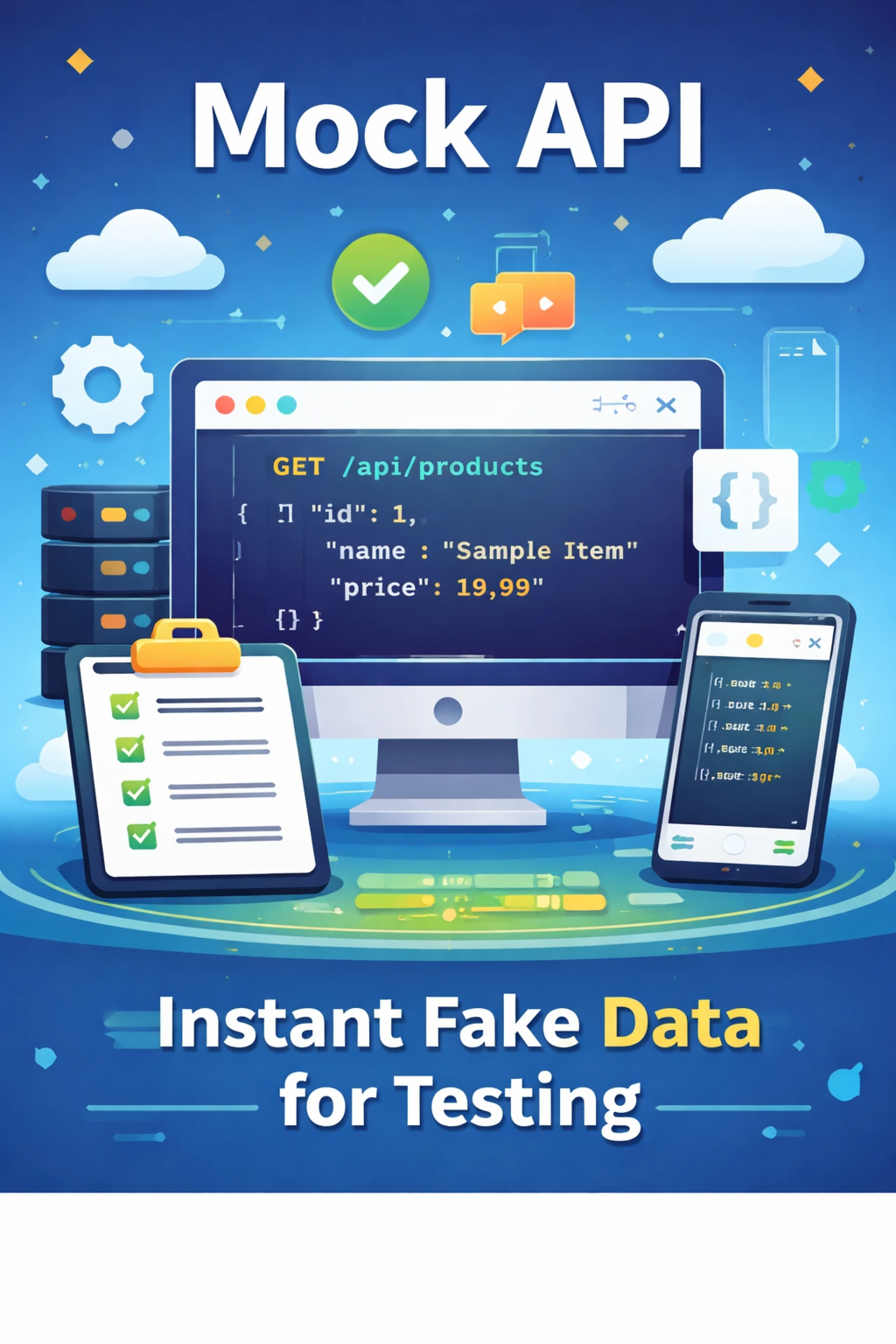
For years, developers relied on local JSON files to simulate APIs during frontend development. While this approach works for very small demos, modern applications demand more realism and flexibility. Today, most developers prefer a proper api mock server over local JSON servers for good reason.
Limitations of Local JSON Servers
Local JSON servers are static by nature. They return the same data every time, regardless of request parameters. This makes it impossible to test real-world scenarios such as pagination, filtering, role-based responses, or error handling.
As applications grow, maintaining multiple JSON files becomes messy and error-prone.
Dynamic Behavior With API Mock Server
An api mock server introduces dynamic behavior that mirrors real APIs. Requests can return different responses based on parameters, headers, or conditions.
With an Instant API Generator, developers can create multiple endpoints instantly without managing local files or scripts.
Pagination Mock API for Real UI Development
Pagination is essential for almost every data-driven application. Local JSON files cannot simulate page-based responses accurately.
A pagination mock api allows developers to test infinite scroll, page navigation, and performance-related UI decisions early in development.
AI API Generator Improves Data Quality
Repeated dummy values make it difficult to identify UI issues. An AI API Generator produces varied and structured responses that expose layout problems, overflow issues, and edge cases.
This leads to better UI quality before production APIs are available.
Team Collaboration and Consistency
Local JSON servers exist only on individual machines. This creates inconsistencies across teams. A shared api mock server ensures everyone works with the same API behavior.
This consistency improves collaboration between frontend developers, designers, QA engineers, and backend teams.
Easier Maintenance and Scalability
As projects evolve, APIs change. Updating a centralized mock server is easier than syncing multiple local JSON files across a team.
A proper mock API setup scales with the project rather than becoming a maintenance burden.
Better Testing and Debugging
Mock APIs allow developers to simulate error responses, empty states, and slow networks. These scenarios are difficult to reproduce using static JSON placeholder setups.
Testing against realistic behavior leads to fewer production bugs.
Conclusion
Developers prefer mock APIs over local JSON servers because they offer realism, scalability, and collaboration benefits. By using an api mock server with Instant API Generator, AI API Generator, JSON placeholder, and pagination mock api, teams build applications that are closer to production quality from day one.