After working across a wide range of product development projects—from dietary supplements to personal care to functional beverages—I’ve come to appreciate certain ingredients not for their trendiness, but for their formulation flexibility and supply-chain reliability.
Corn silk extract powder is one of those ingredients. I first came across it during a project that required a plant-based extract with good process compatibility and a neutral sensory impact. At the time, I didn’t think much of it beyond the functional box it checked. But over time, I started to notice how often it reappeared in different briefs—always unobtrusive, always adaptable.
It’s not a headline ingredient, but it’s quietly useful. That, in my experience, tends to be what makes it a long-term asset.
Understanding Corn Silk Extract 10:1: More Than Just Plant Residue
Corn silk, botanically Zea mays styles, refers to the thin strands found under the husk of the corn ear. Traditionally treated as a by-product, it's increasingly processed into a 10:1 extract powder, where 10 parts raw material yield one part finished extract.
In real terms, that means a highly concentrated botanical—one that offers measurable consistency while occupying less space in a formulation. From a sourcing perspective, extraction methods typically involve water or hydroethanolic processes, followed by spray drying.
What matters to clean-label brands is that reputable suppliers avoid synthetic carriers, ensure non-GMO input materials, and conduct appropriate batch testing. If you’re formulating for regulated markets like Canada, the EU, or Australia, you’ll also want to confirm allergen statements, residual solvent levels, and pesticide screening.
Functional Composition: Why It Works in Formulation
Corn silk extract powder 10:1 offers a unique combination of formulation-friendly properties, making it a practical choice across various product categories. Its natural composition includes flavonoids, volatile compounds, and plant polysaccharides, which contribute to its ease of integration.
Technically, Corn silk extract powder 10:1 provides good water dispersibility, a neutral sensory profile, and batch stability—traits that simplify both formulation and scale-up. It’s also compatible with clean-label requirements and vegan formulations.
For product developers, this translates to a reliable botanical extract that won’t overwhelm flavor systems or complicate dosage planning, making it ideal for multi-ingredient blends across supplements and beverage applications.
Here’s how that plays out in product development:
- It’s water-dispersible, which helps in beverage applications and water-based cosmetic systems.
- It has a low sensory footprint, which reduces the need for masking agents.
- The powder is stable under standard storage conditions, provided it’s kept dry and away from light.
- It aligns well with vegan and plant-derived formulation frameworks, increasingly requested by both food and beauty brands.
In R&D settings, I’ve often turned to it for its formulation simplicity—especially when developing powder blends or clear beverage bases that need low-color, low-taste botanicals.
Cross-Industry Use: Quiet Versatility
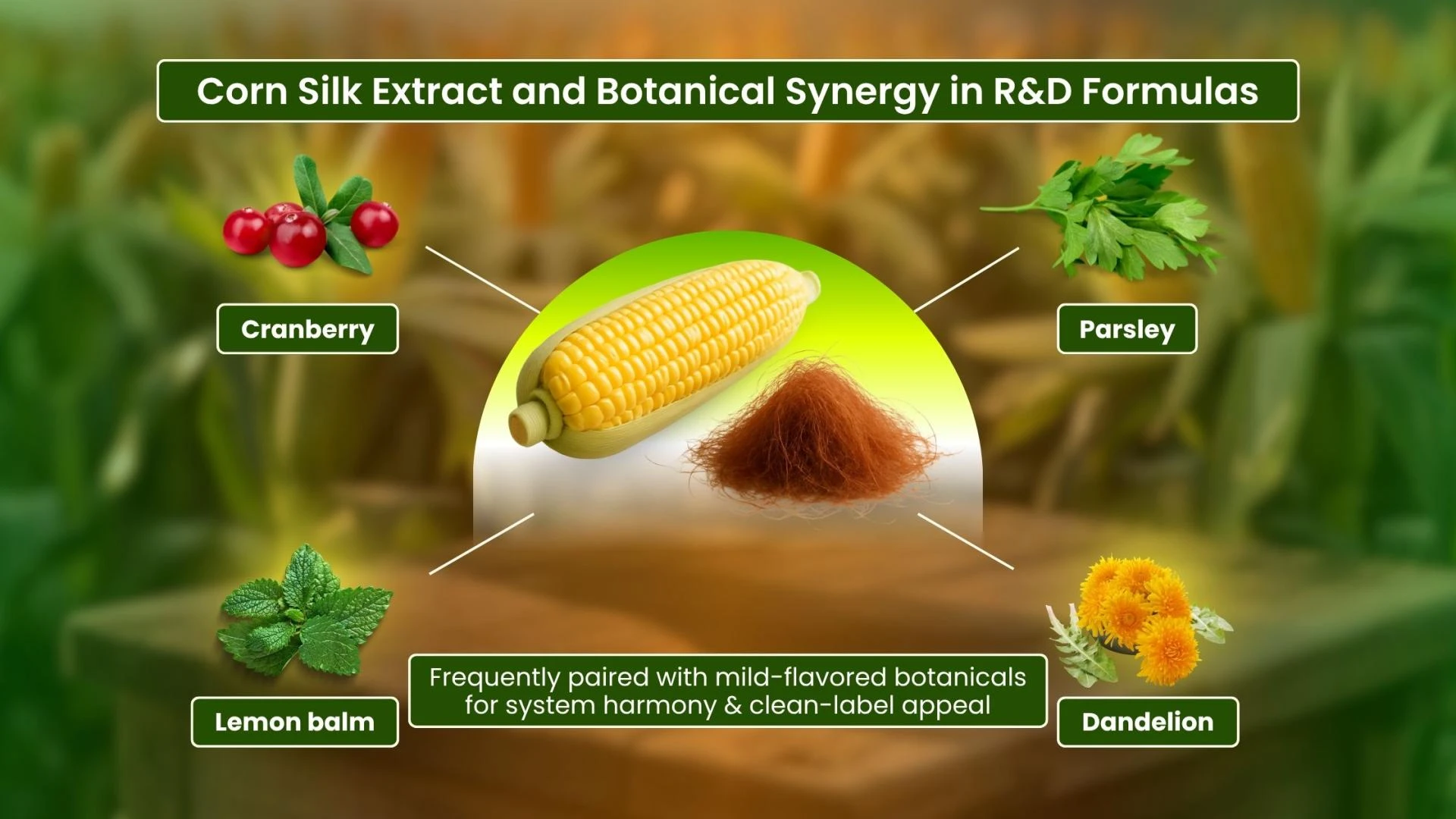
Corn silk extract 10:1 has found a place in a surprising range of formulation categories, largely due to its mild characteristics and adaptable profile. In the supplement industry, it’s used in botanical powder blends and capsule formulations.
In functional beverages, it fits easily into teas, infusions, and sachets without altering flavor. Personal care brands integrate it into water-based creams and skin-care bases, while the pet nutrition space leverages it in plant-based powder mixes. Its compatibility with various product matrices and low visual and taste impact makes it a versatile ingredient for R&D teams developing clean-label, multi-system formulations.
For functional beverages, it works well in infused waters, tea blends, and hydration powders where visual clarity and dispersibility matter. Its neutral taste profile makes it easier to pair with florals or mild citrus notes.
Personal care formulators have started exploring it for inclusion in botanical toner bases, creams, and lotions where a subtle botanical layer supports plant-based positioning. It disperses easily in emulsions and works with other aqueous-phase ingredients.
And in pet and animal nutrition, I’ve seen increased experimentation with corn silk as part of botanical ingredient stacks used in powder premixes or chew formats. The ingredient’s mild nature and plant origin align well with current formulation trends in that space.
Sourcing Considerations for Industrial Buyers
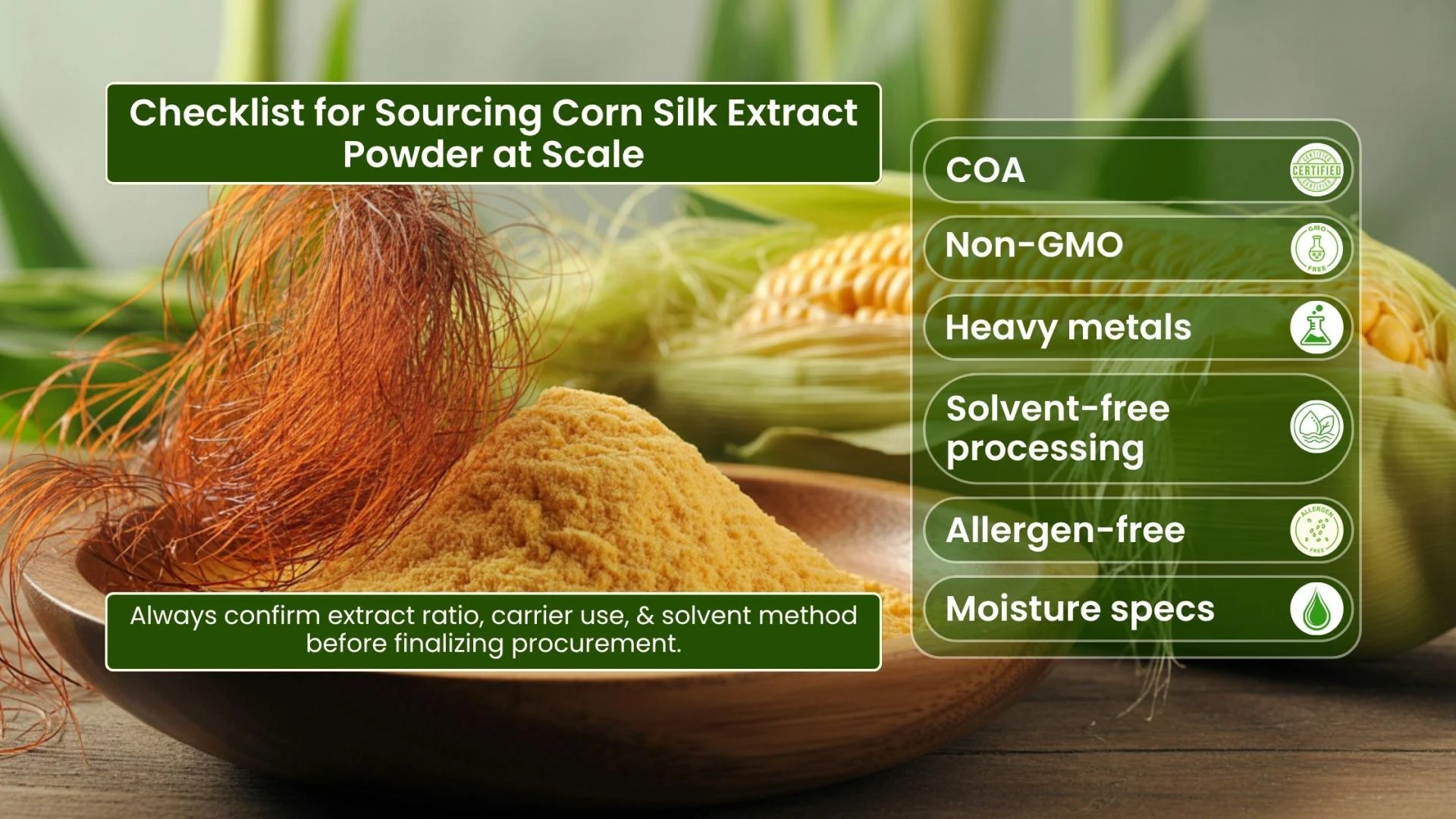
When sourcing corn silk extract powder 10:1 at scale, procurement professionals should focus on traceability, solvent system, and extract standardization. Always verify the declared 10:1 ratio with supplier documentation and ensure the absence of carriers or additives if clean-label compliance is essential.
Reputable ingredient suppliers should provide lot-specific COAs, MSDS, and reports covering heavy metals, microbiological safety, moisture content, and solvent residues. It’s also advisable to confirm allergen statements and non-GMO status, particularly for North American or EU markets.
Understanding these technical details helps reduce formulation risks, streamline QA reviews, and maintain consistent product performance across batches. If you’re sourcing corn silk extract powder 10:1 at scale, a few things are worth verifying:
- Confirm the extract ratio and solvent system—not all 10:1extract powder are processed the same way.
- Look for lot-specific COAs that include moisture, ash content, microbial profile, heavy metals, and solvent residues.
- Always request documentation upfront: MSDS, COA, non-GMO statement, Organic Cert (if applicable), and specification sheets.
- Understand the processing aids used, if any—especially if you’re targeting “no carrier” or “100% extract” claims.
- Typical MOQ is around 25 kg, but many suppliers are open to sample lots for R&D trials.
From a logistics and documentation standpoint, corn silk extract is relatively straightforward to source. But quality does vary, especially with moisture-sensitive botanicals, so storage and shipping conditions matter.
Reflections: A Quiet Ingredient That Earns Its Spot
Corn silk extract powder 10:1 probably won’t make it to your product label’s front panel. But in terms of supply-chain stability, formulation flexibility, and compatibility across systems, it’s become one of those “core ingredients” I revisit often.
In my view, some of the best formulation decisions come from choosing ingredients that don’t fight your process. Corn silk extract is one of those—it integrates cleanly, delivers consistent quality, and aligns well with the documentation and compliance needs of regulated markets.
It’s not showy. But it works. And in today’s increasingly multifunctional product space, that’s exactly what many R&D and sourcing teams need.