A batch fails a quality check. The QC laboratory identifies an out-of-specification result, and QA opens an investigation. The investigation reveals that an operating procedure was recently updated. Now, the quality team needs to confirm whether the revised procedure was approved, whether the employees were trained, and whether the correct instructions were followed during manufacturing.
Each piece of information may exist in a different software system.
The laboratory has its test results. Document control maintains the approved procedures. Training records sit elsewhere, and manufacturing has the batch execution details.
Finding the complete picture can take time, especially when these systems cannot exchange information easily.
This is one reason manufacturers are paying closer attention to connected quality management systems.
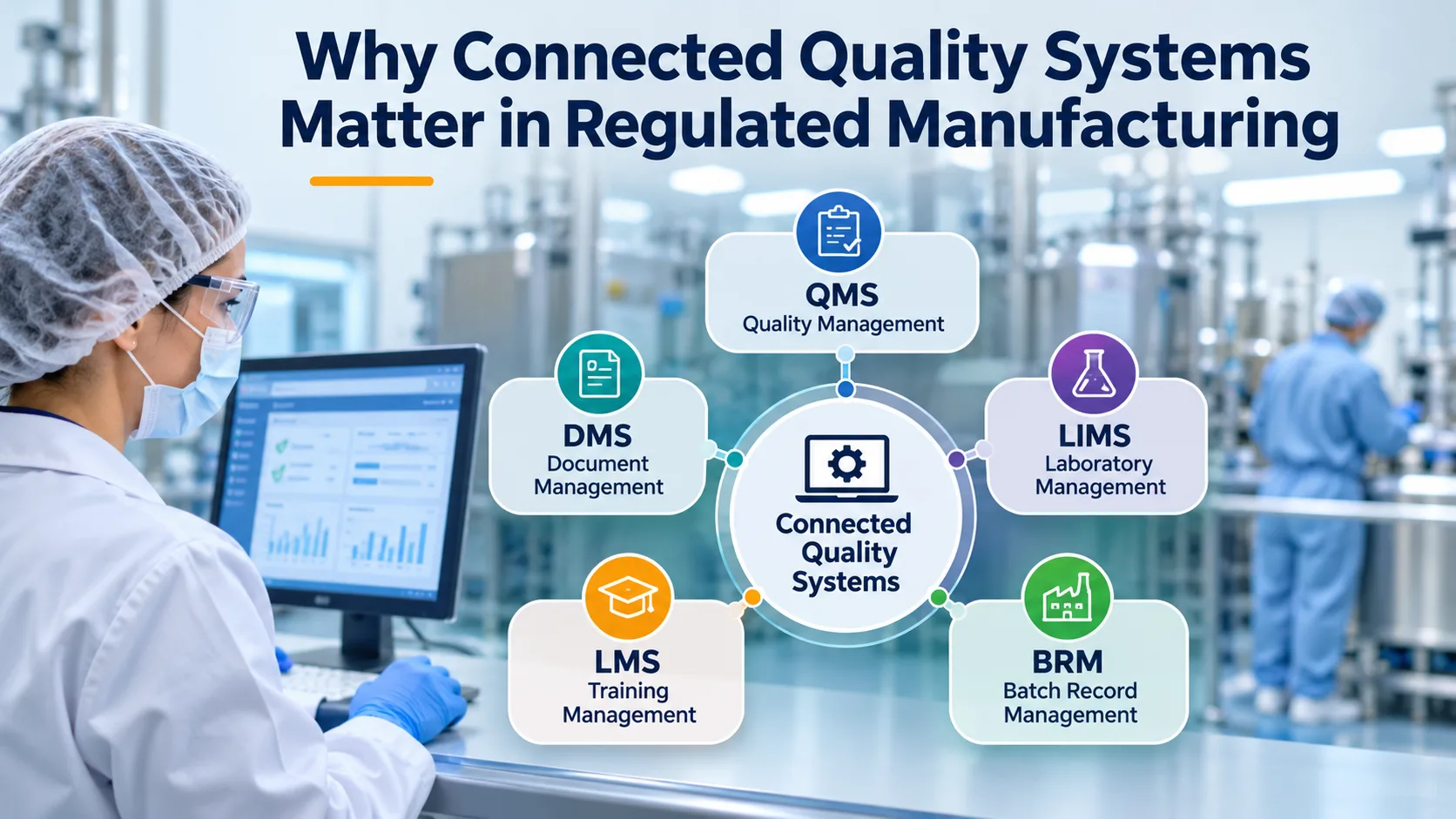
The five systems behind manufacturing quality
Different software applications handle different parts of regulated manufacturing. Understanding their roles helps explain why integration matters.
Quality Management System (QMS)
A QMS manages quality processes such as deviations, corrective and preventive actions (CAPA), change control, audits, and complaints. It helps quality teams investigate problems, assign responsibilities, and track corrective actions through closure.
Laboratory Information Management System (LIMS)
A LIMS manages laboratory workflows, including sample registration, testing, results, specifications, and approvals. It supports data traceability and gives QC teams visibility into laboratory activities.
Document Management System (DMS)
A DMS controls procedures, policies, work instructions, and other regulated documents. It maintains document versions, approval histories, and access to current instructions.
Learning Management System (LMS)
An LMS manages employee training, assessments, qualifications, and training completion records. It helps organizations establish whether personnel have completed the training required for their assigned activities.
Batch Record Management (BRM)
Electronic batch record software manages manufacturing instructions, execution records, process checks, and review activities. It helps production and quality personnel track what happened during a batch.
Each system performs a specific function. Their combined value depends on how reliably information moves between them.
What happens when these systems are connected?
Consider a change to a manufacturing procedure.
The change begins in the QMS, where QA reviews the request and assesses its impact.
Once approved, the DMS manages the revised procedure and its approval history. The LMS can then assign the necessary training to affected employees.
When manufacturing begins using the updated procedure, the batch record system can reference the applicable instructions and capture execution details.
If a laboratory result later requires investigation, the LIMS provides the relevant testing information, while the QMS manages the investigation and corrective actions.
The quality team can examine the related records without having to reconstruct the entire history through separate emails, spreadsheets, and requests.
This type of workflow can improve traceability, reduce duplicate data entry, and help departments make decisions using consistent information.
However, integration must be designed carefully. Data mapping, access controls, audit trails, validation, and exception handling remain important.
How software providers are approaching connected quality
Several enterprise software providers offer applications designed to support connected quality processes.
Caliber Technologies offers solutions across laboratory, manufacturing, and quality operations.
Its epiq QMS connects quality processes, document management through Docs-IQ, and training through Learn-IQ. Caliber also provides CaliberLIMS for laboratory workflows and CaliberBRM for electronic batch records.
For example, Caliber describes workflows in which document changes trigger training requirements and manufacturing deviations can be connected to quality investigations.
MasterControl provides quality management software covering document control, employee training, CAPA, audits, and change control. Its Manufacturing Excellence offering includes electronic batch records to support manufacturing documentation and execution.
Veeva Systems takes a unified approach through its Quality Cloud applications. These include Veeva QMS, QualityDocs, Training, and LIMS. The company describes workflows connecting laboratory testing, employee qualifications, controlled procedures, and quality events.
These offerings illustrate different ways software providers support information sharing across regulated operations.
The appropriate approach depends on an organization's existing systems, workflows, regulatory requirements, and integration needs.
What should manufacturers evaluate before investing?
Software connectivity alone does not guarantee better quality outcomes.
Manufacturers should examine how the applications will work during actual operations.
A useful starting point is to ask:
- Can a deviation investigation access the relevant laboratory and manufacturing records?
- Will document revisions trigger the appropriate training activities?
- Can users identify which document version applied to a particular batch?
- Are audit trails, electronic signatures, and access permissions appropriately controlled?
- Can the integrations be validated and maintained when applications change?
It is also worth evaluating how the systems handle incomplete data, failed integrations, and exceptions.
These situations matter because quality decisions depend on complete, accurate, and accessible records.
Connected quality starts with connected processes
Manufacturers do not necessarily need to replace every existing application to improve quality management.
A practical starting point is identifying workflows where information regularly moves between departments, such as deviation investigations, document revisions, training, laboratory testing, and batch review.
Connecting these activities can reduce unnecessary follow-up work and give quality teams a clearer view of the manufacturing process.
Ultimately, the objective is to ensure that people making quality decisions have the right information, from the right systems, when they need it.