

For businesses, commercial spray foam insulation is much more than a way to manage temperature; it's a strategic investment that directly impacts the bottom line. It delivers a significant return by drastically cutting operational costs, protecting valuable assets, and improving the durability of the building itself. By creating a complete air and moisture barrier, spray foam insulation solves many persistent problems in commercial structures like warehouses and offices, leading to lower energy bills and a more resilient physical plant. This guide explores exactly how spray foam delivers these advantages and what property owners should consider before making a decision
Slashing Operational Costs Through Energy Control
In most commercial buildings, heating, ventilation, and air conditioning (HVAC) are among the largest operating expenses. This is especially true for structures with large, open interiors like warehouses or manufacturing facilities. These buildings, often made of metal or concrete, are notoriously difficult to heat and cool efficiently due to constant air leakage and poor thermal resistance. Energy costs in some commercial buildings can make up a substantial portion of the overall budget.
Spray foam insulation directly attacks this problem at its source. Its ability to create a monolithic, airtight seal is its most powerful feature in a commercial setting.
- Eliminates Air Leakage: It expands to seal every joint, seam, and penetration in a building's envelope. This stops the massive energy loss that occurs when conditioned air escapes and unconditioned air infiltrates.
- Reduces HVAC Load: By creating a tightly sealed and well-insulated space, HVAC systems don't have to run as long or as hard to maintain the target temperature. This not only saves a huge amount on utility bills but also reduces wear and tear on expensive equipment.
- Stabilizes Interior Climates: It creates a consistent temperature throughout the building, eliminating hot and cold spots. This is critical for employee comfort and productivity, and essential for businesses that require a controlled environment for their products or processes.
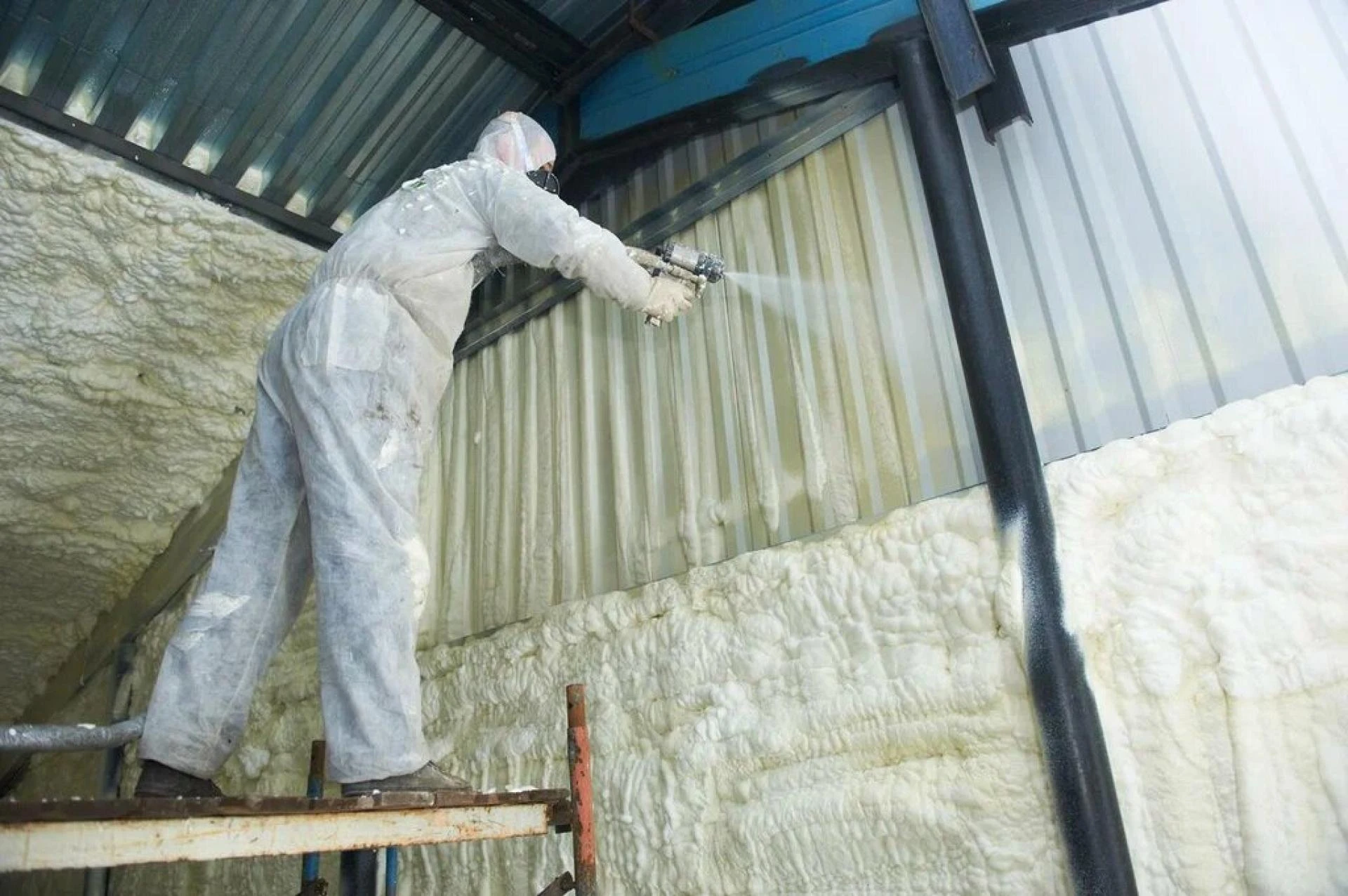
Protecting Assets with Superior Moisture and Pest Control
Beyond temperature, controlling the indoor environment is critical for protecting inventory, equipment, and the building structure itself. Moisture is a constant threat, leading to rust on metal components, damage to stored goods, and the growth of mold.
Closed-cell spray foam is an ideal solution because it functions as a vapor barrier. It has a very low permeance, meaning it resists the passage of moisture. When applied to the interior of metal or concrete walls, it prevents condensation from forming. This is a common problem when warm, humid indoor air comes into contact with a cold exterior wall.
This moisture control is vital for many types of businesses:
- Agricultural Operations: In facilities like wineries or food storage warehouses, stable humidity is essential for product quality.
- Manufacturing: Prevents rust on sensitive machinery and raw materials.
- Warehousing: Protects cardboard packaging and other moisture-sensitive inventory from damage.
Spray foam also creates an effective pest barrier. By sealing the cracks and gaps that rodents and insects use to enter a building, and being an inedible material itself, it helps maintain a cleaner and more hygienic facility.
Enhancing Building Durability and Longevity
Commercial buildings are significant long-term assets. Closed-cell spray foam contributes to their structural integrity and durability. When applied, it is a dense, rigid material that adheres tenaciously to the substrate. This adds significant racking strength to wall assemblies and roof decks, helping them resist sheer forces from high winds or seismic activity.
For the common metal buildings used in commercial and industrial applications, this added rigidity can be a major benefit, reducing flex in the panels and strengthening the overall structure. It also protects the metal from condensation and corrosion, extending the life of the building envelope. As an added benefit, applying spray foam to the underside of a commercial flat roof can also help seal small leaks, extending the life of the existing roof membrane and reducing long-term maintenance costs.
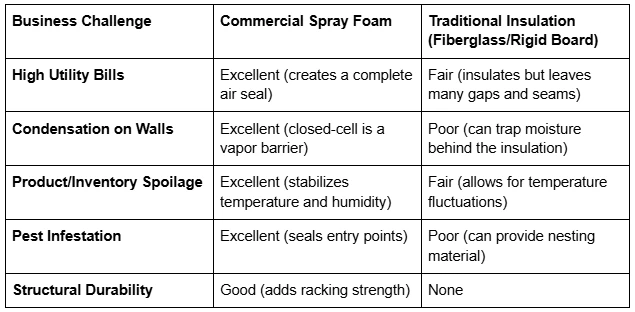
Commercial Insulation Performance Matrix
Things to Consider Before Making a Decision
For a business or facility manager, the decision to install spray foam involves a few key considerations.
Minimizing Business Disruption
The installation process requires the area to be cleared and properly ventilated. A professional contractor should be able to work with the business to create a phased installation plan that minimizes downtime, perhaps by working after hours or on weekends.
The Right Type of Foam for the Job
- Closed-Cell Foam: This is the most common choice for commercial applications. Its rigidity, high R-value per inch, and built-in vapor barrier make it ideal for walls, roofs, and foundations.
- Open-Cell Foam: This can be a good choice for sound control between office spaces or in areas where a vapor barrier is not needed.

Building Codes and Fire Safety
Commercial buildings have strict fire code requirements. Commercial-grade spray foams are manufactured with fire retardants and have specific fire ratings. They typically need to be covered by an approved thermal barrier or an intumescent coating to meet code in occupied spaces. An experienced commercial contractor will be knowledgeable about these local requirements.
Questions People Ask About Commercial Spray Foam
What is the typical ROI for a commercial project?
The payback period varies depending on the building's size, its use, and local energy costs, but it is often between 3 to 7 years. The immediate reduction in operational costs starts from the first month.
Can spray foam be applied to an existing metal building?
Yes, this is one of its most common and effective applications. The surface of the metal must be clean, dry, and free of oil for proper adhesion. The foam then creates a fully sealed and insulated interior.
Is the installation process noisy or disruptive?
The process involves spray equipment and generators that can be noisy. A professional crew will work to contain the work area and schedule the project to cause the least possible disruption to business operations.
How durable is spray foam in a high-traffic industrial setting?
Closed-cell spray foam is extremely tough and durable. Once cured, it is a hard plastic that can withstand the bumps and scrapes common in an industrial environment. In areas with very heavy traffic, it can be protected with a covering like metal paneling or plywood.
Does it help with acoustics in a large, open space?
Yes. Spray foam is very effective at reducing sound reverberation and echo in large spaces like manufacturing floors or gymnasiums. It absorbs sound instead of reflecting it, creating a quieter and more pleasant work environment.
A Strategic Business Upgrade
For business owners and property managers, commercial spray foam is a powerful tool for improving a building's performance and financial efficiency. It moves beyond simple insulation to provide a comprehensive solution for energy control, asset protection, and structural longevity. When applied by a professional spray foam insulation contractor, this system takes a systematic approach to sealing and insulating the building envelope, delivering consistent, measurable returns that make it a smart, strategic investment.
Getting a Professional Commercial Assessment
To get the most out of this strategic investment, a professional assessment is the essential first step. Every commercial building is different, and the best insulation strategy depends on its construction and how it's used. An experienced commercial insulation contractor can perform a thorough evaluation and provide a detailed proposal outlining the costs, benefits, and projected ROI. For businesses in the Fresno area looking for this expertise, Supreme Spray Foam – Fresno specializes in commercial applications. Their team can be reached at (559) 545-0800 or via email at [email protected] for a consultation.
Reviewer: Emma Robinson contributed her knowledge from 8 years working with the spray foam industry. Her review helped shape this content with ideas grounded in what contractors and homeowners actually value.