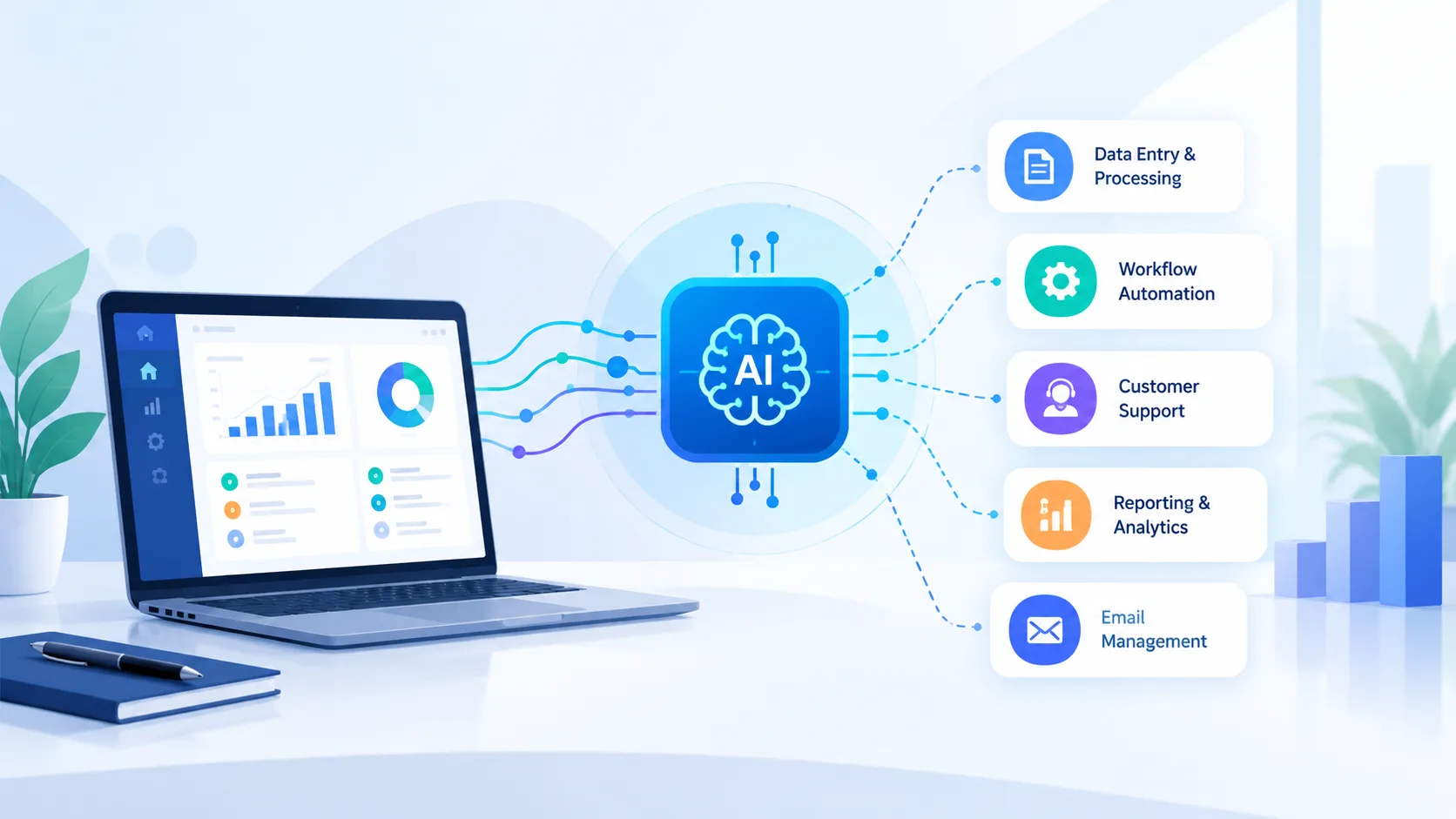
In 2026, the conversation is different. Leaders are asking which AI investments will actually pay off, how fast, and whether to buy a ready-made tool or build something of their own. More and more of them are choosing to build, and that is why custom AI development services have become one of the fastest-growing line items in business technology budgets.
This article explains why. It covers what is driving the shift, where custom AI beats off-the-shelf tools, what the work looks like in practice, and how to choose the right partner, whether that is an AI development company or a broader app development company.
The Honest Truth About Off-the-Shelf AI Tools
Generic AI tools are impressive. You can open a chatbot, paste in a question, and get a decent answer in seconds. For individual productivity, that is often enough.
Businesses run into trouble when they try to build real operations on top of those tools. Here is what usually happens:
- The tool doesn’t know your business. It has never seen your pricing logic, your customer history, your compliance rules, or the way your team actually works.
- Your data stays outside the system. The most valuable information a company has sits in its own CRM, ERP, support tickets, and internal documents. A generic tool can’t use it without careful integration.
- Everyone has the same tool. If your competitor uses the identical product, you get the identical capability, and you gain no advantage.
- Costs add up. Per-seat and per-call pricing looks cheap in a pilot and gets expensive at scale.
- Control is limited. You can’t easily change how the tool behaves, where your data goes, or how it is audited.
Many companies discovered these limits in 2025 and 2026 while running pilots. By 2026, most have moved past the “let’s experiment” phase. They now want AI that fits the business, not the other way around.
What Custom AI Development Actually Means
The term gets thrown around loosely, so here is a plain definition.
Custom AI development means designing and building AI-powered software around your specific data, processes, and goals. Depending on the problem, that might include:
- A customer-facing assistant trained on your product catalog, policies, and support history
- A forecasting engine that predicts demand, churn, or equipment failure using your own historical data
- An internal copilot that helps employees search company knowledge, draft documents, or summarize meetings
- A document-processing system that reads invoices, contracts, or claims and routes them automatically
- A recommendation engine tuned to how your customers actually behave
- An AI agent that completes multi-step tasks, such as scheduling, triaging, or reconciling records, across your existing software Often it doesn’t mean training a large model from scratch. That is expensive and unnecessary for most companies. In practice, a good AI development company combines existing foundation models with your proprietary data, careful engineering, and the right guardrails. The value comes from the integration and the fit, not from reinventing the underlying technology.
Seven Reasons Businesses Are Investing in 2026
1. Competitive advantage has moved from “using AI” to “owning AI capability”When AI was new, adopting it at all set a company apart. Now everyone has a chatbot. What separates winners from the rest is how deeply AI is woven into their products and operations, and how well it uses data that competitors can’t access.
A custom system trained on your own history of customers, transactions, and outcomes is hard to copy. That is a moat, and off-the-shelf software can’t give you one.
2. The ROI conversation has maturedEarly AI projects were often judged on novelty. Today, finance teams want numbers, and well-scoped custom projects can deliver them. Typical targets include:
- Fewer hours spent on repetitive manual work
- Faster response and resolution times
- Lower error rates in data-heavy processes
- Higher conversion from better personalization
- Reduced churn through earlier risk detection
When an AI system is built around a specific, measurable workflow, it is much easier to prove its value. Vague “AI transformation” programs tend to stall, while focused builds tend to ship.
3. Data privacy and compliance are now board-level concernsRegulation around AI and data has tightened across regions, and customers are more aware of how their information is used. Healthcare, finance, insurance, legal, and education organizations in particular can’t afford to push sensitive data through tools they don’t control.
Custom AI lets you decide where data lives, who can access it, how outputs are logged, and how decisions can be audited. For regulated industries, that control is often the deciding factor, not a nice-to-have.
4. Foundation models have become far more accessibleBuilding useful AI used to require large research teams. Today, powerful models are available through APIs and open-weight options, and the tooling around them has matured. This has changed the economics. A mid-sized company can now build something genuinely sophisticated at a fraction of what it would have cost a few years ago.
The hard part is no longer getting access to intelligence. It is applying it correctly: choosing the right model, structuring your data, designing reliable workflows, and testing thoroughly. That is exactly where professional Artificial Intelligence App Development Services earn their fee.
5. Customers now expect intelligent experiencesPeople have been trained by the best consumer apps. They expect search that understands intent, support that responds instantly at any hour, and recommendations that feel relevant. When your app or website feels static by comparison, customers notice, and they leave.
This is especially true on mobile, where attention is short and expectations are high. Businesses are increasingly working with an AI app development company to build intelligence directly into their apps, rather than bolting on a generic widget.
6. Integration is where the real value hidesMost business processes span several systems: a CRM, an ERP, a ticketing platform, spreadsheets, email, and maybe a legacy database nobody wants to touch. An AI that can’t reach those systems can only answer questions. An AI that is integrated with them can take action.
Custom development connects AI to your actual workflow. It can look up an order, check inventory, update a record, and notify the right person, all in one flow. That shift from “AI that talks” to “AI that does” is one of the biggest drivers of investment in 2026.
7. Talent and time pressureFew companies have a full in-house team of machine learning engineers, data engineers, and AI product designers. Hiring them is slow and competitive. Meanwhile, the market isn’t waiting.
Partnering with an experienced AI application development company gives businesses a faster route to a working product. They get a team that has already made the common mistakes on other people’s projects, and that matters more than most buyers expect.
Where Custom AI Is Making the Biggest Difference
Different industries are seeing different wins. Here are some of the clearest patterns.
Retail and e-commerce: Personalized product discovery, smarter inventory forecasting, and support assistants that can actually process returns and track orders instead of just linking to a help page.
Healthcare: Administrative automation (scheduling, documentation, coding support), patient communication tools, and decision-support systems that assist clinicians without replacing their judgment. Privacy and security requirements make custom builds especially important here.
Financial services: Fraud detection, document review, risk scoring, and client-facing assistants that operate within strict compliance boundaries.
Logistics and supply chain: Route optimization, demand prediction, and automated exception handling when shipments are delayed or inventory runs short.
Real estate and professional services: Lead qualification, contract analysis, and internal knowledge assistants that save senior staff hours of searching and summarizing.
Education and training: Adaptive learning paths, automated feedback, and tutoring-style assistants built on an organization’s own curriculum.
The common thread is that each win comes from tying AI to a specific business problem with specific data. Nobody got those results from a generic tool.
Build vs. Buy: A Practical Way to Decide
Custom isn’t always the right answer. Here is a simple framework.
Buy off-the-shelf when:
- The task is common and well-solved (basic transcription, generic writing help, standard analytics)
- You don’t need deep integration with internal systems
- The data involved isn’t sensitive or strategic
- Speed matters more than differentiation
Build custom when:
- The AI touches your core product or your customer experience
- Your proprietary data is what makes the output valuable
- You need strict control over security, compliance, or behavior
- You need deep integration with existing systems
- You want something competitors can’t simply purchase
Many companies end up with a hybrid: standard tools for general productivity, and custom-built systems for the processes that really drive revenue and differentiation.
What a Good Custom AI Project Looks Like
Knowing the process helps you spot a strong partner and avoid expensive surprises. A healthy project usually moves through these stages.
1. Discovery and problem definition. The best teams start by asking what business problem you’re solving and how you’ll measure success, not which model to use. If a vendor jumps straight to technology, be cautious.
2. Data assessment. Your AI is only as good as the data behind it. This stage reviews what you have, how clean it is, where the gaps are, and what privacy limits apply. It is often the most revealing step.
3. Prototype or proof of concept. Rather than committing to a giant build, a good team creates a small working version quickly. This tests assumptions with real users and real data before major money is spent.
4. Development and integration. The solution is built properly, connected to your systems, and designed with security, scalability, and maintainability in mind.
5. Testing and evaluation. AI needs a different kind of testing than traditional software. Teams should test for accuracy, consistency, edge cases, bias, and what happens when the AI doesn’t know the answer. Reliable systems are designed to say “I’m not sure” instead of guessing.
6. Deployment and training. Rollout includes helping your people understand what the system does, what it doesn’t do, and how to work alongside it.
7. Monitoring and improvement. AI systems drift as data and user behavior change. Ongoing monitoring and refinement keep performance strong over time.
The Mobile Angle: Why App Development and AI Are Converging
For many businesses, the app is where customers meet the brand, so the app is where AI delivers the most visible value. Voice and chat interfaces, smart search, personalized feeds, image recognition, and predictive notifications are all becoming standard expectations.
That is why the lines between traditional software work and AI work are blurring. A modern app development company is increasingly expected to have real AI capability, and an AI development company is expected to understand product design, user experience, and mobile performance. Businesses benefit most from partners who can do both well.
Location can matter here too. Companies in major business hubs often prefer a partner nearby for workshops, stakeholder meetings, and faster collaboration. If you’re searching for a Mobile App Development Company in New York, look for one that can show real AI work, not just a general portfolio of conventional apps. Ask to see projects where intelligence was built into the product itself and where results were measured.
How to Choose the Right AI Development Partner
The market is crowded, and nearly every agency now claims AI expertise. These questions help separate real capability from marketing.
Can they show relevant, verifiable work?
Ask for case studies, references, and specifics about outcomes, not just screenshots.
Do they start with your problem or their technology?
Strong partners ask more questions than they answer in the first meeting.
How do they handle your data?
Ask where it is stored, who can access it, how it is protected, and whether it is ever used to train third-party models.
What is their approach to testing and reliability?
If they can’t explain how they evaluate accuracy and handle errors, that is a red flag.
Will you own what they build?
Clarify intellectual property, source code, and model ownership in writing.
Are they honest about limits?
The best partners will tell you when AI isn’t the right solution, or when your data isn’t ready yet. That candor is worth a lot.
Common Mistakes to Avoid
Even well-funded projects go wrong. These are the pitfalls I see most often.
- Starting with the technology instead of the problem. “We need AI” is not a goal. “We need to cut invoice processing time by half” is.
- Trying to automate everything at once. Start with one high-value workflow, prove it, then expand.
- Ignoring data quality. Messy, siloed, or biased data produces messy, biased results.
- Skipping the human side. If employees don’t trust or understand the tool, they won’t use it.
- Treating launch as the finish line. AI systems need care and tuning after going live.
- Underestimating security and compliance. Retrofitting these later is far more costly than designing them in.
Looking Ahead
The direction of travel is clear. AI is moving from a standalone feature to the foundation of how software works. Agents that complete tasks on their own, systems that learn from every interaction, and interfaces that feel more like conversation than clicking are becoming normal.
Businesses that treat AI as a one-time experiment will keep falling behind those that build it into their operations as a long-term capability. The companies investing in custom AI today are essentially buying compounding advantages: better data, smarter processes, and products that improve with use.
That doesn’t mean every company needs a massive budget. It means every company needs a clear plan, a well-chosen first project, and a partner who understands both the technology and the business.
Final Thoughts
Businesses aren’t investing in custom AI development services in 2026 because AI is fashionable. They are doing it because the gap between generic tools and tailored systems has become impossible to ignore. Custom AI delivers measurable results, protects sensitive data, integrates with real workflows, and creates advantages competitors can’t easily copy.
If you’re considering your first project, start small and specific. Pick one problem that costs you real time or money, define what success looks like, and work with a team that is as interested in your results as in the technology.
Frequently Asked Questions
What does an AI development company do?An AI development company designs, builds, and maintains software that uses artificial intelligence, such as chatbots, predictive models, recommendation engines, and automation systems, tailored to a client’s data and goals.
How much does custom AI development cost?It varies widely based on scope, data readiness, integrations, and security needs. A focused proof of concept costs far less than a full enterprise platform. A reputable partner will scope the work and give you a realistic range after a discovery phase.
How long does it take to build a custom AI application?A prototype can often be ready in a matter of weeks, while a production-grade system with integrations and testing typically takes a few months. Timelines depend on complexity and data quality.
Is custom AI better than off-the-shelf AI tools?Neither is universally better. Off-the-shelf tools suit general tasks. Custom AI is better when you need deep integration, strong data control, or a capability that sets you apart from competitors.
What should I look for in an AI app development company?Look for proven, relevant case studies, transparent data-handling practices, solid testing methods, clear ownership terms, and a focus on measurable business outcomes.