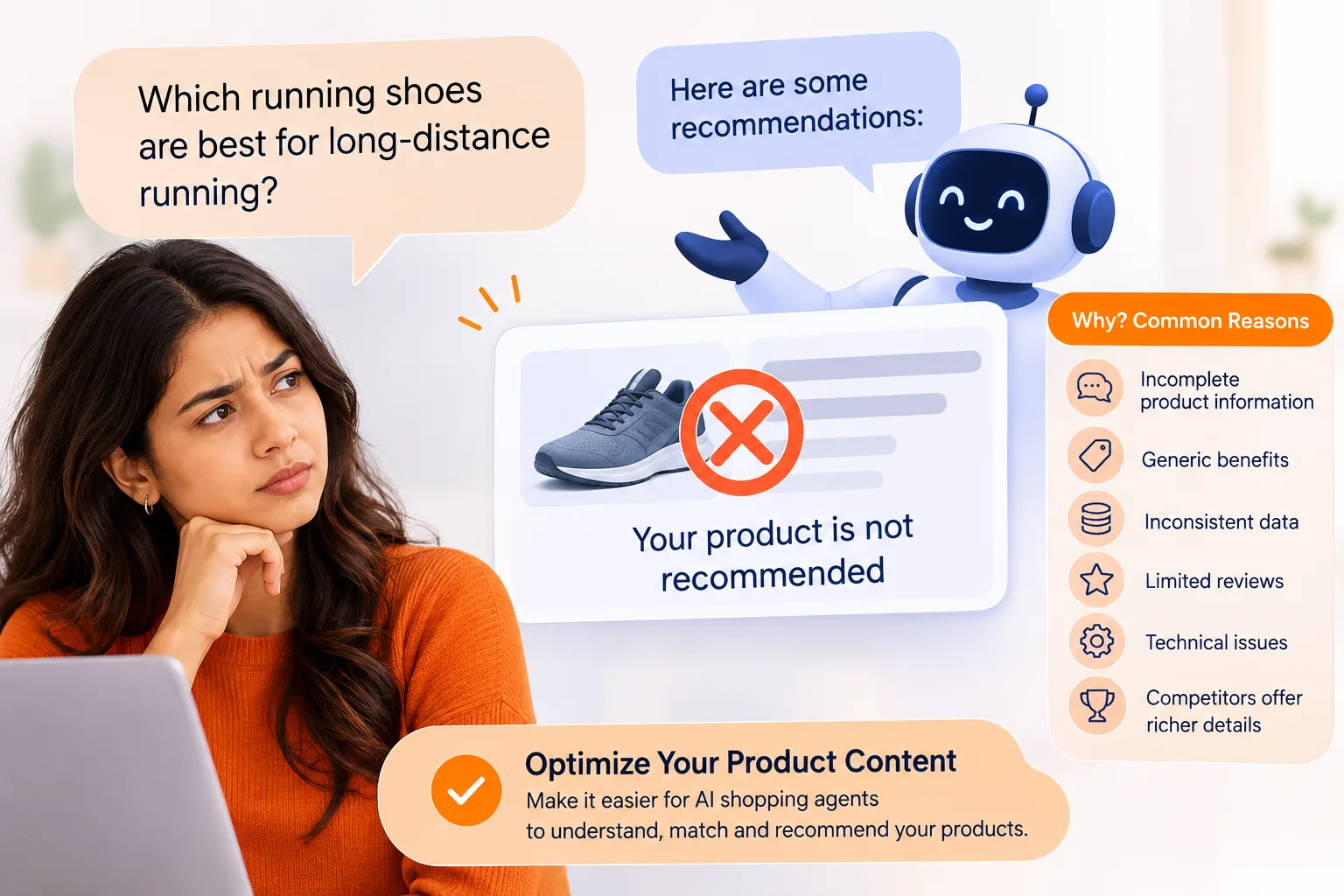
Your product may be available online, have good reviews, competitive pricing, and detailed product descriptions. Yet, when a shopper asks an AI shopping assistant to recommend a product in your category, your brand may not appear in the results.
This is becoming an important challenge for ecommerce brands.
Shopping behaviour is evolving. Consumers are increasingly using AI-powered tools to research products, compare alternatives, understand product features, and make purchase decisions. Instead of browsing multiple product pages, they can ask questions such as:
- Which shampoo is best for an oily scalp?
- What is a good laptop for video editing under $1,000?
- Which running shoes are suitable for long-distance running?
- Which sunscreen is best for sensitive skin?
AI shopping agents use available product information to understand these requests and identify suitable recommendations.
But having a product listed online does not automatically mean it will be recommended. Several factors can affect whether an AI system understands, considers, and recommends your product.
Let's look at why your product may be missing from AI-generated shopping recommendations and what you can do about it.
1. Your Product Information Does Not Answer Shopper Questions
One of the most common reasons a product may not appear in AI recommendations is insufficient product information.
Traditional product descriptions often focus on basic details such as product name, brand, size, colour, price, and general benefits. These details are useful, but they may not answer the specific questions shoppers ask AI assistants.
For example, consider a shampoo product.
A typical product description might say:
Advanced formula for healthy, strong, and beautiful hair.
But shoppers may ask:
- Is this shampoo suitable for oily hair?
- Does it help control dandruff?
- Is it safe for coloured hair?
- How frequently should I use it?
- Does it contain sulphates?
If these details are missing, unclear, or difficult to identify in the product information, an AI shopping agent may struggle to determine whether the product matches the shopper's requirements.
What brands should do: Build product descriptions around actual shopper questions. Include relevant benefits, ingredients, use cases, specifications, compatibility details, and product limitations.
2. Your Product Attributes Are Incomplete
Product attributes help AI systems understand what a product is, what it offers, and who it is suitable for.
When important attributes are missing, the product becomes harder to evaluate against a shopper's requirements.
For example, a footwear product may have a description mentioning comfort and durability, but lack important details such as:
- Material
- Sole type
- Closure type
- Arch support
- Water resistance
- Intended activity
- Available sizes
A shopper looking for waterproof hiking shoes may receive recommendations from brands that clearly provide these attributes, while products with incomplete information may be overlooked.
What brands should do: Review product attributes at the SKU level. Ensure important specifications are complete, accurate, consistent, and easy to understand.
3. Your Content Does Not Match Natural Language Queries
People do not always search using product names or traditional ecommerce keywords.
They describe their needs in everyday language.
For example:
Traditional keywordShopper queryRunning shoesWhich shoes are comfortable for running 10 km every day?Anti-dandruff shampooWhich shampoo helps with an itchy, flaky scalp?Gaming laptopWhich laptop can run demanding games smoothly?Sunscreen SPF 50Which sunscreen is suitable for oily and acne-prone skin?If your product content only targets short keywords, it may not provide enough context to match these more specific queries.
AI shopping agents need to understand the relationship between product features and shopper needs.
What brands should do: Identify the questions shoppers ask before purchasing products. Incorporate relevant use cases, benefits, and natural-language explanations into product content.
4. Your Product Benefits Are Too Generic
Many ecommerce brands use similar marketing language:
- Premium quality
- Advanced technology
- Best performance
- Long-lasting results
- Superior comfort
These statements may sound appealing, but they do not explain what makes a product different.
Consider two descriptions:
Generic description:
"Premium running shoes designed for maximum comfort and performance."
Specific description:
"Lightweight running shoes featuring a cushioned midsole, breathable mesh upper, and rubber outsole for everyday road running."
The second description provides more meaningful product information. It explains the features and intended use instead of relying on broad promotional claims.
What brands should do: Replace vague marketing statements with specific, verifiable product benefits. Explain what each feature does and how it helps the customer.
5. Your Product Information Is Inconsistent Across Platforms
Your product information may appear across your website, ecommerce marketplaces, retailer listings, product feeds, and other digital channels.
If these sources contain conflicting information, it can become harder to establish a consistent understanding of the product.
For example:
- Your website mentions a 500 ml pack, but a marketplace lists 450 ml.
- One listing describes a product as waterproof, while another does not mention water resistance.
- Product specifications differ across retailer pages.
- Product names and descriptions use inconsistent terminology.
Such inconsistencies can affect product discovery and create uncertainty for shoppers and AI systems.
What brands should do: Maintain accurate, consistent product information across all major sales channels. Regularly review product feeds, marketplace listings, and product detail pages.
6. Your Product Reviews Do Not Provide Enough Context
Reviews are an important part of online shopping because they provide real customer experiences.
A product with many positive ratings may still lack the specific information needed to answer a shopper's question.
For example, someone searching for comfortable shoes for people who stand all day may benefit from reviews that discuss:
- Comfort during extended use
- Cushioning
- Fit and sizing
- Durability
- Performance on different surfaces
A collection of generic reviews saying "Good product" or "Nice quality" provides less useful context.
What brands should do: Encourage genuine, detailed customer feedback. Organise reviews and product questions so shoppers can easily understand real-world product experiences. Never fabricate or manipulate reviews.
7. Your Product Pages Are Difficult for AI Systems to Understand
Even when your website contains useful information, its structure and technical implementation can affect how search engines and other systems access and interpret it.
Common issues include:
- Missing or incorrect Product schema.
- Important product information loaded in ways crawlers cannot access.
- Missing product descriptions or specifications.
- Incorrect canonical tags.
- Conflicting product identifiers.
- Poorly structured product pages.
- Important content available only in images.
Structured data can help search engines understand product details such as price, availability, ratings, and other relevant attributes. However, adding schema alone does not guarantee AI recommendations.
What brands should do: Improve product page structure, ensure important content is crawlable, implement accurate structured data, and maintain consistent product information.
8. Your Competitors Provide More Complete Product Information
AI shopping recommendations are influenced by how well available products match a shopper's requirements.
Imagine a shopper asking:
"Recommend a moisturiser for dry, sensitive skin without fragrance."
Your product may be a suitable option, but your competitor's listing explicitly mentions:
- Suitable for dry and sensitive skin.
- Fragrance-free formulation.
- Key moisturising ingredients.
- Dermatologically tested, where supported by evidence.
- Recommended usage.
If your product page does not communicate these details, your competitor may have a clearer information advantage.
This does not mean that the competitor will always be recommended. However, more complete and relevant product information gives AI systems better context to evaluate product suitability.
What brands should do: Benchmark your product pages against competing products. Identify missing attributes, unanswered shopper questions, and opportunities to improve product content.
How to Make Your Products More Visible to AI Shopping Agents
Improving AI shopping visibility requires more than adding keywords to product descriptions. Brands need to make their product information easier to discover, understand, and match with shopper requirements.
Here are five areas to prioritise:
AreaWhat to improveProduct contentWrite clear, detailed, benefit-led descriptions.Product attributesComplete important SKU-level specifications.Shopper query coverageAddress relevant questions and purchase requirements.Technical structureImprove crawlability, schema, and product page organisation.Competitive benchmarkingIdentify content gaps compared with competing products.Understanding the Two Important Factors in AI Shopping Readiness
Two key areas to assess when preparing products for AI shopping readiness are Agent Indexability and Shopper Query Coverage.
Agent Indexability
Agent Indexability refers to how easily AI systems and shopping agents can access, read, and understand product information.
A product page may contain valuable information, but if that information is difficult to access or poorly structured, it may not be interpreted as intended.
Brands should focus on crawlable product content, clear page structures, accurate product data, and appropriate technical implementation.
Shopper Query Coverage
Shopper Query Coverage measures how effectively product content addresses the questions and requirements shoppers may express through AI assistants.
It involves identifying relevant shopper questions and ensuring product pages provide clear, accurate answers.
For example, a skincare brand should consider questions about skin type, ingredients, product benefits, usage, and suitability rather than relying only on basic product descriptions.
Together, these areas help brands assess whether their product information is accessible and relevant to AI-driven shopping discovery.
How Enaiblex Helps Brands Improve AI Shopping Readiness
Improving product visibility in AI shopping experiences requires a structured approach to product data, content quality, and technical readiness.
Enaiblex helps ecommerce brands improve their product information through Agentic Commerce Optimization (ACO). Its approach focuses on evaluating product readiness, identifying content gaps, improving product attributes, and aligning product pages with shopper queries.
The ACO Score helps brands assess how prepared their products are for emerging AI shopping experiences, highlighting areas that need improvement.
Rather than treating every SKU equally, brands can identify priority products and focus optimization efforts where they matter most.
Final Thoughts
Your product may be excellent, but AI shopping agents need clear and relevant information to understand why it is suitable for a particular shopper.
Incomplete attributes, generic descriptions, unanswered questions, inconsistent product data, and technical issues can all limit how effectively products are understood and evaluated.
As AI-powered shopping experiences continue to evolve, ecommerce brands should start reviewing their product content beyond traditional SEO requirements.
The goal is simple: make your products easier to discover, easier to understand, and easier to match with the needs of shoppers.