
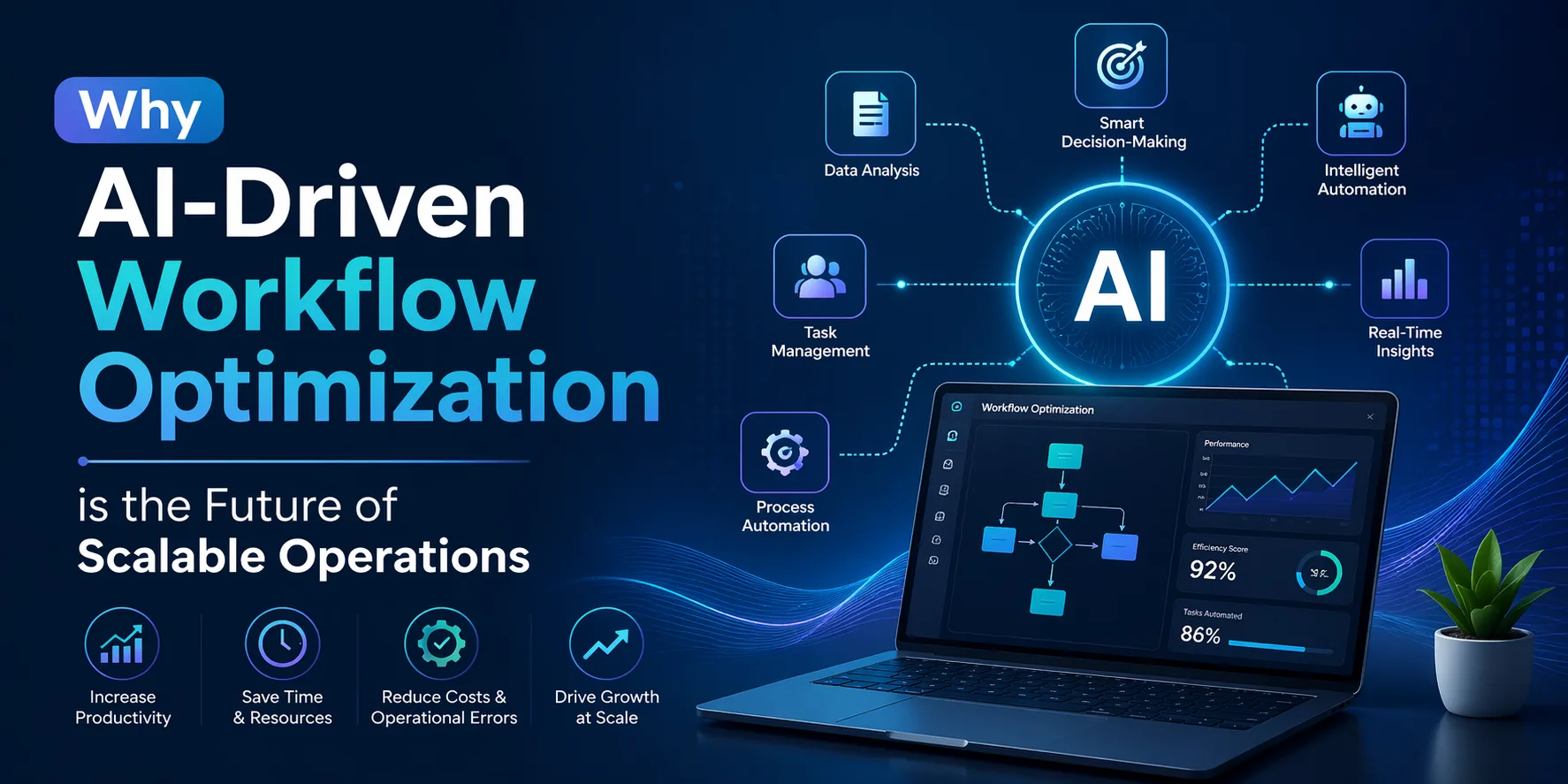
The businesses building operations that actually scale without breaking are doing it with AI-powered workflow optimization at the core not as an add-on, but as the foundation.
Scaling breaks things. Every founder knows this.
What worked at ten people stops working at fifty. What held together at fifty falls apart at two hundred. The processes that felt fine when everyone knew everyone suddenly become bottlenecks nobody can explain and nobody knows how to fix without stopping everything else.

That breaking point is not inevitable. It is the predictable result of building operations on manual processes and hoping they hold. Workflow automation services exist precisely because hope is not a scaling strategy. Across the USA the businesses that have figured out how to grow without the operational chaos are almost always the ones that stopped relying on people to hold their processes together and started building systems that do it automatically.
The Problem With How Most Businesses Currently Scale
More people. More complexity. More things falling through the gaps.
That is the standard scaling experience. Revenue grows. Headcount grows. And somewhere in the middle operational efficiency quietly starts going backwards. The team is bigger but decisions take longer. More hands are involved but output per person is lower. Something that should get easier with more resources somehow gets harder.
The culprit is almost always process infrastructure that never kept pace with the growth around it. Manual handoffs multiplying. Approval chains that made sense at a smaller size now creating delays at every stage. Work that should route automatically sitting in someone's inbox waiting for them to notice it.
Adding more people to a broken process does not fix the process. It just creates more people navigating a broken process.
What AI Changes About This Equation
Beyond Rules and TriggersTraditional workflow automation services operate on fixed logic. If this happens, do that. Simple. Predictable. Useful until something falls outside the rules and the whole system hands the problem back to a human.
Ai-powered workflow optimization works differently at a fundamental level. It does not just execute instructions. It learns from what is actually happening inside the operation. It identifies where work slows down before that slowdown becomes visible in a report. It adapts when conditions change without someone needing to rewrite the ruleset from scratch every time the business evolves.
That adaptability is what makes it a scaling tool rather than just an efficiency tool. Fixed automation helps at a fixed size. AI-driven optimization keeps working as the business grows, changes, and adds complexity.
The Compounding Effect Nobody Talks About EnoughHere is the part of this conversation that consistently gets underemphasized.
AI systems improve with data. Every process completed, every exception handled, every routing decision made teaches the system something about how that specific operation works. A business running AI-driven optimization today will have twelve months of operational learning embedded in their systems by this time next year.
That learning cannot be purchased retroactively. A competitor starting fresh at that point is not just behind on technology. They are behind on intelligence that took twelve months of real operational data to build.
Where the Real Scaling Wins Show Up
Workflow automation services applied to the right areas produce returns that compound fast.
Approval processes that scaled manually with headcount now scale automatically regardless of volume. Onboarding that depended on individual team members staying on top of each step now runs without anyone managing it. Reporting that required three people to compile now generates itself.
None of these are glamorous. All of them add up to an organization that can double in size without doubling the operational overhead that usually comes with it.
The Honest Reality of Waiting
Every month spent scaling on manual processes is a month of inefficiency baked deeper into the organization.
Fixing process debt gets harder as headcount grows. The more people who have built their work habits around a broken system the more disruptive it becomes to replace it. Starting now while the organization is still manageable is significantly easier than starting after the complexity has compounded another year.
Across the USA the businesses that scale cleanly are not the ones that got lucky with their growth. They are the ones that built the operational infrastructure to support it before they needed it.
Conclusion
Getting your operations right is one side of the growth equation.
NotionX handles the other side. It is an AI SEO tool that gets your business cited inside AI-generated answers on ChatGPT, Perplexity, and Google AI Overviews. Clean operations internally and strong AI visibility externally — both matter if sustainable growth is the actual goal.
Source: https://disquantified.org.uk/ai-business-solutions-benefits-applications-and-future-trends/