Most parents who first hear about this kind of training think of it as a party trick - the kid who can multiply large numbers in their head faster than someone else can reach for a calculator. That framing undersells it considerably, and once you understand what abacus mental math actually trains inside the brain, the speed starts to look like the least interesting part.
What happens across months of consistent practice is a form of brain development that touches concentration, memory, spatial reasoning, and academic confidence in ways that extend well beyond a math class. Understanding how the abacus works makes it easier to see why the results show up in subjects and situations unrelated to numbers.
What the Abacus Actually Trains
The abacus is several thousand years old, but the reason it still appears in modern cognitive development programmes isn't nostalgia - it's that the tool does something no calculator or worksheet can replicate.
When a child works with an abacus, they move physical beads to represent numbers and operations. Over time, with structured repetition, something shifts. The child stops needing the physical tool and starts performing the same calculations using a mental image of the beads - a visualised abacus they manipulate entirely in their head. This is what separates abacus training from standard arithmetic practice, and it's the mechanism behind most of the cognitive benefits people observe.
This mental visualisation pulls both hemispheres of the brain into action at the same time. The left hemisphere handles logic and calculation. The right hemisphere manages the spatial side - holding and moving the mental image of the abacus. Most conventional schoolwork relies almost entirely on the left hemisphere. Abacus training is one of the few learning activities that genuinely engages both sides together, which is why educators and researchers in cognitive development have paid attention to it for decades.
The Skills That Transfer Beyond Mathematics
Children who go through a structured abacus math program consistently show improvements that parents and teachers notice well outside of arithmetic lessons. These aren't coincidental - they follow directly from what the training demands.
Concentration builds because abacus work requires sustained, undivided attention.
A child performing mental calculations with a visualised abacus can't afford to be half-present. One lapse and the whole calculation collapses. Doing this repeatedly across months builds a genuine attention habit that carries into classroom listening, reading comprehension, and how a child sits with a difficult problem rather than abandoning it.
Memory strengthens for related reasons. Holding a running mental image while processing new inputs - adding or subtracting from a number mid-calculation - is a working memory exercise that gets repeated hundreds of times through a training programme. Children with strong working memory handle multi-step instructions more comfortably, retain lesson content more reliably, and feel less overwhelmed when tasks require juggling several pieces of information at once.
Processing speed improves, too, and not only for numbers. A brain trained to move quickly and accurately through mental calculations tends to become more responsive across different kinds of problems. Children often describe feeling more confident in class because answers arrive faster and with less hesitation - and that confidence compounds over time.
Why Age Matters and When to Start
The brain develops most rapidly in the early years, and the window between ages four and ten is when abacus training delivers the deepest results. This isn't about rushing children - it's about working with how the brain naturally develops rather than against it.
During these years, the brain is highly adaptable. Skills built, habits formed, and neural pathways developed in this window tend to last. A child who develops the mental visualisation skill at age six carries it forward in a way that someone who starts at fourteen simply can't replicate to the same degree. The earlier the training begins within this window, the more naturally the skill becomes embedded as a cognitive tool rather than a learned technique applied with effort.
This is also the period when a child's relationship with mathematics gets established. A child who builds real number sense and calculation confidence before age ten is far less likely to develop the math anxiety that follows so many students through middle school and beyond. The abacus doesn't just teach calculation - it shapes how the child relates to numbers, and that relationship influences how they approach the subject for years.
What Structured Abacus Math Lessons Look Like
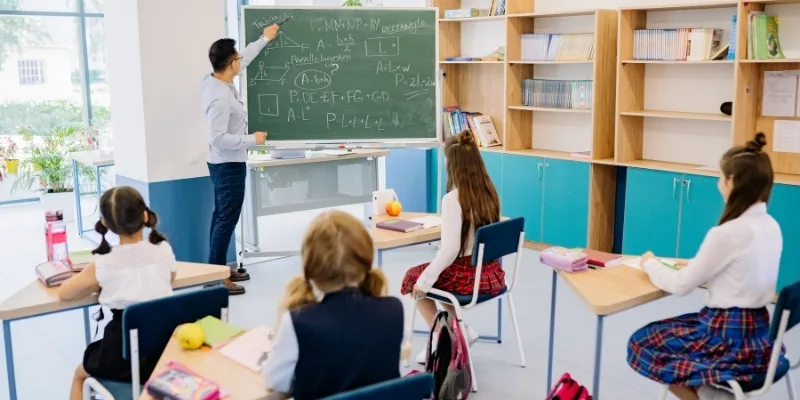
The format of abacus math lessons matters as much as the content. Small group settings - typically four to six children - mean each child gets genuine attention from the instructor rather than disappearing into a larger class. The instructor tracks where each child's mental visualisation is developing, catches hesitations before they become habits, and adjusts the pace for each student individually.
A structured programme covers the full curriculum across a concentrated timeline - one and a half hours of class per week over a year, with material that progressively deepens both physical technique and mental visualisation. Word problems are built into the curriculum so that calculation skills transfer to real academic applications rather than sit separately from school life.
Progress is visible and trackable. Parents see improvement in speed, accuracy and the complexity of problems that their child handles independently. The move from physical beads to full mental calculation has a clear trajectory, which keeps both children and parents genuinely invested in the process.
Conclusion
Abacus math delivers what it promises - not just faster arithmetic, but real improvement in how a child's brain handles information, sustains focus and builds confidence, which carries across subjects. Get a structured, accelerated abacus math program for children aged four to ten, with small group classes across Plano, McKinney, and Prosper, Texas - focused on full brain development, not just quick answers.