
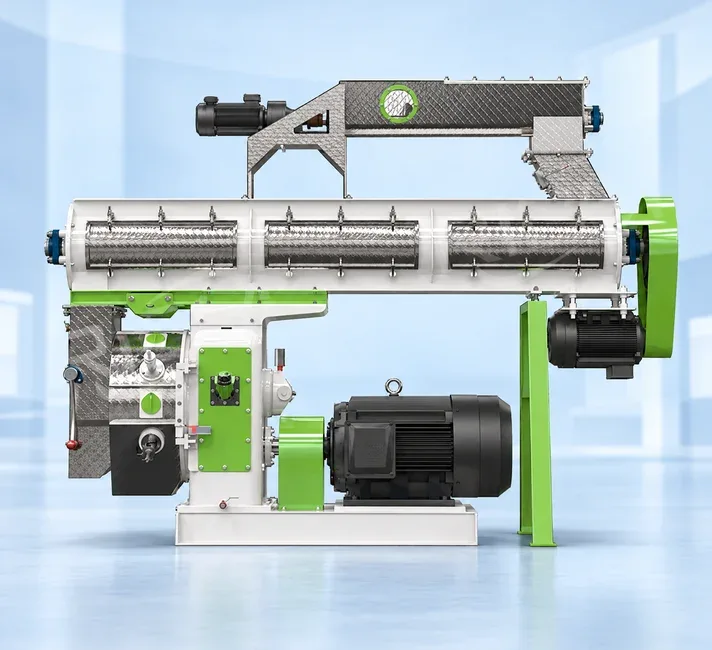
Tapioca residue looks like a simple biomass feedstock. It is fibrous, abundant, and free at the factory gate. So it is tempting to assume that any pellet press can handle it—especially a feed pellet machine that already works on grains and agricultural byproducts. That assumption usually survives until the first batch. Tapioca waste is not grain. It carries residual starch that gelatinizes under heat and pressure, turning the die into a sticky, gummed-up surface. Pellets come out soft, misshapen, or smoky. The press loses pressure. The operator blames the material. The material is not the problem.
A feed pellet machine is designed for dry, uniform, low-starch ingredients. Tapioca residue is wet, fibrous, and high in starch. The starch can act as a natural binder, but only if it is managed. Too much of it and the die clogs. Too little moisture and the pellets crack. A tapioca pellet mill built for this material uses a die compression ratio and a conditioning system that account for the starch instead of being overwhelmed by it. It also includes a feeding mechanism that handles wet, sticky residue without bridging. A repurposed feed press lacks those features, which is why it runs for a few hours and then jams.
The second difference is moisture. Tapioca residue often arrives above 60 percent moisture and dries unevenly because the starch traps water inside the fibers. A feed pellet machine expects material that is already within a narrow moisture range. A tapioca mill expects the opposite, which is why it is paired with a dryer and a grinder that are sized to match the press. If the dryer is too small, the press waits. If the grinder produces inconsistent particle size, the pellets crack. The mill cannot fix those problems alone. It must be part of a balanced line.
The third difference is corrosion. Tapioca waste is acidic and wet, and it can carry residual sugars that accelerate rust. A feed pellet machine built with standard carbon steel will corrode, and rust particles will contaminate the pellets. A tapioca pellet mill often uses stainless contact parts and accessible service points to resist that attack. The upfront cost is higher, but the cost of rejected batches and replacement parts is higher still.
The fourth difference is scale. A small processor might run a few hundred kilos per hour, but tapioca residue volumes can be significant at starch factories and snack plants. Scaling up requires more than a bigger motor. It requires a line where drying, grinding, conditioning, pressing, cooling, and screening are sized to match. That is why experienced buyers think in terms of a complete system rather than a single machine. The press gets the attention, but the line determines whether the plant runs at capacity.
Tapioca waste is not an impossible feedstock. It is a specific one. It rewards equipment that was designed for its starch and moisture, and it punishes equipment that was adapted from something else. A feed pellet machine can be part of a solution, but only if it is configured for the material and supported by the right stages. The mill is the visible investment. The line is what makes it pay.
Related post:https://pelletizerextruder.com/biomass-pellet-machine/