Businesses rarely grow through internal teams alone. Resellers, distributors, franchisees, and service partners often play an important role in reaching new markets and supporting customers.
However, expanding a partner network also creates a training challenge. Every partner needs to understand the company's products, processes, service expectations, and brand guidelines.
Managing this knowledge across multiple organizations can become complicated, especially when partners operate in different locations or serve different customer segments.
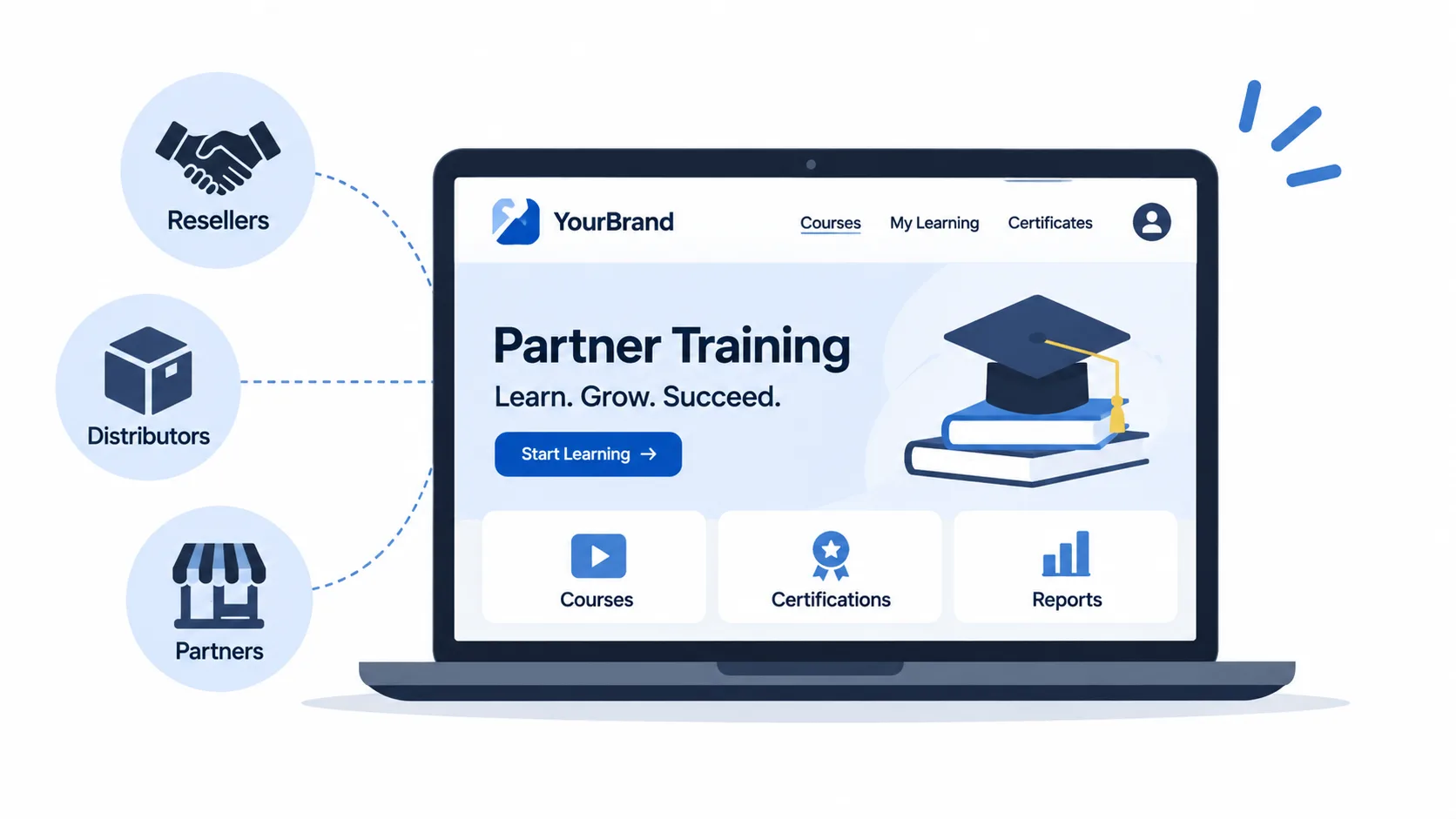
A white-label Learning Management System (LMS) helps businesses organize partner education through branded learning portals. It provides a centralized environment for distributing courses, managing access, evaluating knowledge, and tracking training progress.
Why Resellers and Distributors Need Structured Training
Resellers and distributors represent a company's products to customers. Their knowledge and ability to communicate product information can directly influence the customer experience.
Without consistent training, partners may struggle to explain product features, communicate policies, or provide accurate support.
A structured training program helps address these challenges.
Product Knowledge and Sales Readiness
Resellers need to understand product features, benefits, specifications, and use cases.
Training can help them explain product value, respond to customer questions, and communicate differences between available solutions.
Operational Consistency
Distributors may need guidance on ordering procedures, inventory management, delivery processes, and service requirements.
Providing standardized learning materials helps ensure that partners follow the same operational guidelines.
Customer Service Standards
External partners often interact directly with customers.
Training on communication standards, issue resolution, escalation procedures, and company policies can help maintain consistent service quality.
Compliance and Certification
Some industries require partners to understand specific regulations, safety procedures, or technical standards.
An LMS can help organizations assign mandatory courses, evaluate knowledge through assessments, and maintain completion records.
What Is a White-Label LMS for Reseller and Distributor Networks?
A white-label LMS is a learning platform that businesses can customize to reflect their brand identity.
Instead of asking partners to use a generic learning platform, companies can provide a branded training portal with their own logos, colors, domain settings, and other interface customizations.
For example, a technology company might create a learning portal for its authorized resellers where they can access:
- Product introduction courses
- Sales training materials
- Product demonstration videos
- Technical documentation
- Customer support guidelines
- Product certification programs
The same company may also provide a separate learning environment for distributors with different courses and operational resources.
This approach helps maintain centralized training management while accommodating different partner requirements.
Key Benefits of Using a White-Label LMS for Partner Networks
1. Deliver Training Under Your Own Brand
Brand consistency matters when external organizations represent your business.
A white-label LMS provides a more familiar environment for partners by incorporating company branding into the learning experience.
Customizable portals can help make training feel like an extension of the company's existing digital ecosystem.
2. Manage Different Partner Groups
A business may work with dozens or hundreds of resellers and distributors, each with different responsibilities.
Multi-tenant LMS capabilities can support separate learning environments, partner groups, and access arrangements.
This allows organizations to provide relevant training without making every resource available to every learner.
3. Standardize Product Training
When product education is distributed through individual emails or documents, it becomes difficult to ensure everyone receives the latest information.
A centralized LMS provides a common location for approved product courses and updated training materials.
When a new product or feature is introduced, businesses can publish updated learning resources and assign relevant courses to the appropriate partners.
4. Track Partner Learning and Certifications
Companies need to know whether partners have completed essential training.
An LMS can help administrators monitor course completion, assessment performance, and certification status.
This is particularly useful when organizations require partners to complete training before selling, installing, or supporting particular products.
5. Reduce Manual Training Administration
Managing training through spreadsheets and email often involves repetitive activities, including sending course links, tracking attendance, checking completion, and following up with learners.
Automation capabilities can simplify these processes through enrolments, reminders, notifications, and centralized reporting.
6. Support Partners Across Different Locations
Partner networks are not always concentrated in one city or country.
A web-based, mobile-friendly LMS allows learners to access training resources remotely, making it easier to support partners across different locations and time zones.
Essential LMS Features for Reseller and Distributor Training
When choosing a white-label LMS, businesses should evaluate features according to their partner management requirements.
Customizable Learning Portals
The platform should provide branding options such as logos, colors, login pages, and domain customization.
A consistent interface helps partners recognize the learning environment as part of the business they represent.
Multi-Tenant Learning Management
For organizations working with multiple partner companies, multi-tenant functionality is particularly important.
It should support separate learner groups, content access, and administrative permissions where required.
Centralized Course Management
Administrators should be able to create, organize, update, and distribute training materials from a centralized environment.
Support for different content formats, including videos, presentations, documents, and SCORM packages, can make course delivery more flexible.
Assessments and Certification Management
Product knowledge checks, technical assessments, and certification programs help organizations evaluate partner readiness.
Look for features that allow administrators to monitor assessment results and maintain training records.
Instructor-Led and Virtual Training
Not every topic can be taught effectively through self-paced courses.
Some businesses need product demonstrations, technical workshops, or instructor-led sessions.
An LMS that supports instructor-led training (ILT) and virtual instructor-led training (vILT) can accommodate these requirements alongside online learning.
Reports and Performance Tracking
Training reports help businesses understand how partners are progressing.
Useful reporting areas include:
- Course enrolments and completion
- Assessment results
- Certification records
- Learner activity
- Training participation
These insights can help training managers identify partners who need additional support.
How to Organize Training for Multiple Partner Types
A successful partner training program should reflect the different responsibilities of each partner group.
Here is an example of how businesses can structure their training.
Reseller Training
Resellers need to understand how to position products and communicate their value.
Suggested learning areas:
- Product features and benefits
- Sales conversations
- Product demonstrations
- Pricing and packaging
- Customer objections
- Competitive positioning
Distributor Training
Distributors often require more operational knowledge.
Suggested learning areas:
- Ordering and fulfilment procedures
- Inventory and product handling
- Distribution policies
- Logistics processes
- Service requirements
- Product updates
Technical and Service Partner Training
Service partners need practical knowledge to support customers and resolve technical issues.
Suggested learning areas:
- Product installation
- Technical troubleshooting
- Maintenance procedures
- Service standards
- Safety guidelines
- Technical certification
Franchise Partner Training
Franchisees need to follow consistent operational and brand standards.
Suggested learning areas:
- Brand guidelines
- Business operations
- Customer experience
- Staff training
- Compliance procedures
- Quality management
Organizing these programs into separate learning paths makes it easier to deliver relevant training to each partner group.
White-Label LMS vs. Separate Training Platforms for Partners
Some businesses use different tools for different partner groups. One platform may host product videos, another may manage assessments, and spreadsheets may track certifications.
While this approach can work initially, it often creates disconnected information.
| Requirement | Separate training tools | White-label LMS |
|---|---|---|
| Branding | Varies by platform | Consistent branded environment |
| Content distribution | Multiple locations | Centralized course access |
| Partner management | Separate processes | Organized learner groups |
| Training records | Manual consolidation | Centralized tracking |
| Certifications | Separate systems | Integrated capabilities |
| Expansion | More tools may be needed | Scalable learning environment |
A centralized platform can simplify administration, although the exact benefits depend on the LMS features and integrations available.
How SimpliTrain Helps Manage Partner Training
SimpliTrain combines learning management and training management capabilities to support organizations delivering training across different learner groups.
For companies managing reseller, distributor, and external partner networks, its customizable learning portals and multi-tenant capabilities provide options for organizing branded learning environments.
The platform also supports:
- Course creation and management
- Learning paths and learner enrolments
- Assessments and certifications
- Training progress and reporting
- Instructor-led and virtual instructor-led training
- Self-paced and blended learning
These capabilities help organizations coordinate different training formats and manage learning activities through one platform.
Businesses that work with multiple partner groups can use these capabilities to create more structured learning experiences while maintaining centralized oversight.
Choosing the Right White-Label LMS for Your Business
Before selecting a platform, consider the size and structure of your partner network.
A business with a small reseller network may primarily need branded course delivery and basic progress tracking. A company with hundreds of distributors across different regions may require multi-tenant management, role-based learning paths, certifications, advanced reporting, and automated training workflows.
Consider these questions during your evaluation:
- Can the platform support our branding requirements?
- Can we create separate learning environments for different partner groups?
- Can training be assigned according to partner roles?
- Does it support assessments and certifications?
- Can we monitor learning progress across partner organizations?
- Does it support self-paced and instructor-led training?
- Can the system scale as our partner network expands?
Evaluating these requirements before implementation can help avoid investing in a platform that only addresses basic course delivery.
Final Thoughts
Managing training across a reseller and distributor network requires consistency, visibility, and flexibility.
A white-label LMS helps businesses bring partner education into a branded learning environment while organizing courses, assessments, certifications, and training records.
The most effective solution should support more than uploading training materials. It should provide the tools needed to manage different partner groups, deliver relevant learning experiences, and monitor progress as the network grows.
With the right learning platform, businesses can make partner training more structured and create a consistent foundation for long-term partner relationships.