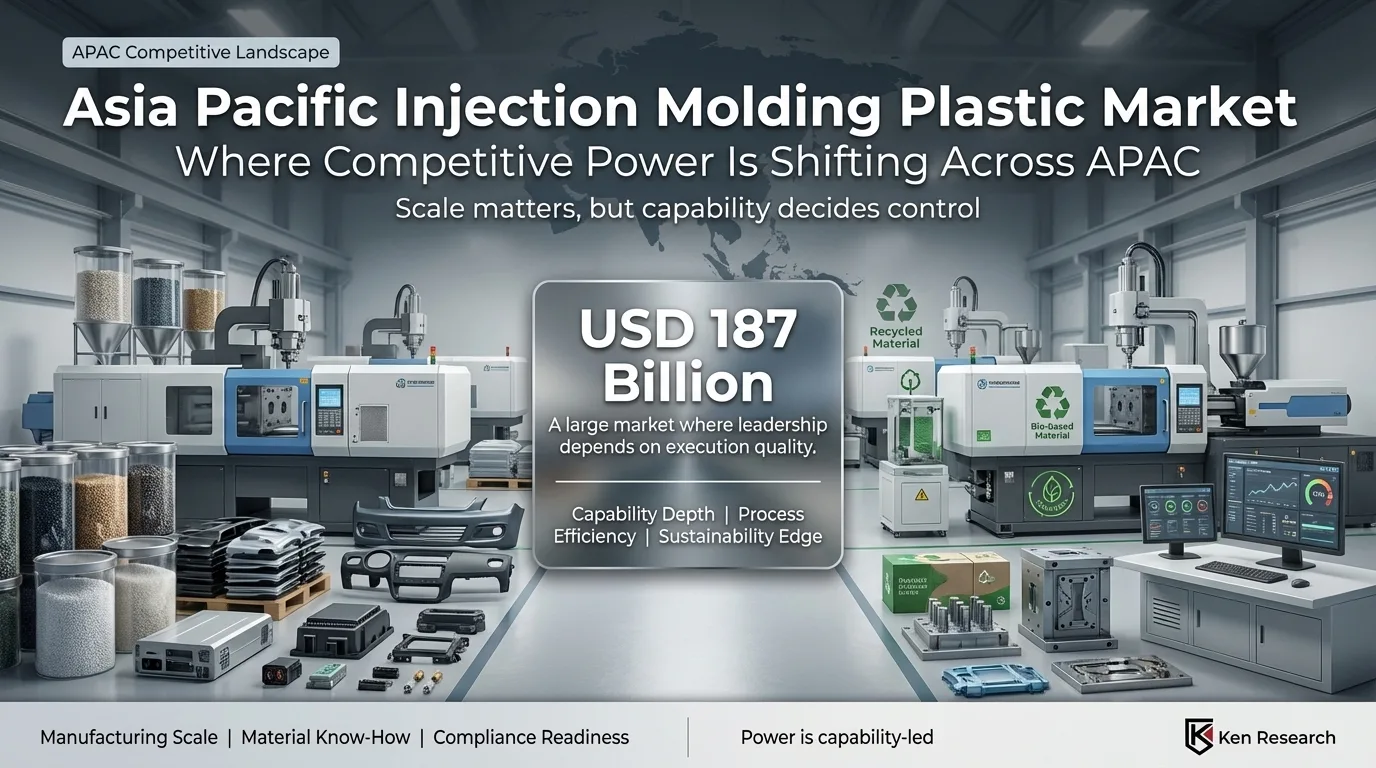
The Asia Pacific Injection Molding Plastic Market has already reached USD 187 billion, but control in this category is not built by volume alone. Competitive strength comes from manufacturing depth, material know-how, process efficiency, and the ability to stay compliant as environmental rules tighten across the region. That is why the market is best read as a capability contest. The companies active here range from Mitsubishi Chemical and Toray to LG Chem, BASF, SABIC, Lotte Chemical, Formosa Plastics, and Reliance Industries, each bringing different strengths across scale, formulation, regional presence, and supply chain access. In that setting, Ken Research becomes valuable not because it names players, but because it shows why some positions are harder to defend than they look.
Why is the Asia Pacific Injection Molding Plastic Market difficult to dominate?
This is a consolidated market, but it is not a simple one. Demand comes from automotive, electronics, healthcare, consumer goods, and construction, and each vertical rewards different capabilities. A company may have scale in commodity-grade output yet still struggle in applications that require tighter tolerances, advanced machinery, or stronger sustainability credentials.
That is why the Asia Pacific Injection Molding Plastic Market remains competitive even with large established names. Winning here means serving multiple demand environments without losing efficiency. It is not only about production volume. It is about staying relevant across changing material and customer requirements.
Which companies matter, and why do they matter differently?
The player list itself tells the story. Mitsubishi Chemical, Toray Industries, Asahi Kasei, Sumitomo Chemical, LG Chem, BASF, SABIC, Lotte Chemical, Formosa Plastics, and Reliance Industries are not competing on a single lever. Some bring resin strength. Some bring regional manufacturing depth. Some are positioned around R&D, and others around large downstream relationships.
That is why adjacent markets matter when reading competitive posture. The Asia Pacific plastic resin market helps explain cost control and feedstock logic, while the Asia Pacific engineering plastics market offers a view into performance-led applications where product sophistication can shift the value mix.
What capabilities are likely to decide competitive share?
The report’s own comparison logic is revealing. Competitive assessment is not framed only around revenue. It also looks at R&D expenditure, production capacity, material specialization, regional presence, environmental compliance, supply chain strength, and technology adoption. That is a more useful way to read the market because molded plastics increasingly sit at the intersection of cost, quality, and regulation.
The APAC injection molding plastics competitive strategy will likely favor companies that can control scrap, manage energy intensity, and respond to faster product cycles in automotive and electronics. In other words, competition is shifting from pure manufacturing breadth to execution quality.
How is sustainability resetting the competitive field?
Environmental pressure is no longer a side issue. Waste management rules, emissions pressure, and material volatility are beginning to reshape advantage. China’s industrial waste reduction push, higher energy costs, and the shift toward recycled and bio-based plastics mean players must rethink both process design and portfolio mix.
That changes the nature of market leadership. A large producer without cleaner operations or adaptable materials may still face margin pressure. By contrast, a player with better machinery, stronger compliance discipline, and a clearer path into sustainable packaging or healthcare applications may hold a stronger long-term position than its scale alone suggests.
Key Takeaways
- Competition in this market is driven by capability depth, not headline volume alone.
- The player set is strong, but their competitive strengths differ across resin access, R&D, scale, and regional positioning.
- Share will likely be shaped by production efficiency, technology adoption, and compliance readiness.
- Sustainability pressure is becoming a strategic differentiator, not just a regulatory cost.
- Adjacent resin and engineering plastics markets help explain which players may hold stronger long-term leverage.
Ken Research analysis is strongest when it treats competition here as a layered industrial contest. The next winners in the Asia Pacific molded plastics competitive landscape are likely to be the players that connect material strategy, process control, and compliance execution better than the rest.
Frequently Asked Questions
- How big is the Asia Pacific Injection Molding Plastic Market?
Asia Pacific Injection Molding Plastic Market size is USD 187 billion, which makes it one of the more consequential industrial plastics categories in the region. The Asia Pacific injection molding plastics market size matters because demand comes from automotive, electronics, packaging, healthcare, and construction at the same time.
- Who are the key players in the APAC injection molding plastics market?
The APAC injection molding plastics market includes Mitsubishi Chemical, Toray Industries, Asahi Kasei, Sumitomo Chemical, LG Chem, BASF, SABIC, Lotte Chemical, Formosa Plastics, and Reliance Industries. The APAC injection molding plastics company landscape is defined by who can combine scale, regional reach, and material capability most effectively.
- What makes competition in the Asia Pacific injection molding plastics industry so intense?
The Asia Pacific injection molding plastics industry is intensely competitive because leadership depends on more than output volume. The Asia Pacific injection molding plastics competition outlook is shaped by R&D strength, supply chain resilience, environmental compliance, and the ability to serve high-growth sectors such as automotive and electronics.
What will influence future leadership in the APAC molded plastics market?
The APAC molded plastics market will likely reward companies that can lower waste, manage energy use, and move into higher-value applications with cleaner material strategies. That makes the APAC molded plastics strategic outlook increasingly dependent on operational quality rather than scale alone.