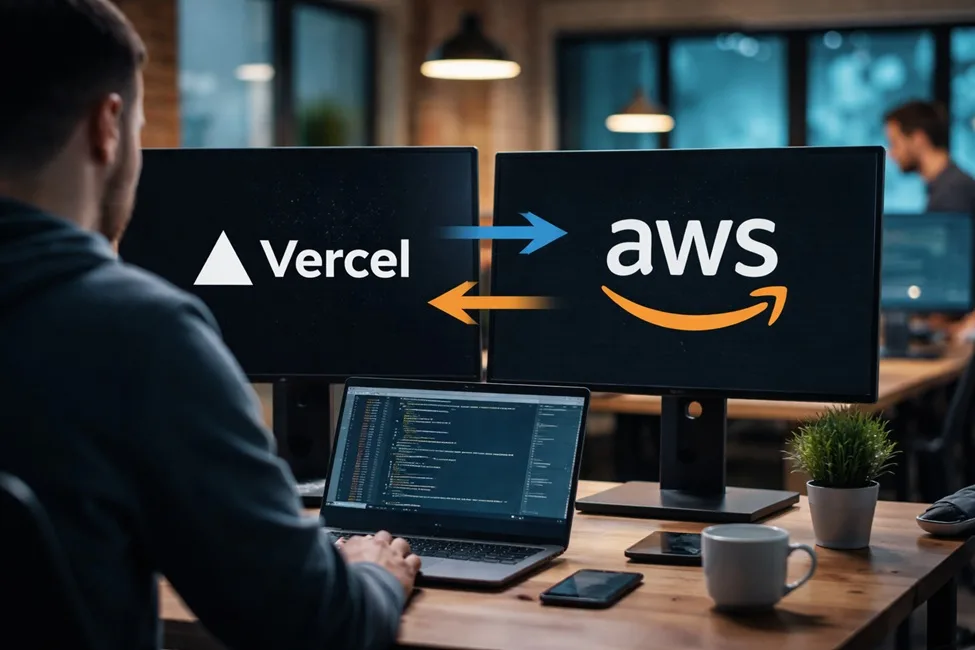
Modern development teams often begin with platforms like Vercel because of their simplicity and speed. However, as applications grow, many organizations start to evaluate whether it is the right long-term solution. If you are planning to migrate from Vercel to AWS, it usually means your project has reached a new stage where scalability, cost control, and infrastructure flexibility matter more than convenience.
This article explores the key signals, industry trends, and practical considerations that indicate when it is time to make that transition.
The Rise of Vercel and Its Early Advantages
Vercel has become a popular choice among developers, especially those working with modern frameworks like Next.js. Its streamlined deployment process, built-in optimization, and developer-friendly interface make it ideal for startups and early-stage products.
Industry data shows that millions of developers use frameworks like Next.js, with a large portion hosted on Vercel due to its tight integration and ease of use.
In the early stages of a product, speed of development is often more important than infrastructure control. Vercel allows teams to launch quickly, iterate faster, and focus on frontend performance without worrying about backend complexity.
However, this convenience comes with trade-offs that become more visible as the application grows.
The Scale Challenge: When Growth Changes Everything
One of the most common reasons companies move away from Vercel is scaling limitations. While Vercel handles small to medium workloads efficiently, larger applications often encounter constraints.
Infrastructure Limitations
Vercel abstracts much of the infrastructure, which is helpful at first but restrictive later. For example:
- Limited backend flexibility
- Constraints on execution time and memory
- Lack of native WebSocket server support
These limitations can force teams to rely on third-party services, creating a fragmented architecture.
Backend Complexity
As applications evolve, they often require:
- Long-running processes
- Complex APIs
- Data processing pipelines
Vercel’s serverless model is optimized for short-lived functions, which may not be suitable for these use cases. In contrast, AWS provides a wide range of services designed for complex backend systems.
Cost Becomes a Serious Concern
Cost is another major factor that drives the transition.
At small scale, Vercel pricing is predictable and manageable. However, as traffic increases, costs can rise rapidly due to:
- Bandwidth overages
- Function execution limits
- Team-based pricing models
For example, bandwidth overages can reach significant levels per additional usage, and high-traffic applications often exceed plan limits quickly.
Comparative analyses show that AWS can be more cost-efficient at scale due to its pay-as-you-go model and granular pricing controls.
Additionally, serverless pricing on AWS allows teams to pay per request, with charges as low as fractions of a dollar per million requests.
This pricing flexibility becomes critical for high-growth applications.
Industry Trends Favor Flexible Cloud Infrastructure
The broader cloud market also reflects a shift toward platforms like AWS.
- AWS holds roughly one-third of the global cloud market, making it the leading provider worldwide
- It is more widely adopted than Vercel across industries and enterprise environments
In addition, modern application architectures are increasingly built on serverless and cloud-native systems. Reports indicate that a large percentage of production workloads now use serverless technologies.
This trend highlights the importance of flexibility, scalability, and integration capabilities, areas where AWS excels.
The Need for Full Control Over Infrastructure
As companies mature, control becomes more important than convenience.
With AWS, teams gain access to:
- Custom networking and private environments
- Fine-grained security configurations
- Multi-region deployments
- Integration with databases, analytics, and AI services
In contrast, Vercel operates as a managed layer with limited customization options.
Many developers describe Vercel as a platform that simplifies deployment but restricts deeper infrastructure control. AWS, on the other hand, allows teams to design systems tailored to their exact needs.
This level of control is essential for enterprise applications and complex systems.
When Performance Requirements Increase
Performance needs evolve as user bases grow.
Vercel excels at frontend performance and edge delivery. However, backend-heavy applications may require:
- High compute power
- Long execution times
- Advanced caching strategies
- Data-intensive processing
AWS provides services that support these requirements, including scalable compute instances and advanced serverless configurations.
In high-volume scenarios, AWS handles large request loads more efficiently, while Vercel may encounter plan limits or increased costs.
Integration and Ecosystem Considerations
Another key factor is ecosystem compatibility.
Many companies already use AWS for:
- Databases
- Storage
- Machine learning
- Analytics
Keeping everything within a single ecosystem reduces latency, simplifies architecture, and improves operational efficiency.
Developer insights suggest that integrating applications within AWS often leads to better performance and easier management compared to combining multiple external services.
Signs That It Is Time to Transition
Not every project needs to leave Vercel. However, several clear indicators suggest it may be time:
Rapid Traffic Growth
If your application is experiencing consistent growth in users and requests, scaling limitations and cost increases will become noticeable.
Increasing Backend Complexity
When your app requires advanced backend logic, microservices, or long-running processes, Vercel may no longer be sufficient.
Rising Costs
If monthly expenses are growing faster than the value generated, it is a strong signal to evaluate alternatives.
Need for Custom Infrastructure
Applications that require custom networking, compliance, or security configurations benefit from AWS flexibility.
Team Expansion
Larger teams often need more control over deployment pipelines and infrastructure, which AWS supports better.
The Learning Curve Trade-Off
It is important to acknowledge that AWS comes with a steeper learning curve.
Vercel is designed for simplicity. AWS is designed for power.
This means:
- More configuration effort
- Greater responsibility for architecture
- Increased need for cloud expertise
However, many teams find that the long-term benefits outweigh the initial complexity, especially for production-grade systems.
Balancing Simplicity and Scalability
The decision is not about choosing one platform as universally better. It is about choosing the right tool for the current stage of your application.
Vercel remains an excellent choice for:
- Prototypes
- Marketing websites
- Small to medium applications
AWS becomes more suitable for:
- Large-scale SaaS platforms
- Data-intensive systems
- Enterprise applications
Understanding this distinction helps teams make strategic decisions rather than reactive ones.
Final Thoughts
Every successful product eventually reaches a point where its infrastructure must evolve. What worked during the early stages may no longer support long-term growth.
Moving away from Vercel is not a failure of the platform. It is a natural progression for applications that demand more control, scalability, and cost efficiency.
By recognizing the signals early and understanding industry trends, teams can make informed decisions and build systems that are ready for the future.