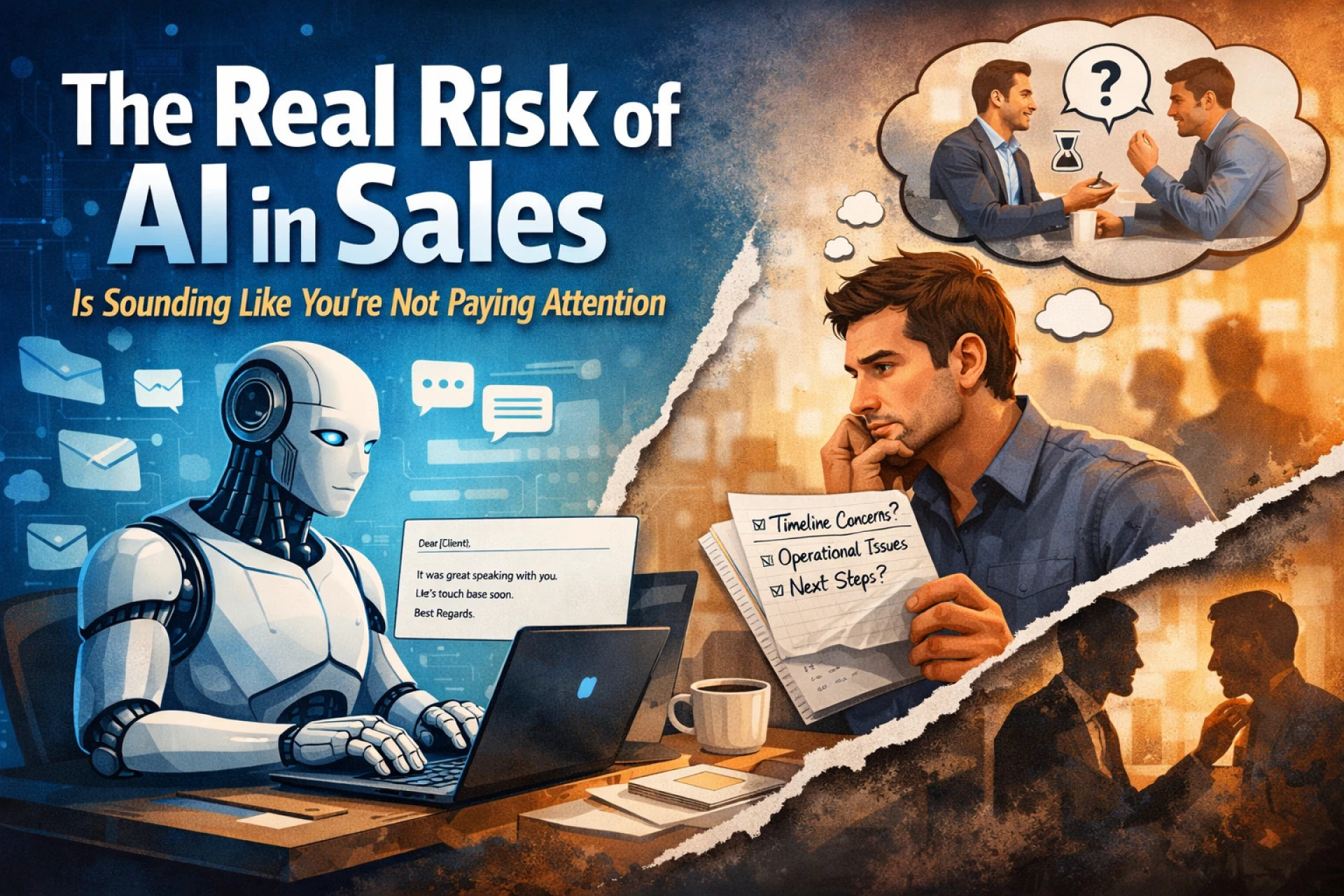
A prospect once replied to a follow-up email with four words: 'Did you write this?'
The seller had used AI to draft it. The message was clean, well-structured, and covered the right topics. It also contained nothing specific to the conversation they had actually had. No reference to the operational challenge the prospect mentioned at the end of the call. No acknowledgment of the timeline concern they had raised twice. Just a polished block of text that could have been sent to any company in any industry.
The prospect noticed. And once they noticed, the credibility of the relationship took a hit that a better follow-up could not fully repair.
This is the real risk of AI in sales, and it is not the one most people talk about. The risk is not that AI will replace sellers. The risk is that sellers will use AI in a way that makes them sound like they are not really paying attention.
The Input Problem Nobody Talks About
Most training on AI for sales focuses on the prompt. Write a better prompt and you get a better email. That is true as far as it goes, but it misses the more fundamental issue.
AI produces generic output because sellers give it generic input. A prompt that says 'write a follow-up email after a discovery call with a CFO at a mid-size manufacturing company' will always produce something that sounds like a follow-up email after a discovery call with a CFO at a mid-size manufacturing company. It will sound exactly like every other email that came from the same prompt.
The quality of the output is determined by the quality of what you bring to the conversation before you ever open the AI tool. Sellers who get strong results from AI-assisted follow-ups are not better at prompting. They are better at briefing.
A brief is different from a prompt. A brief is the thinking you do before you write. It captures what was actually said, what actually matters, and what you actually want the person on the other end to feel when they read the message. When that brief is specific and honest, AI becomes a capable first-draft tool. When the brief is thin, the output is thin regardless of how the prompt is worded.
A Simple Briefing Structure
Before handing any follow-up task to AI, a seller should be able to answer four questions. Not in writing if they prefer, but clearly enough to put into a prompt with real substance:
- What specific thing did this person say that matters? Not the category of concern. The actual words or the actual situation they described.
- What did we agree on, or what is genuinely open, as a next step? If there is no clarity here, the follow-up will paper over it rather than resolve it.
- What do I want this person to feel when they finish reading? Reassured? Curious? Ready to move? That emotional intention shapes tone in ways that generic instructions cannot.
- Is there anything in this relationship I need to protect? A sensitivity, a preference, a previous misunderstanding, something that requires careful handling.
When a seller brings these four answers to a prompt, the output reads differently. It contains the prospect's situation, not a version of a generic situation. It reflects a real conversation, not a template of a conversation. And because the seller's thinking is in it, it sounds like the seller wrote it, because in the ways that matter most, they did.
Three Follow-Up Types and How to Approach Each
Not all follow-ups are asking the same thing of AI, and the briefing approach shifts slightly depending on what the message is trying to accomplish.
After a discovery call, the goal is not to pitch. The goal is to reflect back what was heard in a way that makes the prospect feel understood. The brief for this type of follow-up should lean heavily on the prospect's own language. If they described a problem in a specific way, that specific language should be in the brief and, where appropriate, in the message. Generic paraphrasing signals that the seller was listening for categories, not for the actual person.
After a proposal, the most useful follow-up is not a restatement of the proposal. The prospect has the document. What they often need is acknowledgment of the thing they did not quite say out loud during the presentation. The hesitation. The concern they framed as a question. A seller who can name that thing clearly in a brief gives AI something meaningful to work with, and the result is a message that addresses the real conversation rather than restating the formal one.
Re-engagement after silence is the most delicate type. The brief here needs to include an honest answer to why reaching out again makes sense now. If the reason is just that it has been thirty days and the CRM sent a reminder, that will show in the output. If there is a genuine reason, a relevant update, a shift in circumstances, something the seller learned that changes the picture, that reason belongs in the brief and it gives the message its credibility.
For each of these, there is one human check that should happen before the message is sent. Read it aloud. Not to check for errors, though that helps too, but to hear whether it sounds like you at your best. If it does not, the brief was not specific enough, and it is worth going back rather than sending something that sounds almost right.
Protecting Your Voice While Using AI
Every seller has a way of communicating that their best clients recognize and trust. Some are direct and concise. Some are warm and conversational. Some lead with data. Some lead with story. That voice is a competitive asset, and it is worth protecting when AI is in the process.
One practical way to protect it is to give AI an example. Not just instructions about tone, but an actual message you wrote that represents how you communicate at your best. AI calibrates to examples more accurately than it calibrates to tone descriptions. 'Sound like this' works better than 'be conversational.'
Teams that have built a shared voice standard, a set of principles, examples, and language guidelines that capture how the team sounds, can include that standard in every sales prompt and maintain consistency across the whole team, not just the individuals who happen to be strong writers. That kind of infrastructure is what turns AI from a solo productivity tool into a team-level asset. The Brand Voice Architecture is built specifically for this, helping teams translate their actual communication strengths into a format AI can consistently apply.
Building a Sales Prompt Library That Actually Gets Used
The reason most sales prompt libraries fail is that they are collections of templates rather than collections of thinking. A template tells AI what structure to follow. A library entry that works captures the brief structure, the voice notes, and an example output for a specific scenario.
The most sustainable way to build this library is through the work itself. When a follow-up gets a strong response, save the brief that produced it alongside the email. When a re-engagement message lands well, note what was in the brief. Over time, the library becomes a record of what actually works for this team with these buyers in this market.
Review it quarterly. Retire entries that are no longer relevant. Add entries as new scenarios emerge. The library is only as useful as it is currently, and a library that reflects last year's buyers rather than this year's is worse than no library at all because it gives sellers false confidence.
The Actual Skill
Using AI well in sales is not fundamentally a technology skill. It is a communication skill. The sellers who get the most out of it are the ones who are most honest about what actually happened in a conversation and most intentional about what they want to happen next.
AI handles the drafting. The seller still has to do the thinking. And in a complex sale, the thinking has always been the hard part.
The follow-up that wins is the one that makes the prospect feel that the seller was genuinely present in the conversation, remembered what mattered, and is engaging with the real situation rather than running a process. AI can help produce that message. It cannot substitute for the attention that makes the brief specific enough to get there.