The Market Has Matured, and So Should Your Expectations
The consumer drone market in 2026 looks nothing like it did five years ago. What was once a niche hobby for tech enthusiasts and professional filmmakers has become a mainstream tool for travel vloggers, real estate agents, hobbyist photographers, and even casual hikers who want cinematic footage of their weekend trips.
With that growth comes a wider range of options and, inevitably, a wider range of quality. Not every drone that advertises "4K video" delivers the same results. Not every obstacle-avoidance system performs equally in dense environments. And not every brand offers the same level of post-purchase support.
Let's get into it.
Sensor Size and Resolution: Numbers Alone Do Not Tell the Full Story
Nearly every camera drone on the market now advertises 4K resolution. That specification has become table stakes. But resolution is only one part of image quality, and treating it as the sole metric leads to disappointing results.
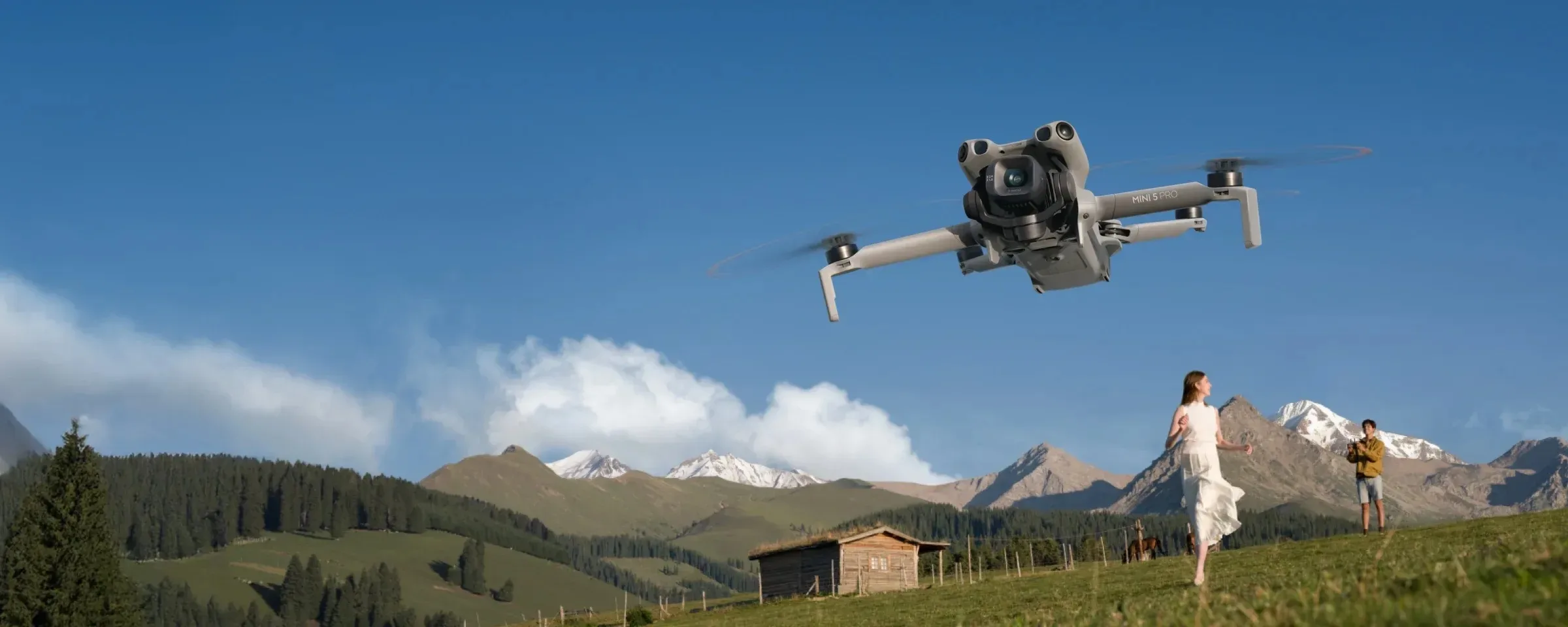
Sensor size matters more than most buyers realize. A larger sensor captures more light, which translates directly into better dynamic range, less noise in shadows, and more natural color reproduction. The DJI Mini 5 Pro, for example, packs a 1-inch CMOS sensor into a sub-249-gram body. That sensor size allows it to produce footage with noticeably more depth and detail than competing drones in the same weight class that use smaller 1/2.3-inch sensors.
At the higher end, the DJI Mavic 4 Pro pushes into 6K/60fps territory with a larger sensor and multiple camera system. For professional work or creators who need extensive cropping flexibility in post-production, that additional resolution provides genuine utility rather than just a bigger number on the spec sheet.
The takeaway: always check the sensor size alongside the resolution. A 4K drone with a 1-inch sensor will outperform a 4K drone with a 1/2.3-inch sensor in almost every real-world scenario.
Stabilization: The Difference Between Usable and Unusable Footage
Raw resolution means nothing if the footage is shaky. Stabilization is the single most important factor in determining whether drone footage looks professional or amateurish.
There are two primary approaches: electronic image stabilization (EIS) and mechanical gimbal stabilization. EIS works by cropping and shifting the frame digitally, which reduces effective resolution and can introduce warping artifacts. Mechanical gimbals physically move the camera on multiple axes to counteract drone movement, producing smoother results without any resolution penalty.
DJI equips its camera drones with three-axis mechanical gimbals as standard across the lineup, from the Mini 3 to the Mavic 4 Pro. The Mavic 4 Pro goes further with what DJI calls "infinity gimbal rotation," meaning the camera can rotate continuously without hitting a mechanical stop. For creators who need sweeping panoramic shots or seamless orbital footage, this removes a limitation that has existed in consumer drones for years.
DJI's HorizonSteady technology adds another layer on top of the mechanical gimbal, using software to keep the horizon perfectly level even during aggressive banking turns. The combination of hardware and software stabilization is a significant reason why DJI footage tends to look more polished than that of competitors relying on EIS alone.
Obstacle Avoidance: Not All Systems Are Created Equal
Flying a camera drone in open fields is straightforward. Flying one through a forest, around buildings, or near cliff faces is where obstacle avoidance becomes critical.
Entry-level drones from many brands offer forward-only obstacle detection, which leaves the sides, rear, and underside of the drone completely blind. This is a significant limitation, especially in follow-me or orbit modes where the drone frequently moves laterally or backward.
DJI's current lineup has largely moved to omnidirectional obstacle sensing. The Mini 5 Pro, Air 3S, and Mavic 4 Pro all detect obstacles in every direction. The Air 3S takes this further with nightscape omnidirectional obstacle sensing, meaning the system remains functional in low-light conditions when visual sensors on other drones would be effectively useless.
For anyone planning to fly in complex environments (and that includes most environments that produce interesting footage), omnidirectional sensing is not a luxury feature. It is a practical necessity that protects both the drone and the people or property nearby.
Flight Time and Battery Strategy
Advertised flight times should always be taken with a grain of salt. Manufacturers test under ideal conditions: no wind, no aggressive maneuvering, moderate temperature. Real-world flight times typically run 15 to 25 percent shorter.
That said, DJI's current generation offers competitive numbers. The Mini 5 Pro achieves up to 34 minutes on a standard battery, with a Plus battery option that extends this further. The Air 3S reaches approximately 40 minutes, and the Mavic 4 Pro tops out around 43 minutes under optimal conditions.
For practical use, the more important question is how many batteries you plan to carry. A single battery covers one extended shoot. Two batteries cover a full morning or afternoon session. DJI sells Fly More Combos for most models, which bundle extra batteries with a charging hub, and this is almost always the better value compared to buying batteries individually later.
Weight, Portability, and FAA Registration
In the United States, any drone weighing 250 grams or more must be registered with the FAA for recreational use. Drones under 249 grams are exempt from this requirement, which is a meaningful convenience for casual users who do not want to navigate the registration process.
DJI has engineered several models to sit just under this threshold. The Mini 5 Pro, Mini 4 Pro, Mini 3, Mini 4K, DJI Flip, and DJI Neo all weigh under 249 grams. This is not a coincidence. It is a deliberate design choice that removes a regulatory barrier for the largest segment of the market.
Beyond registration, weight affects portability in obvious ways. A drone that fits in a jacket pocket or the top compartment of a backpack is one you will actually bring along. A drone that requires its own dedicated carrying case is one that stays home more often than it should.
Intelligent Features: ActiveTrack, Waypoints, and Panorama Modes
Modern camera drones are not just flying cameras. They are increasingly autonomous tools that can execute complex shots without manual input.
DJI's ActiveTrack system allows the drone to lock onto a subject and follow them automatically, adjusting speed, altitude, and framing in real time. The Mini 5 Pro features an upgraded ActiveTrack 360 that maintains tracking even when the subject temporarily moves behind an obstacle.
Waypoint flying lets you pre-program a flight path, so the drone repeats the exact same route and camera movements on subsequent flights. This is invaluable for real estate agents who need consistent property flyovers, or for creators building timelapses that span multiple sessions.
Panorama modes have also improved substantially. The Air 3S includes a Free Panorama mode that stitches multiple frames into a single wide-angle composite, producing images with a field of view and resolution that no single camera frame can match.
The Buying Decision
Choosing a camera drone in 2026 comes down to matching the right tool to your actual use case. Beginners who want a compact, registration-free drone with solid image quality will find the Mini series and DJI Flip more than sufficient. Intermediate users who need longer flight times and advanced low-light performance should look at the Air 3S. And professionals or serious enthusiasts who demand the best sensor, the most versatile gimbal, and the longest flight time will find the Mavic 4 Pro difficult to justify skipping.
Whatever your level, the technology has reached a point where even entry-level models produce footage that would have been considered professional-grade just a few years ago. The gap between price tiers is narrowing in terms of raw capability, which means the real differentiators are now in sensor quality, stabilization sophistication, and intelligent flight features.