
An inspection machine can appear to run perfectly for months while quietly missing the defects it was bought to catch. That is what separates this purchase from other capital equipment. A lathe either cuts or it does not. An NDT system fails silently, and you usually find out through a customer complaint.
Define the part before you shortlist anyone
The most common mistake is starting from the machine. Before contacting any supplier, write down four things: the material, because ferrous or non-ferrous decides the method immediately; the defect type, whether surface cracks, sub-surface flaws, laps, seams, or wall thinning; the component geometry, since bars, tubes, castings, and welds all need different handling; and the throughput, because pieces per hour is what turns a bench unit into an inline system.
Arrive without this and every NDT manufacturer proposes something different — all technically defensible, none comparable.
Insist on a trial with your own parts
Reference blocks prove a machine works. They do not prove it works for your component. Send actual production parts, including known rejects if you have them. Any serious supplier will agree to this. Hesitation tells you what you need to know.
Ask about documentation early
The question always comes eventually: how did you validate this inspection process? Confirm what reference standards are used, what the calibration procedure is, and exactly what paperwork ships with the machine. Assembling this after a customer audit has already gone badly is a miserable exercise.
Look past the quoted price
The gap between two quotes is rarely about the machine. It is about everything afterwards. Ask what spares are stocked, what the response time is, whether the model will still be supported in five years, and who actually attends site. An imported system idle for two months waiting on a control card costs far more than the difference that justified choosing it.
In-house build matters
An NDT manufacturer who designs and builds their own equipment can modify it for your component and your fixtures. An assembler is limited to whatever the catalogue permits — and most real production lines have something non-standard about them.
This is also the practical case for working with an Indian manufacturer rather than an overseas brand represented by an agent. Site visits, quick spares, design changes for your line, and direct access to the engineering team are worth more than a badge on the panel.
About Magkraft NDT
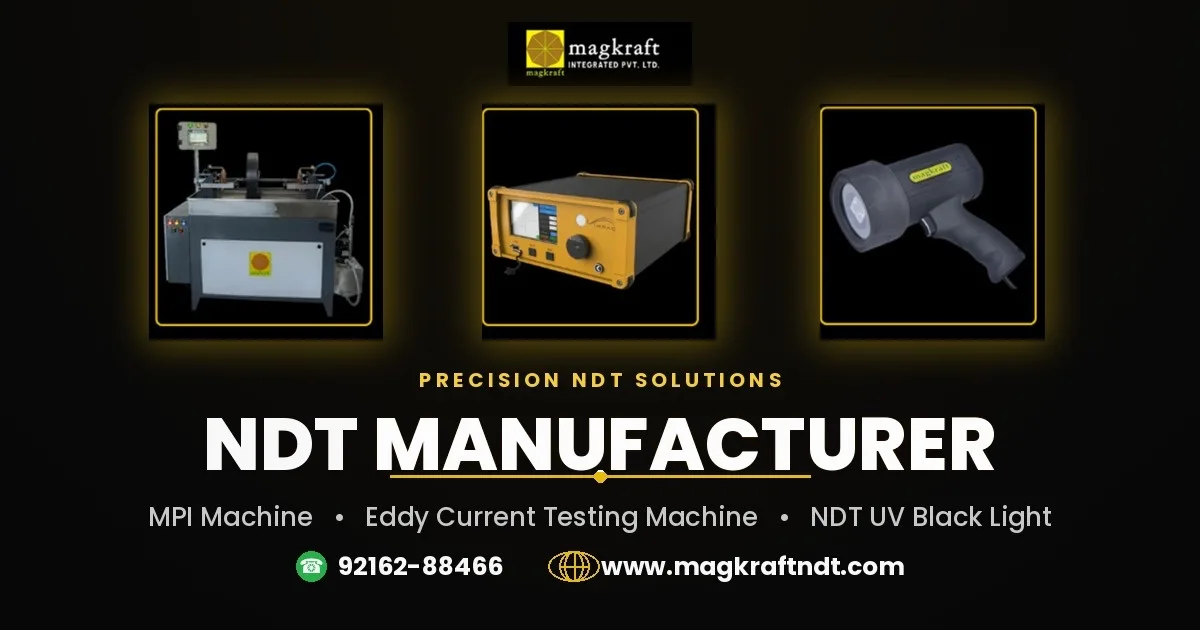
Magkraft NDT, from Magkraft Integrated Pvt. Ltd., designs and builds magnetic particle inspection machines, eddy current testing systems, tube eddy current systems, UV black lights, and custom-engineered inspection equipment.
Everything is manufactured in-house, so the machine is adapted to your component — and support comes from the people who built it.