
Search is changing, but many brands are still measuring their digital performance using metrics designed for traditional search engines. Rankings, organic traffic, and keyword visibility remain important, but they no longer tell the complete story of how customers discover, evaluate, and choose products.
Today, people discover information through Google, receive recommendations from AI platforms such as ChatGPT and Perplexity, and increasingly use AI-powered shopping assistants to research and compare products. Each of these experiences involves a different way of finding and evaluating information.
This is where three important approaches come into the picture: Search Engine Optimization (SEO), Generative Engine Optimization (GEO), and Agentic Commerce Optimization (ACO).
Although these terms are closely related, they do not measure the same thing. Understanding what each one actually measures helps brands identify where they are visible, where they are being recommended, and whether their products are ready to be considered by AI shopping agents.
What Does SEO Actually Measure?
Search Engine Optimization (SEO) measures how effectively a website and its content perform in traditional search engine results. It focuses on improving a website's ability to be discovered, crawled, indexed, and ranked for relevant search queries.
When someone searches for a product, service, or question on Google, SEO helps determine whether a brand's website appears among the results.
However, SEO is not simply about achieving higher keyword rankings. It also involves making websites technically accessible, publishing useful content, building authority, and creating a better experience for visitors.
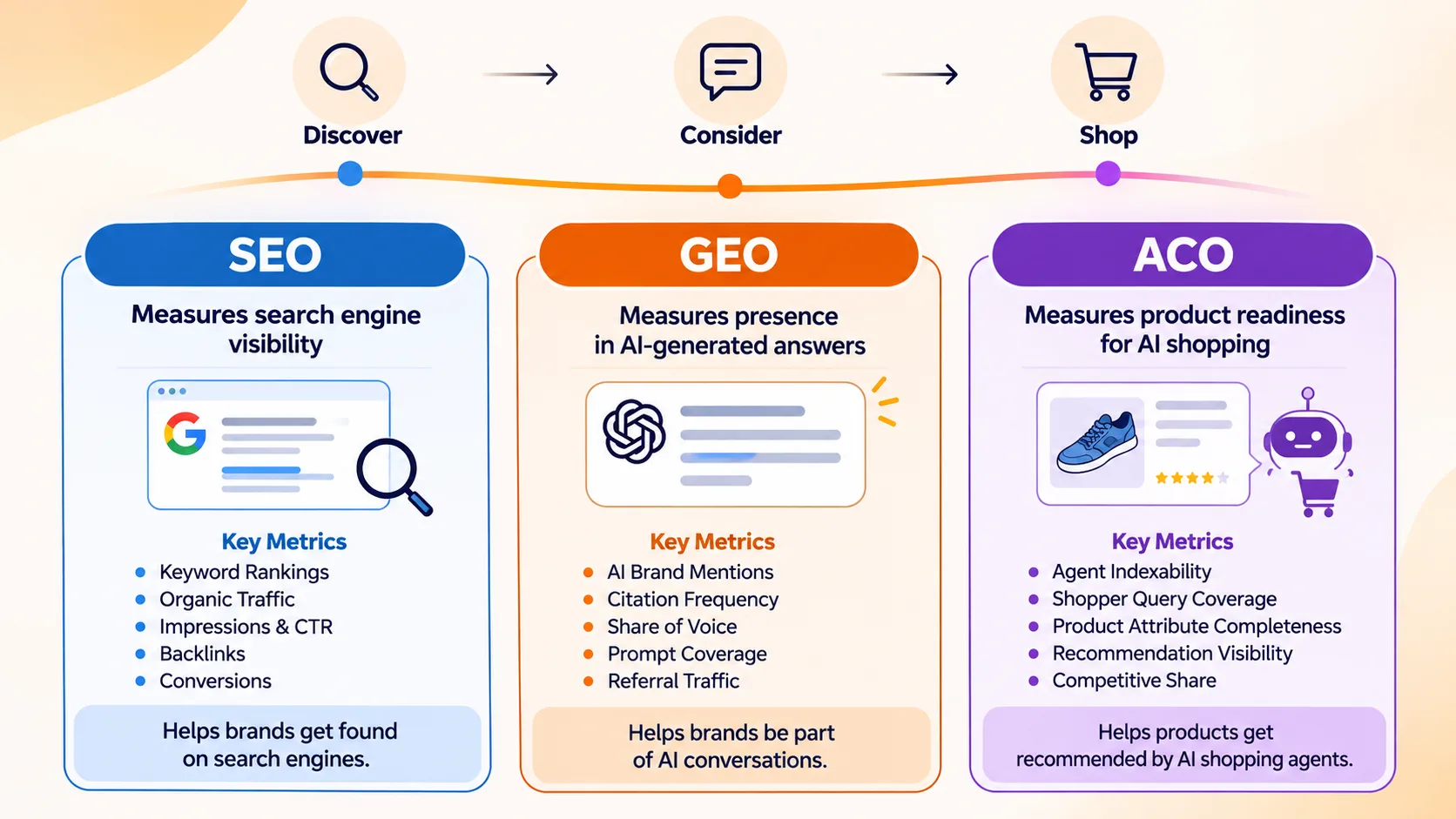
Key SEO metrics include:
- Keyword Rankings: Where a website appears in search results for targeted keywords.
- Organic Traffic: How many visitors arrive through unpaid search results.
- Impressions: How frequently website pages appear in search results.
- Click-Through Rate (CTR): The percentage of impressions that result in clicks.
- Backlink Profile: The quality and relevance of external websites linking to a domain.
- Conversions: How effectively organic visitors complete desired actions, such as enquiries, registrations, or purchases.
For brands, SEO measures their ability to attract relevant audiences through traditional search engines.
But there is an important limitation. A brand can rank on Google's first page and still be absent from AI-generated recommendations. Traditional search visibility does not automatically translate into visibility across AI platforms.
What Does GEO Actually Measure?
Generative Engine Optimization (GEO) measures how effectively a brand's information and content are represented in responses generated by AI-powered search and answer engines.
Unlike traditional search engines, which primarily present a list of links, generative AI platforms can synthesize information from multiple sources and provide users with direct answers.
For example, someone might ask ChatGPT, "What are the best project management tools for small businesses?"
Instead of presenting ten blue links, the platform may generate a comparison, explain the differences between products, and mention specific brands.
GEO focuses on improving the likelihood that a brand's information is discovered, understood, referenced, and represented accurately in these AI-generated responses.
This involves creating clear, credible, well-structured content that addresses real user questions. It also involves building brand authority and ensuring that relevant information is accessible to AI systems.
Key GEO metrics include:
- AI Brand Mentions: How frequently a brand appears in AI-generated responses.
- Citation Frequency: How often AI platforms reference or link to a brand's website and content.
- Share of Voice: How frequently a brand appears compared with competitors across relevant AI queries.
- Prompt Coverage: The range of relevant questions and prompts for which a brand appears.
- Brand Representation: Whether AI systems describe the brand, its products, and its capabilities accurately.
- Referral Traffic: Visitors arriving at a website through links in AI-generated responses.
It is important to understand that GEO measurement is still evolving. Different AI platforms may generate different answers to the same question, and there is no universal measurement standard across all generative engines.
For brands, GEO measures their presence and representation within AI-driven information discovery. It helps answer a different question: When customers ask AI for information or recommendations, does your brand become part of the conversation?
What Does ACO Actually Measure?
Agentic Commerce Optimization (ACO) focuses on a more specific part of the AI ecosystem: product discovery, evaluation, and recommendations by AI shopping agents.
While SEO helps customers discover websites and GEO helps brands appear in AI-generated answers, ACO focuses on whether AI shopping agents can understand, evaluate, and recommend individual products.
Consider a shopper asking an AI shopping assistant:
"Recommend a sulfate-free shampoo for dry hair that is suitable for colour-treated hair and costs under ₹800."
The shopping agent needs more than a product name and a basic description to make a recommendation. It needs to understand product attributes, ingredients, suitability, pricing, benefits, usage information, and other relevant details.
If this information is missing, inconsistent, or difficult to interpret, the product may not be considered a suitable recommendation, even if it performs well in traditional search results.
ACO addresses this challenge by improving product data, product descriptions, attributes, and content so AI shopping agents can interpret and evaluate products more effectively.
Key ACO measurement areas include:
- Agent Indexability: Measures how easily AI shopping agents can access, read, and interpret product information.
- Shopper Query Coverage: Measures how effectively product content answers the questions shoppers and AI shopping agents may ask during product research and comparison.
- Product Attribute Completeness: Evaluates whether important product attributes and specifications are available and clearly communicated.
- Product Information Consistency: Checks whether product details remain accurate and consistent across relevant sources and platforms.
- AI Recommendation Visibility: Tracks how frequently products appear in relevant AI shopping recommendations.
- Competitive Recommendation Share: Evaluates how a brand's products perform against competing products across relevant shopping queries.
For ecommerce brands, ACO measures product-level AI shopping readiness. It helps answer a commercially important question: Can AI shopping agents understand why your product is relevant to a shopper's needs and consider it for recommendation?
SEO vs GEO vs ACO: What Is the Actual Difference?
Although all three approaches contribute to digital visibility, they focus on different discovery and decision-making experiences.
Measurement AreaSEOGEOACOPrimary focusSearch engine visibilityAI-generated answer visibilityAI shopping recommendationsMain environmentGoogle and other search enginesChatGPT, Perplexity and other generative platformsAI shopping agents and shopping assistantsPrimary unitWebsite and web pagesBrand and contentIndividual products and SKUsWhat it measuresRankings, traffic and conversionsMentions, citations and prompt coverageProduct readiness and recommendation visibilityMain objectiveAttract relevant website visitorsBecome part of AI-generated answersMake products understandable and recommendable by AI agentsThe distinction becomes clearer when we look at how a customer moves through the buying journey.
SEO supports discovery. A customer searches for the best skincare products for sensitive skin and discovers a brand through Google.
GEO supports consideration. The customer asks an AI platform to compare skincare brands and receives a response that includes the brand.
ACO supports product evaluation and recommendation. The customer asks an AI shopping agent to recommend a suitable product based on ingredients, skin concerns, price, and other preferences. The agent can interpret the product information and evaluate whether it matches the shopper's requirements.
These approaches are connected, but success in one does not guarantee success in the others.
Why Traditional SEO Metrics Are No Longer Enough
For years, brands have used keyword rankings, organic traffic, backlinks, and website conversions to evaluate their search performance. These metrics remain valuable, but they primarily measure performance within traditional search environments.
The challenge is that customers are no longer relying exclusively on search engine results pages to make decisions.
A shopper might discover a product through Google, ask ChatGPT for a comparison, and use an AI shopping assistant to identify the most suitable option. If a brand is visible only during the first stage, it may lose opportunities during the consideration and purchase stages.
For example, an ecommerce brand may rank among the top search results for a product category and receive consistent organic traffic. However, its products may not appear in AI shopping recommendations because essential information about ingredients, compatibility, product benefits, or usage is missing.
This creates a gap between search visibility and product recommendation readiness.
Brands therefore need to evaluate more than whether their websites attract visitors. They also need to understand whether AI platforms recognize their brand and whether shopping agents can interpret their product information.
How Should Brands Measure SEO, GEO and ACO Together?
Rather than treating SEO, GEO, and ACO as competing strategies, brands should use them as complementary measurement frameworks.
Each provides a different perspective on digital performance, and together they offer a more complete picture of how a brand performs across the evolving discovery and shopping journey.
1. Measure Search Visibility Through SEO
Start by understanding how customers find your website through traditional search engines.
Monitor keyword rankings, organic impressions, clicks, traffic quality, backlinks, and conversions. Identify which pages attract relevant visitors and whether those visitors take meaningful actions.
The objective is not simply to increase traffic but to attract audiences who are likely to engage with your brand.
2. Measure AI Presence Through GEO
Next, evaluate how your brand appears across generative AI platforms.
Build a set of relevant customer questions and test how different AI platforms respond. Monitor whether your brand appears, which competitors are mentioned, what sources are cited, and whether the information presented is accurate.
Track these prompts consistently over time because AI responses can vary depending on the platform, query wording, and available information.
3. Measure Product Readiness Through ACO
For ecommerce brands, product-level measurement becomes particularly important.
Evaluate whether product pages contain complete, accurate, and structured information. Check whether product attributes address the questions shoppers are likely to ask and whether AI shopping agents can interpret that information.
Measure Agent Indexability and Shopper Query Coverage to identify gaps that may prevent products from being understood or considered for recommendations.
Brands should also test relevant shopping prompts to understand how their products appear compared with competing alternatives.
What This Means for Different Types of Brands
The importance of SEO, GEO, and ACO can vary depending on a company's business model.
For service-based businesses: SEO and GEO should be major priorities. These businesses need to appear in traditional search results and become recognizable sources of information when customers ask AI platforms for service recommendations.
For B2B companies: SEO helps attract decision-makers researching solutions, while GEO helps establish brand presence in AI-generated comparisons, industry explanations, and vendor research.
For ecommerce and consumer brands: All three approaches matter. SEO attracts potential buyers, GEO builds visibility during product research, and ACO prepares individual products for AI-powered shopping discovery and recommendations.
The key is to measure the areas that directly influence how customers discover and choose your products or services.
The Future of Digital Visibility Requires More Than Rankings
Search visibility is no longer limited to where a website appears on a search results page. Brands now need to consider how their information is discovered, interpreted, and presented across different AI-driven experiences.
SEO remains essential for building organic visibility and attracting relevant website traffic. GEO extends that visibility into AI-generated answers and recommendations. ACO takes the next step for ecommerce brands by focusing on whether individual products are accessible, understandable, and relevant to AI shopping agents.
The important takeaway is that these approaches measure different aspects of digital performance. A strong SEO strategy does not automatically create strong GEO visibility, and appearing in AI-generated answers does not necessarily mean that individual products are ready for AI shopping recommendations.
Brands that understand these differences can build a more comprehensive optimization strategy, identify gaps earlier, and measure performance beyond traditional search rankings.
The question is no longer just whether customers can find your brand. It is whether search engines, generative AI platforms, and AI shopping agents can understand your brand and recognize the value of what you offer.