
On a demolition site, two operators can use the same hydraulic breaker on the same concrete structure and still end up with completely different results. One finishes the job quickly with clean fractures, while the other spends more time, burns more fuel, and puts extra strain on both the machine and the attachment.
It's easy to assume the breaker itself is responsible, but that's not always the case. In many situations, the difference comes down to the working tool fitted to the breaker. A worn or unsuitable moil point changes how impact energy reaches the concrete, making every strike less effective than it should be.
That is why choosing the right rock breaker moil is more important than many operators realize. Its shape influences how quickly cracks develop, how efficiently the breaker performs, and how long the tool lasts before replacement becomes necessary.
So, what is the ideal moil point shape for breaking concrete? The answer depends on how concrete fractures under impact and why certain moil designs perform better than others.
Why Is Moil Point Shape So Important?
Every hydraulic breaker produces impact energy, but the moil decides how that energy reaches the material. Think of it as the final contact point between the machine and the concrete. If its design isn't suitable for the application, a portion of that impact goes to waste.
That's why two moils made from the same material can deliver completely different results. One may create clean fractures with fewer blows, while the other chips away at the surface without breaking the concrete efficiently.
The right point shape helps you:
- Initiate cracks faster
- Improve breaking efficiency
- Reduce unnecessary impacts
- Extend tool life
- Maintain consistent productivity throughout the job
Over the course of a large demolition project, these differences become noticeable in fuel consumption, operating time, and overall equipment performance.
Different Types of Moil Points
Not every demolition job requires the same working tool. Hydraulic breaker tools come in different shapes, each designed to transfer impact energy differently depending on the material being broken. Using the correct tool not only improves breaking efficiency but also reduces unnecessary wear on both the breaker and the attachment.
The most common moil point types include:
Standard Moil Point (Conical Point)
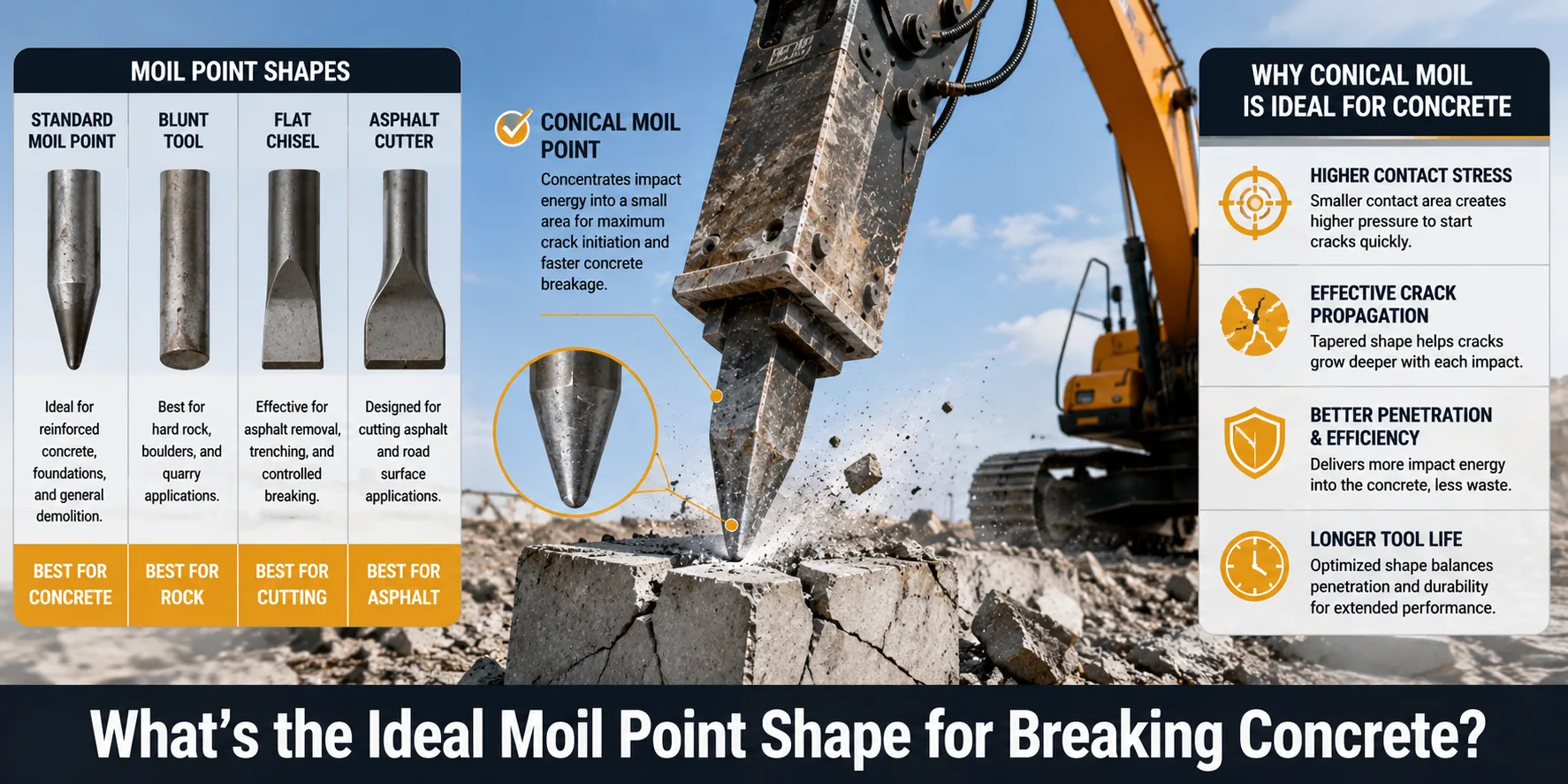
The standard moil point features a gradually tapered, conical tip that concentrates impact energy into a relatively small contact area. It is the most versatile breaker tool and is widely used for reinforced concrete, foundations, large concrete blocks, and general rock-breaking applications.
Because it combines good penetration with high durability, it is the first choice for most structural concrete demolition jobs.
Blunt Tool
A blunt tool has a flat or rounded working end instead of a pointed tip. Rather than penetrating the material, it transfers impact over a larger area to crush brittle materials through compressive stress.
It is commonly used for oversized boulders, quarry applications, and hard rock where surface crushing is more effective than concentrated penetration.
Flat Chisel
A flat chisel spreads impact along a straight cutting edge instead of concentrating it at a single point. This makes it suitable for applications where controlled cutting or splitting is required.
It is commonly used for:
- Asphalt removal
- Road surface demolition
- Thin concrete slabs
- Pavement removal
- Trenching work
Asphalt Cutter (Spade Tool)
The asphalt cutter has a wide blade-like profile designed specifically for cutting through asphalt layers without causing unnecessary damage to the underlying base.
It is primarily used in road maintenance and utility repair projects where clean edge cuts are required before excavation.
Which Moil Point Shape Is Ideal for Breaking Concrete?
Among the different breaker tool designs, the standard conical moil point is generally the most suitable for structural concrete demolition.
Concrete behaves differently from asphalt or brittle rock. While it has high compressive strength, its tensile strength is relatively low. A conical moil takes advantage of this by concentrating the breaker's impact into a small contact area. The resulting stress waves travel through the concrete and generate tensile stresses that initiate internal cracking. With repeated blows, these cracks grow until the concrete fractures into manageable sections.
This working principle makes the conical moil suitable for applications such as:
- Reinforced concrete structures
- Foundation blocks
- Floor slabs
- Bridge decks
- Retaining walls
- Thick precast concrete elements
Unlike a flat chisel, which removes material across a wider edge, or a blunt tool, which relies on surface crushing, a conical moil focuses on initiating and propagating cracks. That is why it remains the preferred choice for most concrete demolition work recommended by hydraulic breaker manufacturers.
How Does the Shape of a Moil Point Affect Concrete Breaking?
Once you've selected the right type of moil point, its shape becomes the next factor that influences demolition performance. Although every hydraulic breaker delivers impact energy, the way that energy enters the concrete depends on the geometry of the tool's tip.
Concrete is strong under compression but comparatively weak in tension. When a hydraulic breaker strikes the surface, it generates compressive stress waves that travel through the concrete.
As these waves reflect within the material, they create tensile stresses. If these stresses exceed the concrete's tensile strength, cracks begin to form and gradually propagate with repeated impacts.
A Pointed Profile Creates Higher Contact Stress
A conical moil has a much smaller contact area than a flat chisel or blunt tool. For the same impact force, the pressure at the point of contact becomes much higher.
This concentrated stress makes it easier to initiate cracks, especially in thick structural concrete where surface damage alone is not enough to fracture the material.
The Taper Helps the Tool Stay Effective
As concrete begins to crack, the opening around the tool changes with every impact. The gradual taper of a standard moil allows it to remain engaged within these developing fractures, helping transfer impact energy into the concrete instead of dissipating it across loose debris.
This is one reason why conical moils perform consistently when breaking thick foundations, bridge decks, and reinforced slabs.
The Shape Also Affects Tool Life
Selecting the sharpest possible point doesn't always improve productivity.
A very fine tip produces higher contact stress but has less supporting material behind it, making it more susceptible to rapid wear, mushrooming, or tip breakage under repeated high-energy impacts.
On the other hand, an excessively blunt point spreads impact over a larger area, reducing stress concentration and requiring more blows to achieve the same level of fracture.
For this reason, manufacturers design standard moils with a controlled taper that balances penetration, energy transfer, and durability rather than maximizing sharpness alone.
Final Thoughts
The shape of a rock breaker moil has a direct impact on how efficiently concrete breaks. While different tool profiles serve different applications, a standard conical moil remains the most practical choice for general concrete demolition because it concentrates impact energy, initiates cracks effectively, and performs well across a wide range of structural applications.
That said, the best results don't come from the tool shape alone. When the right moil tool is paired with the correct operating technique, demolition becomes faster, tool life improves, and the hydraulic breaker delivers the performance it was made for.