
Introduction
Six Sigma remains a core method for improving process consistency and reducing variation, but its application continues to change. By 2026, organizations are applying Six Sigma in ways that reflect new data practices, digital systems, and operational demands. This article explains how Six Sigma is evolving, where it is being applied differently, and what trends are shaping its future use. Readers will understand how Six Sigma fits into modern business operations and why it continues to matter across industries.
How Six Sigma Is Evolving in Business Operations in 2026
Six Sigma in 2026 is no longer limited to isolated improvement projects. Organizations now apply its principles as part of ongoing operational management. This section explains how Six Sigma practices are shifting to align with faster decision cycles and broader organizational goals.
Shift from project-based improvement to continuous performance management
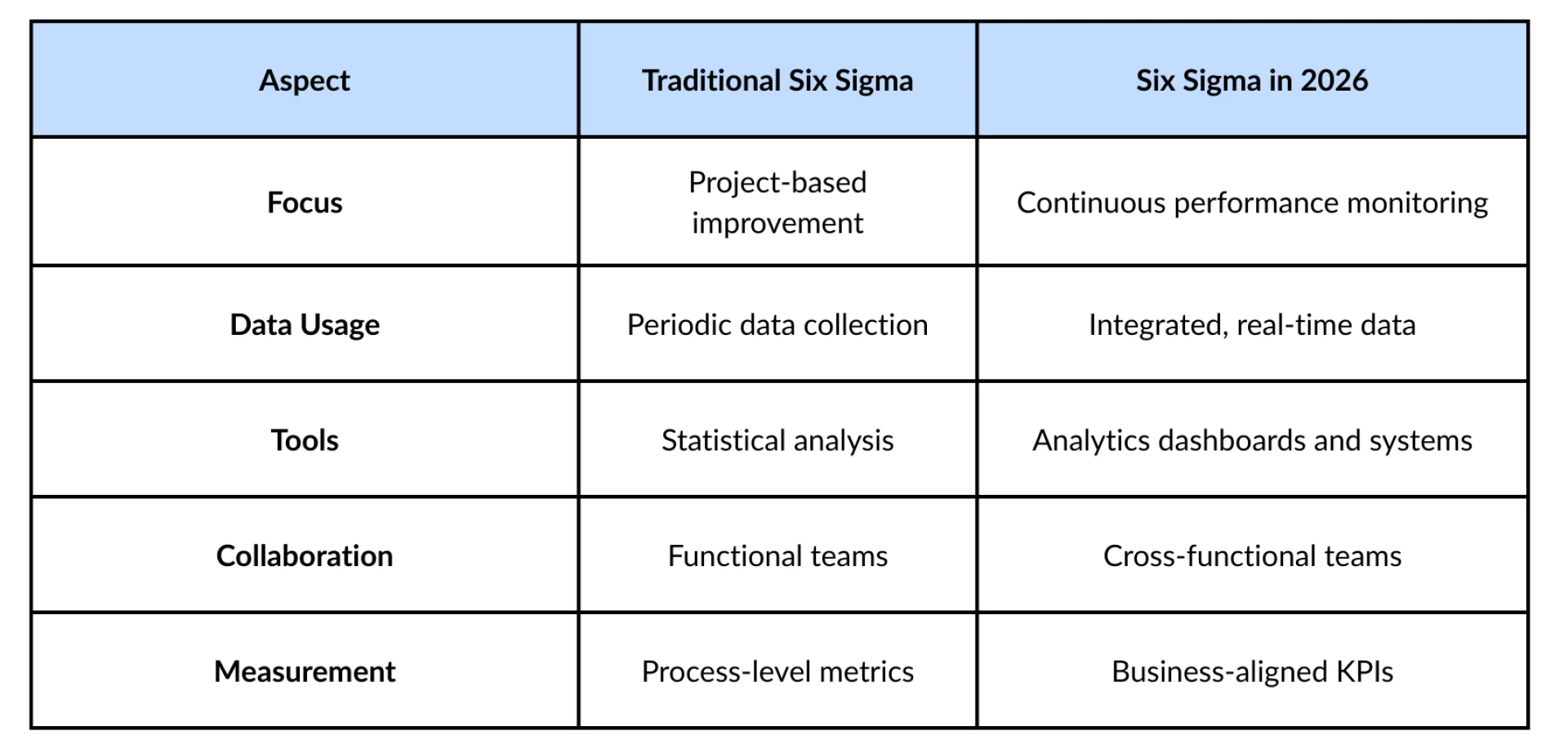
Many organizations are moving away from short-term Six Sigma projects toward continuous monitoring of process performance. Instead of closing improvement initiatives after completion, teams track key metrics over time using dashboards and performance reviews. This approach helps organizations respond more quickly to variation and maintain process stability in changing environments.
Greater focus on cross-functional process improvement
Six Sigma initiatives increasingly involve teams from multiple departments rather than a single function. Operations, IT, finance, and customer service often collaborate to address process gaps that span the entire workflow. This cross-functional approach improves problem visibility and leads to solutions that address root causes rather than isolated symptoms.
Emphasis on measurable business outcomes
Organizations in 2026 place stronger emphasis on linking Six Sigma work to business results. Metrics such as cost control, delivery reliability, and quality consistency are tied directly to improvement efforts. Leadership teams use these outcomes to assess effectiveness and prioritize future initiatives.
Integration of Six Sigma with Digital and Data Technologies
Digital tools and data platforms now play a central role in how Six Sigma is applied. This section explains how analytics, automation, and system integration influence Six Sigma methods.
Use of data analytics to support DMAIC decisions
Advanced analytics support decision-making during the Define, Measure, and Analyze phases of DMAIC. Teams use trend analysis and data visualization to identify patterns that were previously difficult to detect. These insights support clearer problem definition and more accurate identification of process drivers.
Role of automation in process control
Automation supports consistent execution of standardized processes. In many environments, automated alerts and system controls replace manual checks. This allows organizations to respond to variation quickly while reducing reliance on manual monitoring.
Integration with enterprise systems
Six Sigma teams increasingly rely on data from ERP, CRM, and operational platforms. Integrated systems reduce delays caused by manual data collection and reporting. This access to timely data supports faster analysis and more informed improvement decisions.
Changing Skills and Expectations for Six Sigma Professionals
As Six Sigma practices evolve, the skills expected of practitioners also change. This section explains how professional expectations are shifting in 2026.
Increased data literacy requirements
Six Sigma professionals are expected to understand how data is collected, structured, and interpreted. Beyond using statistical tools, they must assess data reliability and relevance. Strong data literacy supports more accurate analysis and better decision-making.
Broader business and process understanding
Practitioners are expected to understand end-to-end processes rather than isolated tasks. This broader perspective helps align improvement efforts with operational priorities. Understanding business context also supports solutions that are practical and sustainable.
Stronger communication and stakeholder coordination
Clear communication is essential when improvement initiatives involve multiple teams. Six Sigma professionals must explain findings, align stakeholders, and document decisions clearly. Effective coordination helps ensure that changes are implemented consistently across the organization.
Industry-Specific Applications of Six Sigma in 2026
Six Sigma continues to be applied across industries, but the focus and execution vary. This section highlights how different sectors use Six Sigma methods.
Manufacturing and supply chain operations
In manufacturing, Six Sigma supports control of production variation and supplier quality. Supply chain teams use it to stabilize delivery performance and manage inventory flow. These applications support predictable operations in complex networks.
Healthcare and service environments
Healthcare and service organizations use Six Sigma to improve consistency in scheduling, documentation, and service delivery. Process clarity helps reduce delays and errors. These improvements support reliable outcomes in environments with high operational pressure.
Finance and administrative processes
Finance teams apply Six Sigma to improve transaction accuracy and reduce processing time. Applications include billing, reporting, and compliance workflows. Standardized processes reduce rework and support consistent performance.
Traditional Six Sigma vs Six Sigma in 2026
Conclusion
Six Sigma in 2026 reflects a shift from isolated improvement efforts to continuous, data-supported process management. While the core principles of reducing variation and improving consistency remain unchanged, how organizations apply them has evolved. Integration with digital systems, broader collaboration, and stronger alignment with business outcomes define the next phase of Six Sigma.