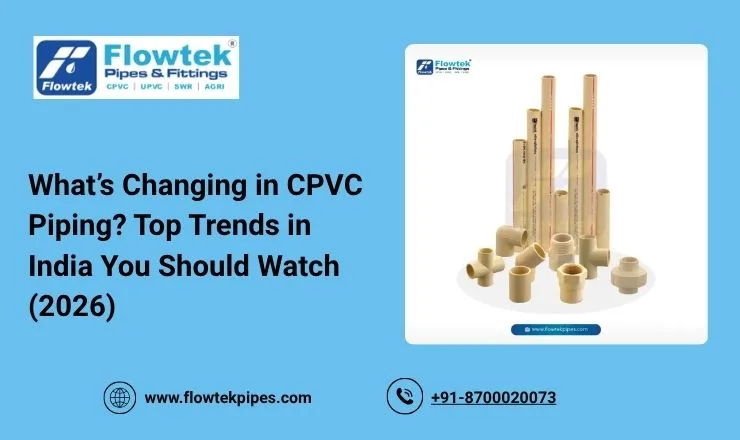
Margins are getting tighter, and suddenly your choice of CPVC Pipe Fittings is no longer just a procurement decision—it’s a liability decision.
That’s where most buyers miscalculate. They assume CPVC is a stable category. It isn’t. Material formulations are shifting, certification scrutiny is rising, and the gap between reliable and risky suppliers has widened sharply since 2023. Which means the old vendor list you trusted even two years ago may already be outdated.
And yet, many contractors are still approving CPVC Ball Valves, CPVC Union Fittings, CPVC Flanges, Column Pipes, and Borewell Pipes based on price sheets and familiarity. That’s how projects bleed money—quietly, through rework, delays, and pressure failures that don’t show up until handover.
India’s CPVC market is expected to cross ₹18,000 crore by 2027, growing at over 10.2% CAGR. Growth is good. But growth also attracts shortcuts.
SPECIFICATION
Material Shifts That Buyers Rarely Track
Most buyers still assume all CPVC compounds behave similarly under heat and pressure. They don’t. Post-2024, several manufacturers adjusted resin blends due to raw material cost volatility. That change alone has affected thermal resistance by up to 6–8% in some batches.
Here’s what matters now:
- Heat tolerance consistency above 93°C (not just claimed, but batch-tested)
- Chlorine resistance in municipal water (especially in Tier-1 cities)
- Wall thickness variance within ±0.2 mm tolerance
Nobody tells you this, but inconsistent wall thickness is where failures start—not at joints, but mid-line under sustained pressure.
Product Categories Evolving Fast
- CPVC Ball Valves: Shift toward quarter-turn precision valves with improved sealing rings
- CPVC Union Fittings: Increasing demand for quick-disconnect designs in maintenance-heavy systems
- CPVC Flanges: Higher adoption in industrial retrofits replacing GI systems
- Column Pipes: Now expected to handle deeper borewell installations beyond 300 meters
- Borewell Pipes: Reinforced variants gaining traction in high-sediment regions
And here’s the overlooked detail: thread compatibility tolerance between fittings from different manufacturers is still inconsistent. Mixing brands? That’s a risk most buyers underestimate.
OBJECTIVE
The 5 Checks That Actually Protect Your Purchase
1. Certification Isn’t Paper — It’s ProcessGood answer: “Batch-wise ISI and third-party test reports available.”
Bad answer: “We are ISO certified.”
That’s not the same thing. ISO doesn’t guarantee product performance.
Rated for 16 kg/cm² at 27°C, with derating charts
Bad answer: “Suitable for all applications.”
That’s vague—and dangerous.
Good answer: “Average dispatch time: 4–6 days, with 92% on-time record in 2025.”
Bad answer: “We try our best.”
That’s not a system. That’s hope.
Written replacement policy within 7 days of defect validation" is a good response.
Bad answer: “We’ll review case by case.”
That’s where disputes begin.
Good answer: “In-house molds replaced every 18–24 months.”
Bad answer: “Molds are fine.”
Worn molds create invisible defects that show up after installation.
BENEFITS
What These Trends Actually Mean for Buyers
- Reduced leakage risk by up to 27% with improved fitting tolerances
- Lower maintenance cycles in industrial setups using upgraded CPVC Flanges
- Faster installation times (up to 18% reduction) with better-designed CPVC Union Fittings
- Higher ROI in agriculture projects using reinforced Borewell Pipes
- Longer lifecycle (up to 15 years) when material consistency is maintained
- Better flow efficiency due to smoother internal surfaces in newer pipe designs
Which means fewer callbacks, fewer disputes, and less money stuck in post-installation fixes.
AVAILABILITY
Why Kundli, Sonipat Is Becoming a Supply Hub
Kundli isn’t just a pin code anymore. For Indian manufacturers of CPVC pipes and fittings, it is developing into a significant manufacturing cluster..
Here’s why that matters:
- Proximity to Delhi NCR reduces logistics time by 1–2 days
- Direct highway connectivity lowers freight cost volatility
- Faster access to raw material suppliers in North India
Most buyers overlook geography. They shouldn’t. A supplier located 1,200 km away may quote cheaper—but your lead time and damage risk go up.
And yes, several Borewell Pipes Suppliers are shifting base closer to this region for exactly that reason.
ABOUT US
We’ve been manufacturing piping systems long enough to know where things go wrong—and it’s rarely where buyers expect.
At Flowtek, we don’t just produce CPVC Pipe Fittings, CPVC Ball Valves, CPVC Union Fittings, CPVC Flanges, Column Pipes, and Borewell Pipes. We track failure patterns. In 2022, we replaced an entire mold batch after noticing a 1.8% increase in thread misalignment complaints across three states. Most suppliers would have ignored that. We didn’t.
Our facility in Kundli, Sonipat is built for consistency, not just capacity.
If you're sourcing for a project, don’t send a generic enquiry.
Send us:
- Required product list
- Pressure rating specifications
- Quantity (MOQ starts at 500 units depending on product)
- Delivery location
We respond within 24 working hours. And if something doesn’t meet your spec, we’ll tell you upfront instead of adjusting quietly.
CONCLUSION
The shift in CPVC piping isn’t about new products—it’s about stricter expectations around performance and consistency. Buyers who treat CPVC Pipe Fittings as a commodity will keep running into the same problems. The ones who adapt to these trends will see fewer failures and better project margins. And the gap between those two groups is only going to widen after 2026.
FAQs
1. How do I identify reliable CPVC Pipes & Fittings Manufacturers in India?
Look at batch testing, not just certifications. Ask for recent test reports. If they hesitate, move on.
2. What should I check before buying from a CPVC Ball Valve Manufacturer?
Check sealing performance under pressure cycles. Many valves pass initial tests but fail after repeated use.
3. Are Borewell Pipes Suppliers providing consistent quality across batches?
Not always. Batch variation is still a problem in this segment. You need random sampling, not trust.
4. Can I mix CPVC fittings from different manufacturers?
You can, but it’s risky. Thread tolerances vary slightly, and that’s enough to cause leakage over time.
5. How long do CPVC systems actually last in Indian conditions?
Anywhere between 10 to 15 years realistically—but only if installation and water chemistry are controlled.
6. Are cheaper CPVC Ball Valves worth considering?
Only if you’re okay replacing them early. Lower cost usually means compromise in sealing or material grade.
7. Do Borewell Pipes Suppliers offer custom specifications?
Some do, but expect longer lead times and higher MOQs. Custom orders aren’t quick-turn products.