Muscle growth is another common context where peptides come up, usually centered around a specific category: growth hormone secretagogues. Unlike the weight-loss space, this category doesn't include any FDA-approved medications specifically for muscle growth — it's almost entirely a research-use area, which makes understanding the mechanism and evidence base especially important before drawing conclusions. This guide covers the main compounds discussed in this context.
This article is for general education only. It is not medical advice. Consult a licensed healthcare provider before using any peptide.
Growth Hormone Secretagogues: The Core Category
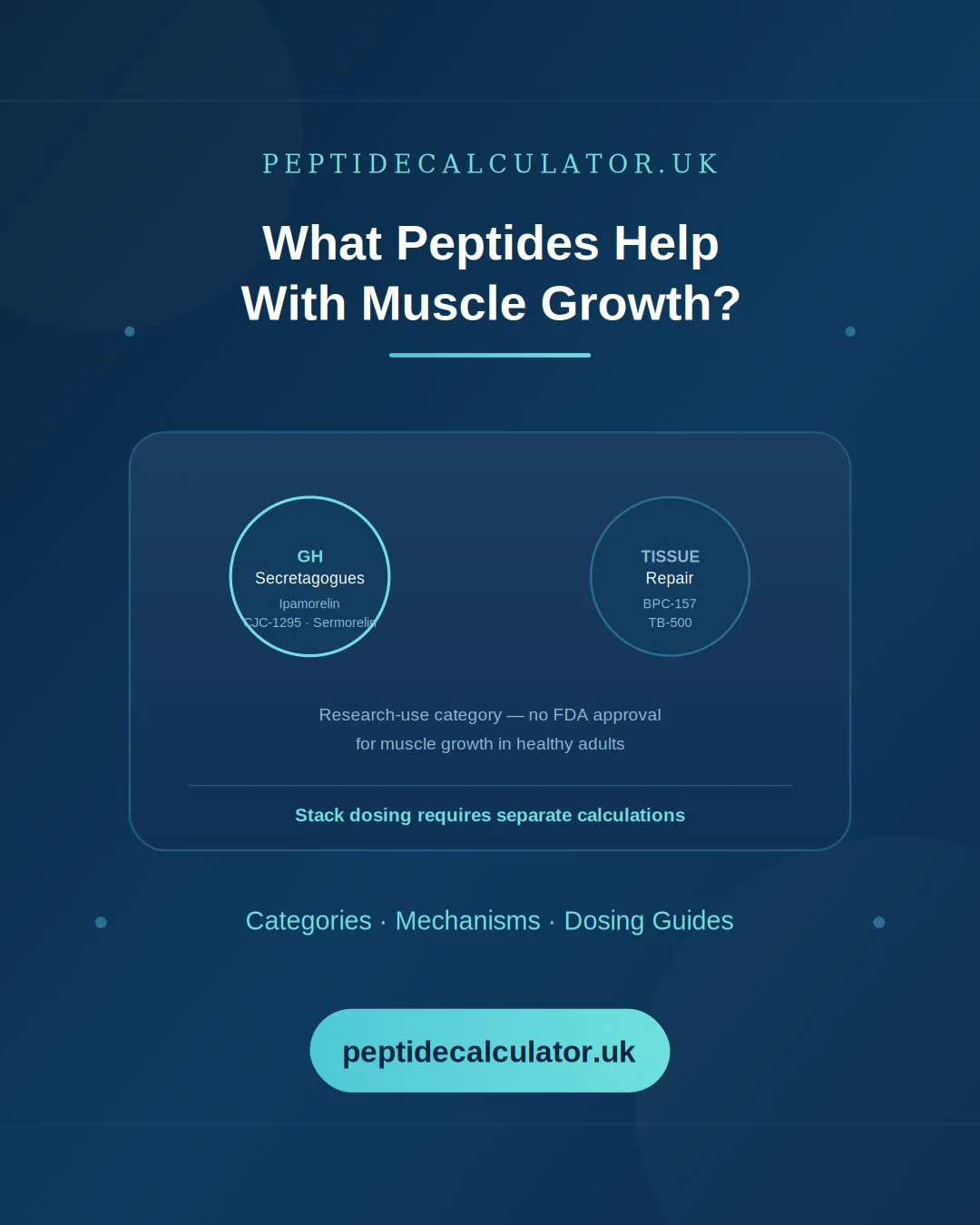
Most muscle-growth-related peptide discussion centers on compounds that stimulate the body's own growth hormone release, rather than introducing synthetic growth hormone directly:
- Ipamorelin — a selective growth hormone secretagogue, commonly discussed alongside CJC-1295 as a combined protocol.
- CJC-1295 — a GHRH analog, available in forms with and without DAC that affect its duration of action differently.
- Sermorelin — another GHRH analog, generally considered a shorter-acting option compared to some other secretagogues.
These compounds work upstream of growth hormone itself, prompting the pituitary gland to release more of it, rather than directly supplying growth hormone the way a synthetic HGH product would. See our ipamorelin & CJC-1295 guide and sermorelin guide for compound-specific dosing formulas.
Tissue Repair-Oriented Peptides
BPC-157 and TB-500 are frequently discussed in recovery and tissue-repair contexts adjacent to muscle-building goals, though their proposed mechanisms differ from growth hormone secretagogues entirely. These are generally discussed in the context of supporting recovery around training and injury, rather than directly driving muscle protein synthesis the way secretagogues are commonly discussed. See our BPC-157 and TB-500 guides for dosing details.
Why This Category Lacks FDA Approval for Muscle Growth Specifically
Unlike the GLP-1 weight-loss category, growth hormone secretagogues and tissue-repair peptides don't currently have FDA approval specifically for muscle growth or athletic performance use in healthy adults. Some individual compounds have approved uses in other specific medical contexts (unrelated to bodybuilding or athletic performance), but that's a different thing from being approved for muscle growth purposes. This means claims about effectiveness in this specific context are generally based on research-stage evidence, anecdotal reports, or extrapolation from other studied uses, rather than the kind of large-scale clinical trial data behind GLP-1 medications.
The Reconstitution Math Applies the Same Way
Whichever compound you're working with, the dosing calculation follows the same formula:
Concentration (mg/mL) = Vial strength (mg) ÷ Diluent added (mL) Units to draw = (Target dose ÷ Vial strength) × Diluent (mL) × 100
A peptide calculator handles this the same way across compounds — what changes between them is the specific vial strength, typical dose range, and evidence context, not the arithmetic itself.
Stacking Considerations
Combining multiple compounds (such as ipamorelin with CJC-1295) is common in this space, but stacking adds complexity to your dosing math, since you're tracking multiple concentrations rather than one. Calculate each compound's reconstitution and dose independently, even when injecting them close together — see our stack dosing guide for the specific math involved in combined-vial versus separate-vial approaches.
Common Misconceptions
- Assuming growth hormone secretagogues work the same way as directly administered growth hormone. The mechanism is different — these stimulate the body's own release rather than supplying it directly.
- Assuming strong anecdotal popularity reflects an established evidence base. These remain research-use compounds without the same clinical trial history as approved medications.
- Treating this entire category as risk-free because it's "natural" or peptide-based. Evidence quality and safety considerations are compound-specific, not something to generalize across the category.
Frequently Asked Questions
Are growth hormone secretagogues legal? Regulatory status varies by country and is typically sold labeled "for research purposes only" without an approved pathway for muscle-growth or performance use in healthy adults. Check your specific location's regulations directly if this matters to you.
Is BPC-157 the same category as ipamorelin? No — they have different proposed mechanisms. BPC-157 is generally discussed in tissue-repair contexts, while ipamorelin is a growth hormone secretagogue. Don't assume dosing or effects transfer between them.
Do I need to cycle these compounds? Protocol structure, including whether and how to cycle, is specific to individual compounds and goals. This article intentionally doesn't recommend specific protocols — that's a research or medical-guidance question, not something a general calculator article should determine for you.
Can I use a general peptide calculator for any compound in this category? Yes — as long as it accepts your specific vial's mg strength, diluent volume, and target dose. See our full reconstitution guide for the underlying process.
Final Thoughts
Peptides discussed in muscle-growth contexts mostly fall into two categories — growth hormone secretagogues and tissue-repair-oriented compounds — neither of which currently carries FDA approval for this specific use in healthy adults. Understanding the mechanism and evidence base for whichever specific compound you're researching matters more than treating "muscle growth peptides" as a single, uniformly-supported category.
This article is for general education only. It is not medical advice. Consult a licensed healthcare provider before using any peptide.