You can usually tell when a sculpture has real quality, even before you know why. One piece looks impressive for a moment, then fades into the background. Another keeps drawing the eye back. The form feels settled. The lines feel intentional. Even the stillness seems alive. That difference is rarely accidental. It usually comes from the meeting point of material choice, fabrication skill, and visual discipline.
That is why the question of what makes a high-quality metal sculpture matters so much for collectors, designers, businesses, property developers, and public spaces. A sculpture is not just something to place in a room or landscape. It becomes part of how a setting feels, what it communicates, and how long it holds attention. When the piece is well-made, people may not describe every technical reason, but they feel the result immediately.
The broader public connection to art helps explain why this matters. The National Endowment for the Arts reported that 42.8 percent of U.S. adults created or performed art in 2022, showing how deeply art remains woven into everyday American life. In that context, quality is not a luxury detail. It shapes how people encounter meaning, memory, and place.
Key Takeaways
- Quality starts with the right material for the right setting.
- Good craftsmanship is visible in structure, proportion, and restraint.
- Strong detail supports the whole form instead of distracting from it.
- A sculpture should work from near, far, and every angle in between.
What Does Quality Really Mean?
A direct answer helps here. What makes a high-quality metal sculpture is not just an interesting subject or a polished finish. It is the successful combination of suitable materials, structural confidence, visual clarity, and details that feel purposeful rather than excessive.
That means the sculpture should feel believable in its own language. If it is figurative, the gesture should make sense. If it is expressive, the movement should feel controlled rather than chaotic. If it is large, the scale should still feel resolved from a distance. Quality is not about perfection in a sterile sense. It is about whether the work feels complete, intentional, and able to live well in its environment.
Why Materials Matter First
Material choice shapes everything that follows. It affects durability, weight, maintenance, finish behavior, installation needs, and how light interacts with the form. A sculpture intended for an outdoor site does not have the same demands as one meant for a protected interior. A large public piece also asks more from its materials than a smaller tabletop work.
This is one of the clearest answers to what makes a high-quality metal sculpture. The right material is not chosen only because it looks good at the start. It is chosen because it suits the sculpture’s purpose over time. The studio source material reflects this practical range, describing work in metal wire and sheet steel, from tabletop sculptures to large installations for corporate offices, public parks, and architectural spaces.
How Does Craftsmanship Show Up?
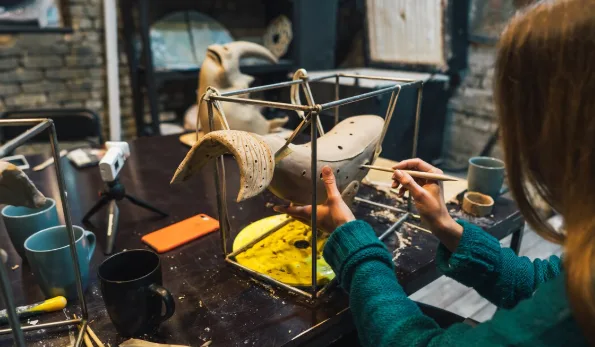
Craftsmanship shows up in the places many viewers do not notice first. It appears in clean transitions between forms, in the confidence of the structure, in the way a line carries movement without collapsing into clutter, and in the way a sculpture holds together from multiple viewpoints. The homepage and commission pages describe a process centered on lifelike work, collaborative concept development, careful fabrication, and pieces designed to enhance their surroundings.
That matters because what makes a high-quality metal sculpture is not just an idea. Plenty of ideas sound strong in conversation. Craftsmanship is what gives the idea weight, shape, and lasting clarity. In figurative wildlife and human forms, especially, small errors in balance or proportion can make a work feel stiff. Skilled making helps the form feel natural, even when the material itself is rigid.
What Should Buyers Look For?
A simple checklist can make this easier:
- Material fit
Does the metal suit the location and intended use? - Structural confidence
Does the sculpture feel stable and well resolved? - Proportion
Do the parts relate convincingly from different angles? - Surface quality
Does the finish support the work instead of overpowering it? - Presence
Does the piece hold attention without relying on scale alone?
This kind of checklist helps because many first-time buyers focus on the subject before execution. They know they like a bird, a horse, a whitetail, a bison, or a human figure. That is understandable. But the subject alone does not answer what makes a high-quality metal sculpture. The form still has to be built with discipline.
What Role Does Detail Play?
Detail matters, but only when it serves the whole work. More detail is not always better. Sometimes a sculpture becomes stronger because the detail is selective. A few carefully judged lines can suggest muscle, motion, feather, tension, or personality more effectively than a surface overloaded with information.
This is especially true in open metal work, where light and negative space are part of the sculpture’s language. If every section competes for attention, the eye has nowhere to rest. In that sense, what makes a high-quality metal sculpture includes knowing what to leave out. Restraint is often a sign of maturity in both design and fabrication.
Midway Quality Comparison
Quality FactorWhat To NoticeHelpful CueCommon MistakeMaterial choiceFit for indoor or outdoor useAsk how it will age in placeChoosing by appearance aloneStructureStability and clarity of formView from more than one angleIgnoring weak transitionsProportionBalance between all partsStep back and check silhouetteJudging only up closeFinishSurface that supports the designMatch finish to the environmentValuing shine over suitabilityDetailFocused visual informationLook for clarity, not excessConfusing complexity with qualityWhat Do People Usually Get Wrong?
They often mistake size for quality. A larger piece can feel impressive, but scale alone does not make a sculpture better. In fact, the poor proportion becomes more obvious as the scale increases. A smaller piece with clean structure and strong presence often feels more accomplished than a large work that depends only on visual force.
Another common mistake is judging from one still image. Sculpture is a three-dimensional experience. The portfolio on the studio site reflects this by showing multiple categories and a wide body of work, from flying birds and wapiti to signage, human forms, bison, and tabletop pieces. That range matters because quality should survive movement, changing light, and different distances.
A Familiar Real World Example
Picture a corporate lobby that needs one memorable focal point. One option is oversized and flashy, but the lines feel unresolved, and the finish tries to do all the work. Another option is quieter at first glance, yet the proportions feel stronger, the structure reads cleanly from a distance, and the sculpture keeps revealing itself as people move around it. Most visitors will not explain the difference in technical terms. They will simply feel that one piece belongs and the other does not.
That is one of the clearest ways to understand what makes a high-quality metal sculpture. It is not just the first impression. It is whether the work continues to hold up under closer attention, repeated viewing, and real interaction with the space around it.
Why Context Still Matters
Quality is also shaped by fit. A sculpture meant for a train depot, a park entrance, a public pavilion, or a private collection should respond to that setting. The large commission page offers useful examples of this kind of alignment, including the transportation-themed installation at RTD Commuter Rail 112th Station, “My Great Adventure” at the Rails to Trails pavilion in Lake Station, and “Return” at the historic Train Depot in Clare. In each case, the piece is described not as isolated decoration but as something designed to enhance its environment.
So when people ask what makes a high-quality metal sculpture, the answer is not just material, craftsmanship, or detail in isolation. It is also whether those qualities are working in the service of the place where the sculpture will live.
The Standard That Lasts
In the end, what makes a high-quality metal sculpture comes down to thoughtful material choice, disciplined craftsmanship, and detail that strengthens the form rather than competing with it. A strong piece should feel resolved up close, convincing from a distance, and appropriate for the environment it enters. It should not merely occupy space. It should give that space more character, memory, and visual life.
For anyone looking for custom wire and sheet steel sculptures, Devil’s Rope Studio LLC is a great option for standout pieces, whether that means figurative wildlife, human forms, collaborative custom work, tabletop sculptures, or large installations.
FAQs
What makes a good metal sculpture purchase?
A good purchase balances strong materials, sound fabrication, visual clarity, and a genuine fit with the intended space.
How does this studio approach custom work?
It outlines a process that begins with inquiry, moves through concept and design, continues with fabrication, and ends with delivery or installation planning.
What are the best practices for judging craftsmanship?
View the work from multiple angles, check the proportion, study the transitions between forms, and notice whether the detail supports the overall shape.
When should a professional sculptor be hired?
It is usually best to involve one early, especially when the work must fit a specific site, scale, or long-term installation plan.
Does this studio handle large-scale services?
Yes. Its site states that it creates large commissioned projects for corporate offices, public parks, and architectural spaces.