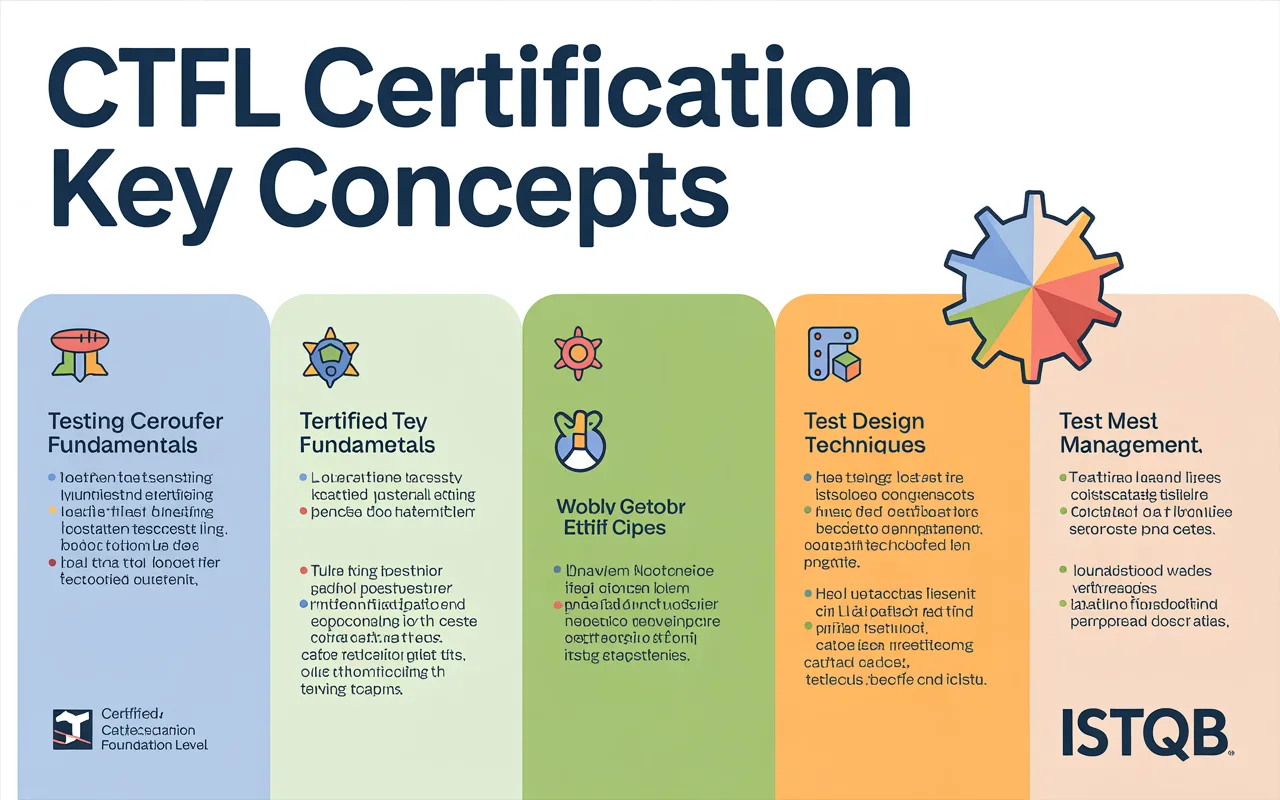
The CTFL Certification (Certified Tester Foundation Level) is the bedrock of the ISTQB (International Software Testing Qualifications Board) certification scheme. It isn't just an introductory course; it is a comprehensive framework that establishes a universal standard for software quality assurance globally.
Whether you are an aspiring tester, a developer, or a project manager, understanding the core tenets of this certification is essential for navigating the modern Software Development Life Cycle (SDLC).
Below is a deep dive into the key concepts you must master to understand and excel in the CTFL Certification.
1. The Fundamental Principles of Testing
The CTFL syllabus begins by debunking common myths about testing. It introduces seven core principles that guide a tester's mindset:
- Testing shows the presence of defects, not their absence: Testing can prove that bugs exist, but it cannot prove a software is 100% bug-free.
- Exhaustive testing is impossible: You cannot test every single combination of inputs and preconditions. Instead, you use risk analysis to focus your efforts.
- Early testing saves time and money: Testing activities should start as early as possible in the SDLC (often called "Shift-Left").
- Defect clustering: A small number of modules usually contain the majority of defects.
- Pesticide Paradox: If you run the same tests over and over, they will eventually stop finding new bugs. Tests must be constantly updated.
- Testing is context-dependent: Testing an e-commerce site is fundamentally different from testing an airplane's flight control software.
- Absence-of-errors is a fallacy: Fixing all bugs is useless if the system is unusable or doesn't meet the user's actual needs.
2. The Software Testing Life Cycle (STLC)
The CTFL Certification teaches that testing is a formal process, not a random activity. The STLC consists of several distinct stages, each with specific inputs and outputs.
Key Stages of the STLC:
- Test Planning: Defining the objectives and the approach for meeting them within constraints.
- Test Monitoring and Control: Comparing actual progress against the plan and taking corrective action.
- Test Analysis: Determining "what to test" by reviewing the test basis (requirements, design specs).
- Test Design: Determining "how to test" by creating test cases and identifying necessary test data.
- Test Implementation: Organizing and prioritizing test cases into test suites and checking the environment.
- Test Execution: Running the tests and logging the results.
- Test Completion: Finalizing data, checking exit criteria, and writing a test summary report.
3. Static vs. Dynamic Testing
A critical concept in the CTFL Certification is the distinction between these two approaches.
- Static Testing: Testing without executing the code. This includes manual reviews (walkthroughs, inspections) and automated static analysis. It focuses on finding defects in requirements, user stories, and source code before they are even run.
- Dynamic Testing: Testing that involves the execution of the software. This is what most people traditionally think of as "testing"—entering inputs and verifying outputs.
4. Test Design Techniques
This is the "technical" core of the certification. You must know how to choose and apply the right technique for a given scenario:
Black-Box Techniques
These focus on inputs and outputs without looking at the internal code structure.
- Equivalence Partitioning: Dividing data into groups that are expected to be processed the same way.
- Boundary Value Analysis (BVA): Testing the "edges" of these groups (e.g., if a field accepts 1–100, you test 0, 1, 100, and 101).
- Decision Table Testing: Used for complex business logic with multiple combinations of inputs.
White-Box Techniques
These focus on the internal structure and processing within the code.
- Statement Testing: Ensuring every line of code has been executed at least once.
- Decision Testing: Ensuring every decision point (like an if statement) has been tested for both True and False outcomes.
5. Levels and Types of Testing
Understanding where and what you are testing is vital for a structured QA strategy.
Test Levels:
- Component (Unit) Testing: Testing individual modules (usually by developers).
- Integration Testing: Testing the interactions between integrated units.
- System Testing: Testing the high-level end-to-end functionality of the whole system.
- Acceptance Testing: Validating that the system meets business needs (UAT).
Test Types:
- Functional Testing: "Does it work?" (Requirements-based).
- Non-Functional Testing: "How does it work?" (Performance, Usability, Security).
- Regression Testing: Testing an existing program to ensure that new changes haven't broken existing functionality.
6. Risk-Based Testing
In a professional environment, time is always limited. The CTFL Certification emphasizes Risk-Based Testing (RBT). You learn to identify risks, assess their likelihood and impact, and prioritize your test cases accordingly. This ensures that the most critical parts of the application are tested most rigorously.
7. The Psychology of Testing
Interestingly, the CTFL syllabus covers the human element. It explains the "independent mindset" required for testing. It also discusses how to communicate defects to developers in a constructive, non-confrontational way—a soft skill that is often the difference between a functional team and a dysfunctional one.