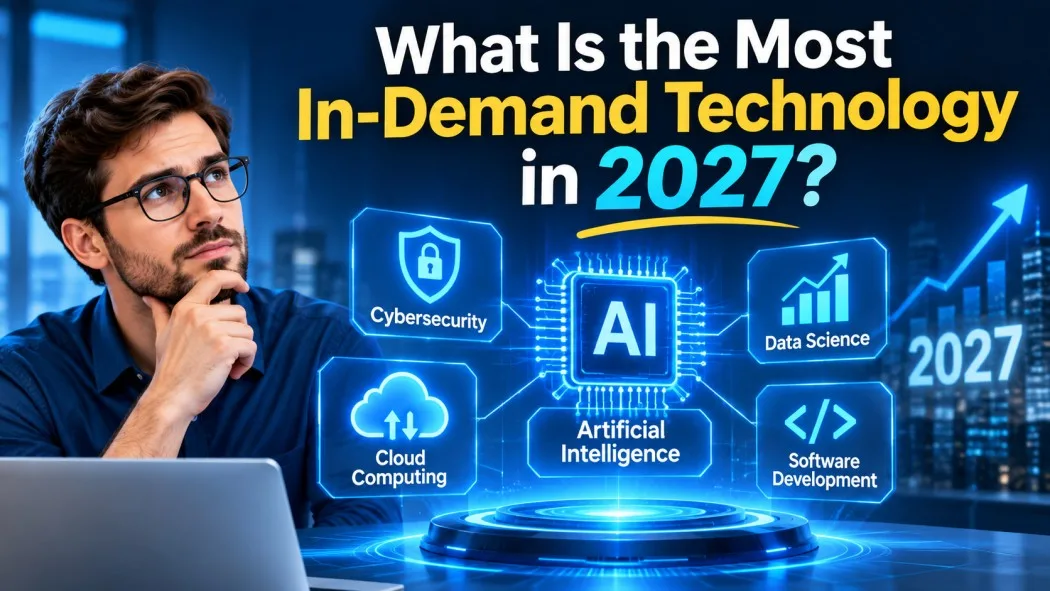
Technology continues to transform how people work, communicate, and do business. In 2027, Artificial Intelligence (AI) is expected to remain one of the most in-demand technologies across multiple industries. Businesses are investing in automation, intelligent software, data analysis, and digital security. However, AI is not the only growing field. Cybersecurity, cloud computing, and data science are also creating valuable career opportunities. Understanding these technologies can help students, professionals, and business owners prepare for the future.
1. Artificial Intelligence (AI) and Machine Learning
Artificial Intelligence is one of the leading technologies shaping the future. It allows computers and software to perform tasks that traditionally require human intelligence.
Machine learning, a branch of AI (Learn more), helps systems learn from data and improve their performance.
In 2027, businesses are expected to use AI for:
- Automating repetitive business tasks.
- Improving customer service through AI chatbots.
- Analyzing large amounts of business data.
- Creating content, images, and software.
- Improving business decisions and productivity.
AI engineering, machine learning, and AI automation are valuable skills for people interested in building a technology career.
2. Cybersecurity
As businesses move more operations online, protecting digital information becomes increasingly important. Cybersecurity focuses on protecting computers, networks, applications, and sensitive data from cyberattacks.
Organizations need skilled professionals to identify security weaknesses and prevent data breaches.
Important cybersecurity skills include:
- Network security.
- Ethical hacking.
- Cloud security.
- Security monitoring.
- Risk management.
According to the U.S. Bureau of Labor Statistics, employment of information security analysts is projected to grow 28.5% between 2024 and 2034. This highlights the strong demand for cybersecurity expertise.
3. Data Science and Big Data
Data science helps businesses understand information and make better decisions. Companies collect enormous amounts of data from websites, applications, customers, and online transactions.
Data scientists analyze this information to identify patterns, predict trends, and solve business problems.
Some important data science skills include:
- Python programming.
- SQL and database management.
- Statistical analysis.
- Data visualization.
- Machine learning.
The U.S. Bureau of Labor Statistics projects 33.5% employment growth for data scientists between 2024 and 2034, making this one of the fastest-growing occupations in the United States.
4. Cloud Computing
Cloud computing allows businesses to store information, run applications, and access computing resources through the internet.
Instead of maintaining expensive physical servers, companies can use cloud platforms to manage their digital operations.
Popular cloud platforms include Amazon Web Services (AWS), Microsoft Azure, and Google Cloud.
Cloud computing offers several advantages:
- Flexible storage and computing resources.
- Lower infrastructure maintenance.
- Remote access to business applications.
- Improved collaboration.
- Scalable business operations.
Cloud engineering, cloud security, and cloud architecture are useful skills for aspiring IT professionals.
5. Software Development and Automation
Software development remains an important technology field in 2027. Businesses need applications, websites, and digital platforms to serve customers and improve their operations.
Automation also helps organizations reduce repetitive work and increase productivity.
Popular programming technologies include Python, JavaScript, Java, and other modern development tools.
People interested in this field can explore web development, mobile application development, software engineering, and DevOps.
Which Technology Should You Learn in 2027?
The best technology to learn depends on your interests, existing knowledge, and career goals.
Here is a simple comparison:
| Technology | Best For |
|---|---|
| Artificial Intelligence | Automation and intelligent applications |
| Cybersecurity | Protecting systems and digital information |
| Data Science | Analyzing data and predicting trends |
| Cloud Computing | Managing online infrastructure |
| Software Development | Building websites and applications |
The World Economic Forum's Future of Jobs Report 2025 identifies AI and big data as the fastest-growing skills, followed by networks and cybersecurity and technological literacy.
For beginners, learning Python, basic programming, and AI fundamentals can provide a useful starting point.
Conclusion
Artificial Intelligence is a strong contender for the most in-demand technology in 2027 because businesses are increasingly adopting intelligent tools and automation. However, cybersecurity, data science, cloud computing, and software development also offer promising opportunities. The best approach is to choose a technology that matches your interests and build practical skills through consistent learning and real-world projects. Staying updated with industry developments can help you remain competitive in the changing technology landscape.
Frequently Asked Questions
1. What is the most in-demand technology in 2027?
Artificial Intelligence (AI) is among the most in-demand technologies in 2027. Machine learning, AI automation, and intelligent applications are attracting significant business investment.
2. Which technology is best for beginners in 2027?
Python programming and AI fundamentals are good starting points for beginners. They provide a foundation for exploring machine learning, data science, and automation.
3. Is cybersecurity a good career choice in 2027?
Yes. Cybersecurity is a promising career field because businesses need professionals who can protect their networks, applications, and sensitive information.
4. Will AI replace software developers?
AI can automate some programming tasks, but software developers remain important. Businesses still need professionals who can design systems, solve complex problems, test applications, and manage software projects.