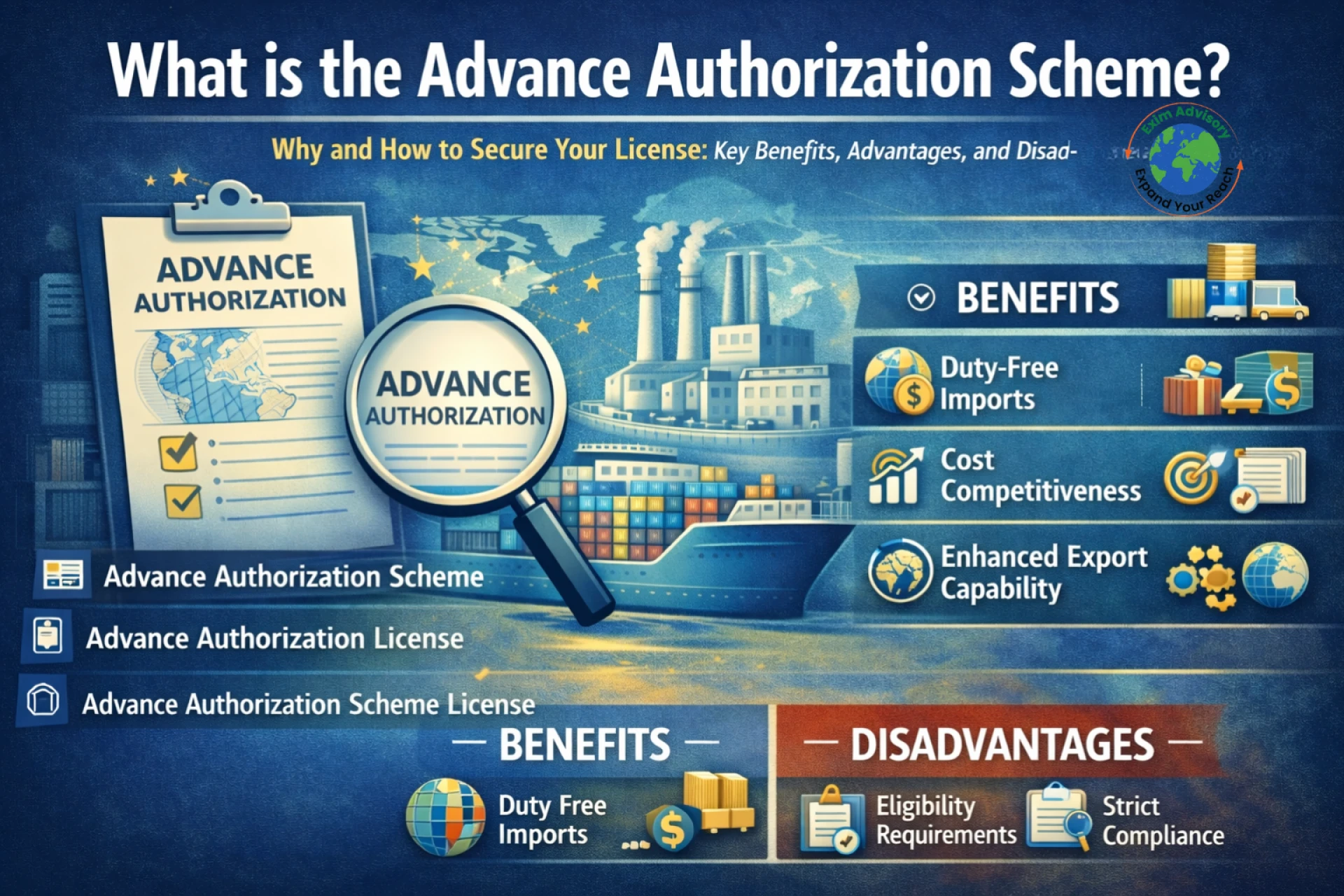
Introduction: For Indian manufacturers looking to scale their exports, paying heavy import duties on raw materials is a massive drain on working capital. The Advance Authorization Scheme is a highly strategic government mechanism designed to solve this exact problem. By allowing businesses to import critical inputs completely duty-free provided those inputs are used to manufacture export goods enterprises can drastically lower their production costs. Partnering with elite trade consultants ensures you navigate the Directorate General of Foreign Trade (DGFT) portals flawlessly, securing your license without regulatory friction.
What is the Advance Authorization Scheme?
What exactly does this scheme do for an active manufacturer and exporter?
At its core, it is a powerful cash-flow preservation tool. Normally, when you import raw materials, components, or packaging, you must pay upfront basic customs duties, education cesses, and sometimes anti-dumping duties. The Advance Authorization Scheme acts as a legal waiver for these taxes.
The government essentially allows you to bring these materials into India for free, strictly on the condition that you will add value to them (manufacture them into a finished product) and export them within a specific timeframe. The DGFT uses Standard Input Output Norms (SION) to calculate exactly how much raw material you are allowed to import duty-free based on the volume of the final product you intend to export. This ensures that the tax benefit is used exclusively to boost India’s export economy, not for domestic market dumping.
Why Do Ambitious Exporters Need an Advance Authorization License?
Why should a company go through the trouble of getting this license instead of just paying duties and claiming a refund later?
Relying on post-export duty refunds (like the Duty Drawback scheme) means your capital is trapped with the government for months. If you are executing a massive international order, tying up millions of rupees in customs duties severely limits your operational agility.
An Advance Authorization License stops the cash outflow at the border. By not paying the duty in the first place, your working capital remains highly liquid. You can use that saved cash to negotiate better bulk rates with your foreign suppliers, invest in better manufacturing technology, or offer more aggressive pricing to outbid international competitors on global tenders. Furthermore, this specific authorization allows for the duty-free import of mandatory spares (up to 10% of the CIF value), which is a massive advantage for high-tech and heavy machinery exporters.
How Do You Successfully Apply for and Manage This Scheme?
How does an enterprise actually secure this authorization from the government?
Getting approved requires precise technical documentation and a flawless export commitment plan. You cannot simply estimate your raw material needs; you must mathematically prove them.
The process begins by submitting an application through the DGFT's digital portal. You must provide a detailed breakdown of your export product, the exact technical specifications of the inputs you need to import, and commercial invoices.
The most critical step is proving your "Value Addition" the scheme mandates a minimum of 15% value addition (the difference between the export value of the finished goods and the import value of the raw materials). Once the DGFT evaluates and approves your metrics, the license is issued. However, management does not stop there; you must meticulously track every imported input and file proof of your final exports (Export Obligation Discharge Certificate) to formally close the license.
What Are the Direct Benefits of the Advance Authorization Scheme License?
What is the bottom-line financial impact of integrating this license into your supply chain?
The financial and operational benefits of an Advance Authorization Scheme License hit your profit margins directly:
- Zero Upfront Import Taxes: Completely waives Basic Customs Duty, Additional Customs Duty, Education Cess, and Anti-dumping Duty on critical inputs.
- Enhanced Global Competitiveness: Because your raw material costs are fundamentally lower, you can price your finished export products much more aggressively in foreign markets.
- Improved Cash Flow: Keeps your working capital in your bank account rather than locked up in government tax deposits.
- Supply Chain Flexibility: Allows for the import of items that are otherwise restricted or strictly regulated, provided they are tied directly to an export obligation.
Advantages and Disadvantages of Managing Authorizations In-House
Should your internal logistics team handle the DGFT portal, or should you hire external trade experts?
Business leaders must weigh the operational risks of handling complex government compliance internally.
Strategic Factor
Advantages of Outsourcing to Experts
- Flawless Documentation: External consultants specialize in SION calculations and technical matching, ensuring your application is rarely rejected.
- Obligation Tracking: Experts actively monitor your Export Obligation (EO) periods, ensuring you never miss a deadline and face compounding government penalties.
- Speed of Issuance: Experienced advisors navigate the DGFT bureaucracy daily, dramatically accelerating the time it takes to get your authorization physically issued.
Disadvantages (and How to Mitigate):
- Flawless Documentation: Requires sharing sensitive manufacturing formulas. (Mitigation: Use strict Non-Disclosure Agreements with highly reputable advisory firms.)
- Obligation Tracking: Incurs an upfront consulting fee. (Mitigation: The fee is negligible compared to the massive duty savings and penalty avoidance.)
- Speed of Issuance: Internal teams may feel bypassed. (Mitigation: Integrate the consultants directly with your supply chain managers to create a seamless workflow.)
How ASC Group Helps
How do our trade experts guarantee your duty-free supply chain runs without friction?
Navigating the dense regulatory requirements of the DGFT takes valuable time away from your core business of manufacturing. Operating as your dedicated trade compliance partner, the experts at ASC Group handle the entire lifecycle of your Advance Authorization Scheme License.
We do the heavy regulatory lifting: calculating precise input-output norms, filing flawless online applications, and actively liaising with customs authorities to secure your approvals rapidly. We also take over the highly complex post-import tracking, managing your Export Obligation extensions and securing your final redemption certificates. By managing your end-to-end compliance, ASC Group ensures you maximize your tax savings, avoid severe penalties, and scale your global exports with total peace of mind.
Conclusion: Dominating the Global Supply Chain
What is the final takeaway for manufacturers looking to maximize their export profitability?
In a hyper-competitive global market, treating heavy import duties as an unavoidable cost of doing business is a major strategic error. The enterprises that dominate international trade do so by aggressively optimizing their supply chains. By proactively integrating the Advance Authorization Scheme into your procurement strategy, you instantly lower your production friction and boost your pricing power. Forward-thinking exporters leverage expert trade advisory to secure these licenses efficiently, transforming complex government compliance into a powerful, automated engine for international profitability.
Frequently Asked Questions (FAQs)
1. What is the minimum value addition required under the Advance Authorization Scheme?
The standard minimum value addition required by the DGFT is 15%. However, for certain specific products (like tea or specific electronics), the government sets different, tailored value addition percentages.
2. What happens if I fail to meet my export obligation within the given timeframe?
If you import materials duty-free but fail to export the finished goods (usually within 18 months), you are legally required to pay the original customs duties you were exempted from, plus severe, compounding interest penalties (often around 15% per annum).
3. Can I buy raw materials from domestic suppliers under this scheme?
Yes. You can use an Advance Release Order (ARO) or an Invalidation Letter. This allows you to source the required inputs from an indigenous (domestic) supplier instead of importing them, and the domestic supplier can claim deemed export benefits.
4. Is the Advance Authorization License transferable to another company?
No. Unlike the Duty Free Import Authorisation (DFIA) scheme, the Advance Authorization is issued with "Actual User" conditions. This means the imported materials must be strictly used by the license holder in their own manufacturing facility and cannot be sold or transferred.
5. How are the allowed import quantities calculated if my product does not have a standard norm (SION)?
If your specific export product does not fall under the pre-published Standard Input Output Norms (SION), you can apply for an authorization under "self-declaration" or "ad-hoc norms," where a special DGFT committee will evaluate your technical data to determine the allowed import quantities.