INTRODUCTION
You do not need a massive budget or a global brand to win online. If your business serves a local area, local SEO is quite possibly the single most cost-effective marketing strategy available to you — and most small business owners are barely using it.
Every day, millions of people open their phones and search for things like "dentist near me," "best biryani in Karama," or "AC repair Dubai." These searches have a clear, immediate intent — the person wants to visit or contact a business nearby. Local SEO is the process of making sure your business appears in front of those people at exactly that moment.
This guide will walk you through everything you need to know — what local SEO actually is, why it works, what it involves, and how small businesses can start benefiting from it today. No fluff, no complicated jargon. Just clear, practical information.
UNDERSTANDING LOCAL SEO
What Does "Local SEO" Actually Mean?
SEO stands for Search Engine Optimization — the practice of improving your website and online presence so that search engines like Google show your business higher in search results. Local SEO is a specific branch of this that focuses on geographic relevance. Instead of trying to rank for broad terms like "accounting services," local SEO helps you rank for "accounting services in Business Bay" or "accountant near me."
The key difference is intent. When someone searches with a location in mind, they are usually much closer to making a decision. They want someone nearby, someone they can visit, call, or trust. That makes local search traffic far more valuable than general web traffic for most small businesses.
Key Insight:
A visitor from a local search is not just browsing — they are often ready to buy. That is why local SEO typically delivers a better return on investment than most other forms of digital marketing for location-based businesses.
The Local Pack — The Most Valuable Real Estate on Google
When you search for a local business, Google usually shows three listings in a box near the top of the page — sometimes above the regular website results. This is called the "Local Pack" or "Map Pack." It shows the business name, rating, address, and sometimes a phone number or hours.
Getting into this pack is the primary goal of local SEO. Studies consistently show that these three listings receive the majority of clicks from local searches. If you are not in the pack, you are invisible to a huge portion of potential customers — even if you have a great website.
Quick Stats:
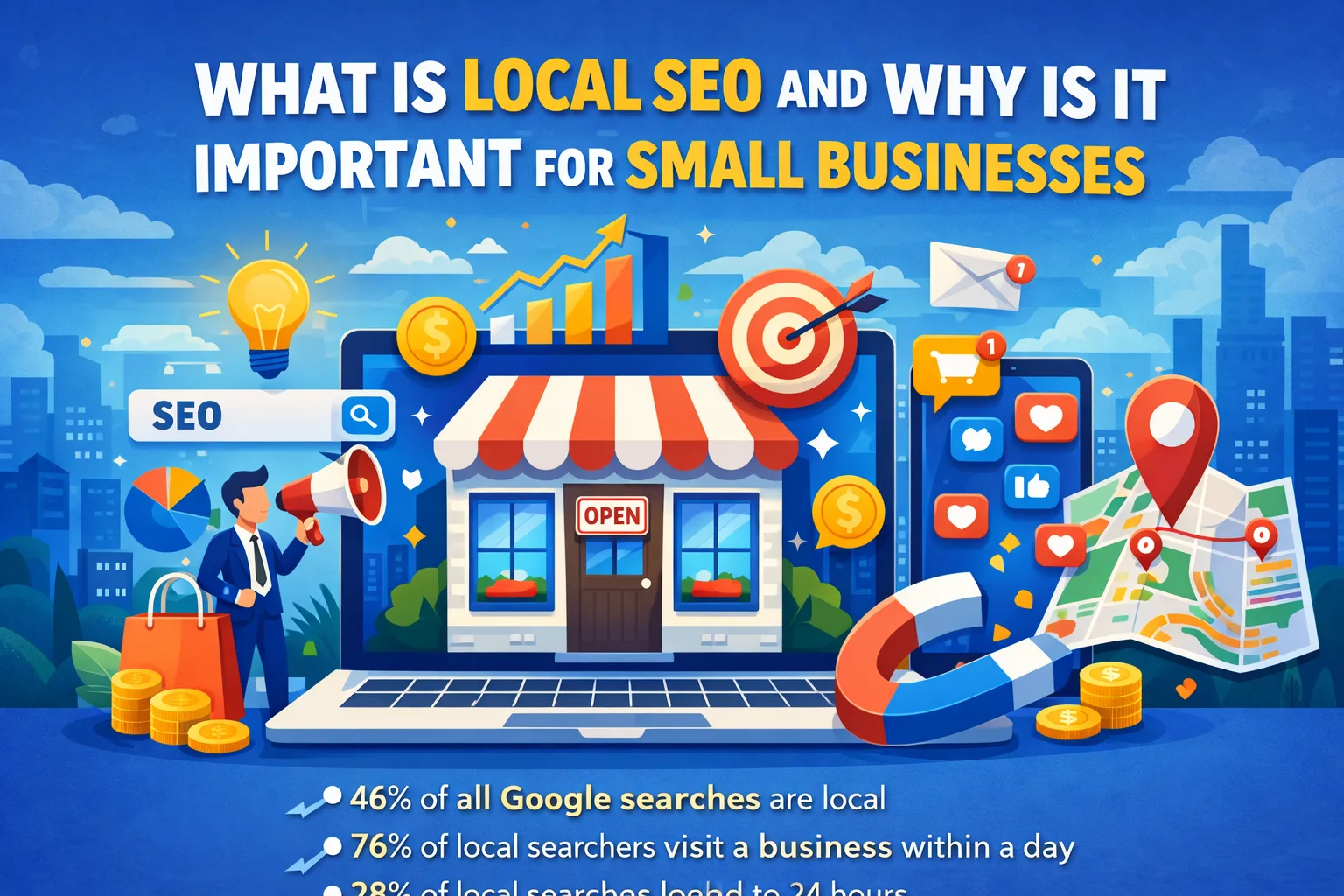
- 46% of all Google searches are looking for local information
- 76% of people who search locally visit a business within a day
- 28% of local searches result in a purchase within 24 hours
- Local search traffic is 3x more likely to convert than non-local traffic
WHY LOCAL SEO MATTERS SO MUCH FOR SMALL BUSINESSES
Large corporations already have enormous advantages in regular SEO — millions of backlinks, decades of domain history, and teams of specialists. Competing with them for broad search terms is nearly impossible for a small business. But local SEO is different.
A small family restaurant in Deira can outrank a global fast-food chain in local search if it is better optimized. A boutique law firm in Abu Dhabi can appear above a multinational firm when someone searches for a lawyer nearby. Local relevance beats brand size, and that is genuinely exciting for small business owners.
The Cost Advantage
Unlike paid advertising, where visibility stops the moment your budget runs out, local SEO builds something that lasts. A well-optimized Google Business Profile and a strong set of reviews can keep bringing in customers for months and years with very little ongoing cost. It is one of the rare forms of marketing where your past efforts keep compounding.
Trust and Credibility
Appearing at the top of local search results also signals trust to potential customers. Most people assume that Google has "vetted" the top results in some way. A high-ranking local business profile — especially one with strong reviews — instantly appears more established and reliable, even if the business is relatively new.
Mobile Search Has Changed the Game
Over 60% of local searches now happen on mobile devices. People search while they are commuting, walking through a mall, or sitting at a café. These searches are spontaneous and urgent — and the business that shows up first almost always wins. If your business is not optimized for local search, you are missing these moments entirely.
THE CORE ELEMENTS OF LOCAL SEO
Local SEO is not a single action — it is a combination of several things working together. Here are the most important elements:
1. Google Business Profile
This is the foundation of everything. Your Google Business Profile (formerly Google My Business) is the free listing that appears in the Local Pack and on Google Maps. Claiming and fully optimizing this profile is the single most important thing any local business can do.
What to do:
- Add your exact business name, address, and phone number
- Select the most accurate business category
- Upload high-quality photos of your premises, products, or team
- Write a clear, natural business description
- Keep your opening hours updated, especially during holidays
- Use the "Posts" feature to share offers or news regularly
2. NAP Consistency
NAP stands for Name, Address, and Phone number. These three details need to be exactly identical everywhere your business is listed online — your website, Google, Facebook, Instagram, local directories, and review sites. Even small differences like "St." versus "Street" or a slightly different phone number format can confuse search engines and hurt your rankings.
3. Online Reviews
Reviews are one of the most powerful ranking signals in local SEO, and they also directly influence whether a potential customer chooses you over a competitor. A business with 80 four-star reviews will almost always rank higher and convert better than one with 5 reviews — even if the second business's website is technically better optimized.
The best way to get reviews is simply to ask. After a positive interaction, let your customers know you would appreciate a Google review. You can send a follow-up message with a direct link. Most happy customers are willing to help — they just need a nudge.
Pro Tip:
Always respond to reviews — both positive and negative. Responding shows potential customers that you are attentive and professional. For negative reviews, a calm, helpful response can actually increase trust rather than damage it.
4. On-Page Local SEO
Your website itself needs to speak to search engines in a local language. This means including your city, area, or neighborhood naturally throughout your content, page titles, and headings. If you serve multiple areas, consider creating separate pages for each location with unique, useful content — not just the same page copied with different city names.
5. Local Citations and Directories
A "citation" is any online mention of your business's name, address, and phone number. Getting listed in reputable local directories — such as Yelp, Foursquare, TripAdvisor, Yellow Pages, and industry-specific platforms — strengthens your local SEO signals. The more consistently your information appears across the web, the more confident Google becomes about your business's legitimacy and location.
6. Local Backlinks
Backlinks (links from other websites to yours) are important in all SEO, and local backlinks carry extra weight for local rankings. Getting mentioned or linked to by local news outlets, community blogs, business associations, or event sponsors is a strong signal that your business is genuinely embedded in the local community.
A PRACTICAL STARTING PLAN FOR SMALL BUSINESSES
If you are new to local SEO, it can feel overwhelming. Here is a simple sequence to follow that will give you the best results with the least wasted effort:
Step 1: Claim and complete your Google Business Profile
Fill in every section. Add photos. Pick the right category. This alone can produce visible results within a few weeks.
Step 2: Audit your NAP consistency
Search your business name online and check that your address and phone number are identical everywhere you appear.
Step 3: Ask for reviews
Reach out to your five most loyal customers and ask them to leave a Google review. Then build a habit of asking every satisfied customer going forward.
Step 4: Optimize your website for your city
Make sure your city and neighbourhood appear naturally in your homepage title, meta description, and body content.
Step 5: Get listed in local directories
Submit your business to five to ten relevant directories with consistent information.
Step 6: Create local content regularly
Write a blog post or FAQ page once a month that addresses questions your local customers actually ask.
COMMON LOCAL SEO MISTAKES TO AVOID
1. Inconsistent contact details
Different phone numbers or address formats across platforms confuse Google and reduce your ranking potential.
2. Ignoring reviews
Not asking for reviews — or not responding to them — is a missed opportunity that competitors will exploit.
3. Wrong business category
Choosing a vague or incorrect category on Google Business Profile means appearing in the wrong searches.
4. No local content
A generic website with no mention of your city or area gives Google no reason to show you in local results.
5. Outdated opening hours
Wrong hours on your profile can send customers to a closed door — and earn you a bad review instantly.
6. Keyword stuffing
Forcing location keywords into every sentence reads unnaturally and can actually harm your rankings.
WHEN TO BRING IN PROFESSIONAL HELP
For many small business owners, handling local SEO themselves is perfectly achievable — especially when starting. The fundamentals are learnable, and the basic tools are free. But there comes a point where professional guidance saves both time and money.
If you operate in a competitive market, have multiple locations, or do not have the time to stay on top of updates, partnering with a reliable Digital Marketing Agency in Dubai can make a significant difference. A good agency will audit your current presence, identify gaps, build a consistent strategy, and track results so you always know what is working.
The key is choosing a partner that focuses on long-term organic growth rather than quick fixes. Local SEO done right takes a few months to show full results, but the returns are durable. A business that ranks well organically in its area will keep receiving high-intent traffic without paying for every click.
Questions to Ask a Potential SEO Partner:
Ask them how they measure success, how they build local citations, whether they provide monthly reporting, and what their approach is to review management. Their answers will quickly tell you whether they understand local SEO or are just selling generic packages.
WHAT TO EXPECT AND HOW LONG IT TAKES
One of the most common questions from small business owners is: "How long before I see results?" The honest answer is that meaningful improvements typically appear within three to six months. Some changes — like completing your Google Business Profile — can show results within weeks. Building a strong review profile and earning local backlinks takes longer but has a compounding effect over time.
Local SEO is not a sprint. It is more like tending a garden — the more consistently you invest in it, the stronger it grows. A business that has been working on local SEO for two years will have a structural advantage over a competitor that has just started, because trust, citations, and reviews accumulate over time.
The businesses that give up after two months are often the ones that would have seen results in month four. Consistency is the real secret.
FINAL THOUGHTS
Local SEO is one of the most powerful tools available to small businesses — and it is accessible to anyone willing to put in consistent effort. You do not need a big budget. You do not need to be a technology expert. You need a complete Google Business Profile, genuine customer reviews, a website that speaks your city's language, and the patience to let it build over time.
Whether you manage it yourself or work with a trusted Digital Marketing Agency in Dubai, the businesses that invest in local search today are the ones that will dominate their local markets tomorrow. Start with the basics, be consistent, and the results will follow.