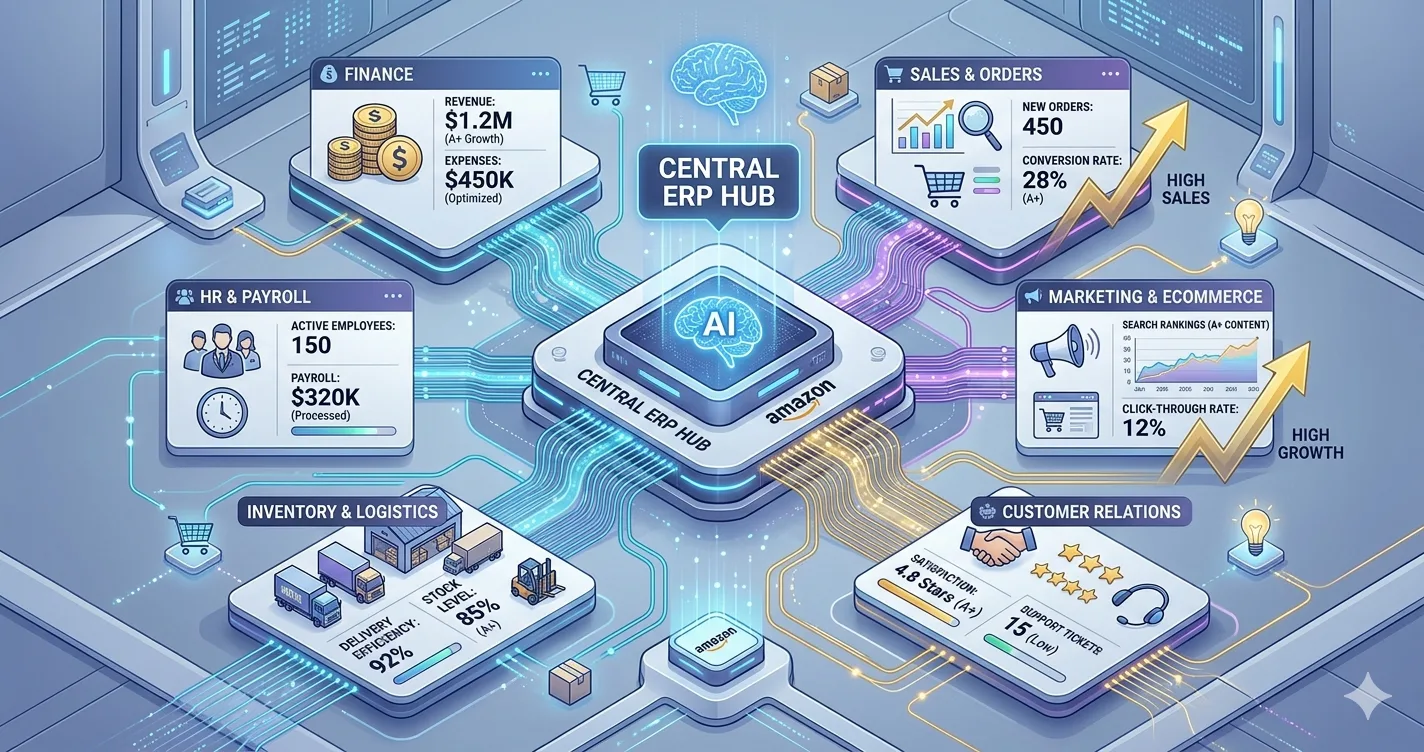
Most businesses don’t fail because of a lack of effort—they struggle because their operations become too complex to manage.
As companies grow, managing data, processes, and teams across different departments becomes increasingly difficult. This is where Enterprise Resource Planning (ERP) systems come into play, helping businesses bring everything together, streamline operations, and significantly improve efficiency.
What Is ERP?
Enterprise Resource Planning (ERP) is a type of software that integrates and manages core business processes within a single system.
Instead of using separate tools for each department, ERP systems connect everything—from finance and inventory to human resources and customer data—into one unified platform.
Core functions of an ERP system include:
- Financial management
- Inventory and supply chain management
- Human resources (HR)
- Customer relationship management (CRM)
- Procurement and operations
According to SAP’s ERP overview, ERP systems provide a centralized database that ensures all departments work with consistent and accurate information.
Why Businesses Need ERP Systems
As businesses scale, operational challenges increase.
Common problems without ERP:
- Data scattered across multiple systems
- Manual processes causing delays
- Lack of real-time visibility
- Inefficient communication between departments
- Increased risk of errors
ERP systems address these issues by creating a unified, streamlined operational environment.
How ERP Systems Improve Business Efficiency
1. Centralized Data Management
One of the biggest advantages of ERP is having a single source of truth.
Benefits include:- Real-time access to accurate data
- Improved collaboration across teams
- Faster decision-making
According to Oracle’s ERP insights, centralized data helps organizations eliminate inconsistencies and improve operational efficiency.
2. Automation of Business Processes
Manual tasks consume time and increase the risk of errors.
ERP systems automate:
- Invoice processing
- Order management
- Payroll and HR tasks
- Inventory updates
- Reduced manual workload
- Faster operations
- Increased accuracy
3. Improved Workflow Efficiency
ERP systems streamline workflows by connecting different processes.
Example:When a customer places an order:
- Inventory updates automatically
- Finance records the transaction
- Shipping is triggered
This eliminates delays and ensures smooth operations.
4. Real-Time Reporting and Analytics
Data-driven decisions are essential for growth.
ERP systems provide:
- Real-time dashboards
- Performance reports
- Financial insights
According to Tableau’s data insights, organizations using real-time analytics outperform competitors in efficiency and decision-making.
5. Enhanced Collaboration Across Departments
When teams work in silos, efficiency drops.
ERP systems enable:
- Shared access to data
- Better communication
- Coordinated workflows
This improves productivity and reduces misunderstandings.
Real-World Scenario: Life Before and After ERP
Without ERP:
- Teams use separate tools
- Data inconsistencies are common
- Processes are slow and manual
- Decision-making is delayed
With ERP:
- All departments work on one system
- Data is consistent and updated in real time
- Processes are automated
- Decisions are faster and more accurate
The difference is not just efficiency—it’s operational clarity.
Key Benefits of ERP Systems
1. Increased Productivity
Automation and streamlined workflows reduce time spent on manual tasks.
2. Better Decision-Making
Access to real-time data enables smarter business decisions.
3. Cost Reduction
ERP systems reduce operational costs by improving efficiency and minimizing errors.
4. Scalability
ERP systems grow with your business, supporting expansion without operational disruptions.
5. Improved Customer Experience
Efficient processes lead to faster service and better customer interactions.
Types of ERP Systems
1. On-Premise ERP
- Installed on company servers
- Full control over data
- Requires higher upfront investment
2. Cloud-Based ERP
- Hosted on the cloud
- Accessible from anywhere
- Lower upfront costs
According to AWS cloud computing insights, cloud-based ERP systems offer flexibility and scalability for modern businesses.
3. Hybrid ERP
- Combination of on-premise and cloud solutions
- Balances control and flexibility
Common Challenges in ERP Implementation
While ERP systems offer many benefits, implementation can be complex.
Common challenges include:
- High initial investment
- Resistance to change from employees
- Data migration issues
- Lack of proper training
Best Practices for Successful ERP Implementation
1. Define Clear Objectives
Understand what you want to achieve with ERP.
2. Choose the Right System
Select an ERP solution that fits your business needs.
3. Ensure Proper Training
Help employees understand how to use the system effectively.
4. Focus on Data Accuracy
Clean and organize data before migration.
5. Monitor and Optimize Continuously
Regularly evaluate system performance and make improvements.
The Role of ERP in Digital Transformation
ERP systems are a key component of digital transformation.
They enable businesses to:
- Integrate technology across operations
- Automate workflows
- Use data for strategic decision-making
According to IBM’s digital transformation insights, companies that adopt integrated digital systems achieve higher efficiency and growth.
Future Trends in ERP Systems
ERP technology continues to evolve.
Key trends include:
- AI-powered ERP systems
- Predictive analytics
- Cloud-first ERP solutions
- Mobile ERP access
- Integration with IoT devices
These advancements will further enhance efficiency and scalability.
Why ERP Systems Are a Strategic Investment
ERP systems are not just tools—they are strategic assets.
They help businesses:
- Operate more efficiently
- Reduce complexity
- Improve visibility across operations
- Scale without disruption
Organizations that invest in ERP gain a competitive advantage in both performance and adaptability.
Conclusion
Enterprise Resource Planning (ERP) systems play a crucial role in improving business efficiency by integrating processes, automating workflows, and providing real-time insights.
In a world where operational complexity can slow growth, ERP offers a structured and scalable solution. It enables businesses to streamline operations, reduce errors, and make better decisions—all from a single platform.
For companies looking to fully leverage ERP capabilities and drive operational excellence, working with a trusted digital solutions provider like Helionex can help implement and optimize ERP systems effectively—ensuring long-term efficiency, scalability, and business success.
Frequently Asked Questions (FAQs)
1. What does ERP stand for in business?
ERP stands for Enterprise Resource Planning, a software system that integrates and manages core business processes such as finance, inventory, HR, and operations in one centralized platform.
2. How does an ERP system improve business efficiency?
An ERP system improves efficiency by automating workflows, reducing manual tasks, centralizing data, and enabling real-time decision-making across departments.
3. What are the main benefits of using ERP software?
Key benefits include:
- Improved productivity
- Better data accuracy
- Enhanced decision-making
- Reduced operational costs
- Scalable business operations
4. Is ERP only for large businesses?
No, ERP systems are suitable for businesses of all sizes. Many cloud-based ERP solutions are designed specifically for small and medium-sized businesses to help them scale efficiently.
5. How long does it take to implement an ERP system?
The implementation timeline depends on the business size and complexity, but it typically ranges from a few months to over a year for larger organizations.