In today's digital world, we generate an astounding amount of data with every click, swipe, and tap. From the shows we binge-watch on Netflix to the routes our navigation apps suggest, data is the invisible engine powering our modern lives. It's often called "the new oil," a valuable, unrefined asset with the potential to fuel innovation, drive growth, and solve complex problems.
But how do we transform this raw, chaotic flood of information into something useful? This is where the powerful disciplines of Data Analytics and Data Science come into play.
Though often used interchangeably, they are distinct fields with different goals, tools, and outcomes. If you're exploring career options, looking to upskill, or simply trying to understand the technology shaping our future, clarifying this difference is the first crucial step.
This guide will demystify these terms completely. We will explore what each field entails, break down their key differences with real-world examples, and answer the critical questions you might have about pursuing a career in this exciting domain.
What is Data Analytics? Unpacking the Past and Present
At its core, Data Analytics is the process of inspecting, cleaning, transforming, and modeling data with the goal of discovering useful information, informing conclusions, and supporting decision-making. Think of a data analyst as a historian and a detective. They sift through existing data to understand what has already happened and why it happened.
The primary focus of data analytics is to answer specific, well-defined business questions by analyzing historical data. The output is often a report, a dashboard, or a presentation that translates complex numbers into actionable business insights.
"Without data, you're just another person with an opinion." - W. Edwards Deming, Statistician and Author
This quote perfectly captures the essence of data analytics. It replaces guesswork with evidence, allowing organizations to make informed, strategic decisions.
What Are the 4 Types of Data Analytics?
To truly grasp the field, it's essential to understand its four progressive levels. Each type builds upon the last, offering deeper and more valuable insights.
1. Descriptive Analytics: What Happened? This is the most common and fundamental type of analytics. It summarizes past data into a form that is easily digestible. It’s the "rear-view mirror" of your business.
- Example: An e-commerce company’s marketing team uses descriptive analytics to create a dashboard showing total sales, website traffic, and a list of the top-selling products for the last quarter. This report simply states the facts of what occurred.
2. Diagnostic Analytics: Why Did It Happen? This is the "drill-down" phase. Once you know what happened, the next logical question is why. Diagnostic analytics involves looking for dependencies, patterns, and anomalies to understand the root causes of an outcome.
- Example: The same e-commerce company notices that sales for a specific product unexpectedly dropped in the last month. A data analyst would use diagnostic analytics to investigate. They might discover that a recent website update introduced a bug in the checkout process for that product, or that a competitor launched a major promotional campaign at the same time.
3. Predictive Analytics: What Is Likely to Happen? Here, we shift from looking at the past to forecasting the future. Predictive analytics uses historical data, statistical algorithms, and machine learning techniques to identify the likelihood of future outcomes.
- Example: Using past sales data, customer demographics, and seasonal trends, the e-commerce company builds a model to forecast sales for the upcoming holiday season. This allows them to manage inventory, plan marketing spend, and allocate staff effectively. This type of analytics is where the field begins to overlap significantly with data science.
4. Prescriptive Analytics: What Should We Do About It? This is the most advanced form of analytics. It not only predicts what will happen but also recommends actions to take to achieve a desired outcome. It’s about providing data-driven advice.
- Example: The company’s predictive model shows that a certain segment of customers is likely to stop making purchases soon (customer churn). A prescriptive analytics model could then automatically recommend a specific intervention, such as sending these customers a targeted 15% discount offer to encourage them to stay.
What is Data Science? Building the Future with Data
If data analytics is about finding insights in existing data, Data Science is a broader, more forward-looking umbrella. It is an interdisciplinary field that uses scientific methods, processes, algorithms, and systems to extract knowledge and insights from structured and unstructured data.
Think of a data scientist as an inventor and an explorer. They not only analyze data but also design and construct new processes for data modeling and production. They often work with massive, messy datasets (big data) and use advanced machine learning algorithms to create models that can predict and influence future events. They are tasked with asking questions that the business may not even know to ask yet.
"The ability to take data—to be able to understand it, to process it, to extract value from it, to visualize it, to communicate it—that’s going to be a hugely important skill in the next decades." - Hal Varian, Chief Economist at Google
Data science involves a blend of skills from three major areas:
- Computer Science & Programming: Writing code (usually in Python or R), working with databases, and using big data technologies.
- Math & Statistics: Understanding statistical modeling, probability, and the mathematics behind algorithms.
- Domain/Business Expertise: Having a deep understanding of the industry to frame the right questions and interpret results in a meaningful context.
The Core Showdown: Difference Between Data Science and Data Analytics with Example
The simplest way to frame the difference is to think about their primary focus:
- Data Analytics focuses on the past and present: It seeks to solve defined business problems and explain current trends.
- Data Science focuses on the future: It seeks to ask new questions, explore the unknown, and build models to predict and shape future outcomes.
Let’s use a practical example: A streaming service like Netflix.
· A Data Analyst's Role:
- Question: "What were our most-watched shows in the U.S. last month, and what demographic watched them the most?"
- Process: The analyst would pull structured viewing data from a database, clean it, and create a dashboard in a tool like Tableau or Power BI. The dashboard would feature charts showing top shows, viewing hours by region, and breakdowns by age and gender.
- Outcome: A clear report presented to the content acquisition team to help them decide what kind of shows are currently popular.
· A Data Scientist's Role:
- Question: "Can we build a system that recommends a personalized list of shows to each user to keep them engaged and reduce churn?"
- Process: The scientist would collect vast amounts of data—not just viewing history, but time of day watched, device used, shows the user paused or abandoned, and even what similar users watch. They would then use machine learning (like collaborative filtering) to build a complex recommendation engine. This involves heavy programming in Python, testing different algorithms, and deploying the final model into the Netflix app.
- Outcome: The personalized "Recommended for You" row that every Netflix user sees, a dynamic system designed to predict what you will want to watch next.
Data Analytics vs. Data Science: A Quick Comparison Table
Feature
Data Analytics
Data Science
Main Goal
To solve specific, existing business questions using historical data.
To ask new questions and build predictive models for future outcomes.
Focus
Past and Present (What happened? Why?)
Future (What will happen? What can we make happen?)
Data Type
Primarily structured data (e.g., from spreadsheets, databases).
Both structured and unstructured data (e.g., text, images, videos, logs).
Key Questions
"Which marketing campaign had the best ROI?" "Why did sales decline last quarter?"
"Can we predict which customers are likely to churn?" "What is the optimal price point for a new product?"
Common Tools
SQL, Microsoft Excel, Tableau, Power BI, Google Analytics.
Python (with libraries like Pandas, Scikit-learn), R, TensorFlow, Spark, Hadoop.
Core Skills
Data visualization, business intelligence, communication, SQL, statistical analysis.
Machine learning, advanced statistics, programming, data modeling, big data technologies.
Output
Dashboards, reports, presentations, key performance indicators (KPIs).
Predictive models, machine learning algorithms, custom data products, research papers.
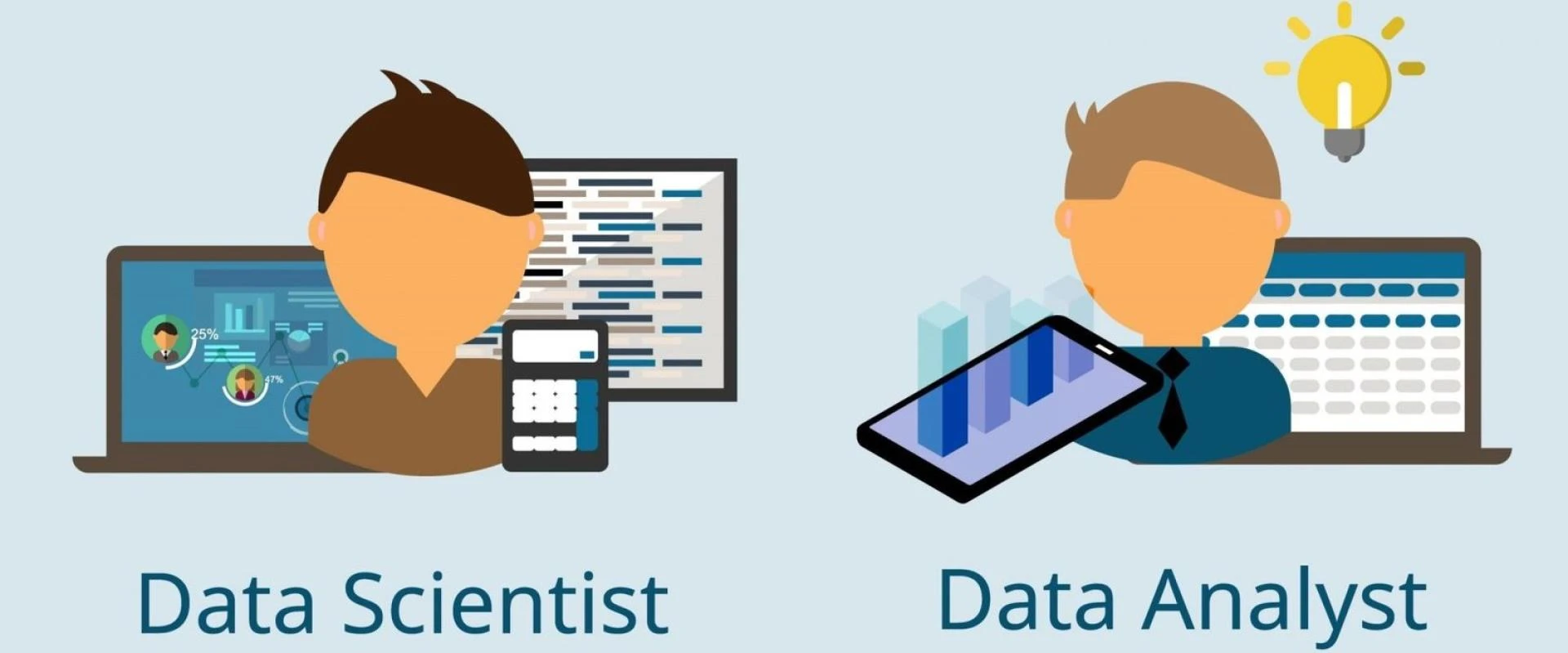
The People Behind the Data: Difference Between Data Analyst and Data Scientist
Just as the fields differ, so do the roles of the professionals who work in them.
A Data Analyst is a storyteller. They are experts at taking a dataset, finding the narrative within it, and communicating that story to business stakeholders in a clear and compelling way. Their work directly influences day-to-day business strategy.
A Data Scientist is a builder and a strategist. They are often more technical, with strong programming and advanced statistical skills. They design and implement machine learning models, run complex experiments, and often work on more open-ended, exploratory projects that can fundamentally change how a business operates.
Building a Career in the Data Universe
Now for the big questions. With all this potential, what does a career in this field look like?
Is data science and analytics a good career?
The answer is a resounding yes. Here’s why:
- High Demand: Companies across every single industry—from healthcare and finance to retail and entertainment—are desperate for professionals who can make sense of their data. The demand for these skills far outstrips the current supply.
- Impactful Work: You get to solve real, tangible problems. Your insights can lead to better products, more efficient processes, and smarter business decisions.
- Competitive Salaries: The high demand and specialized skillsets command excellent compensation.
- Continuous Learning: The field is constantly evolving, which means you'll never be bored. There is always a new tool, technique, or algorithm to learn.
What are data science and analytics jobs?
The job titles are diverse and can vary by company, but they generally fall into these categories:
- Analytics Track: Data Analyst, Business Analyst, Business Intelligence (BI) Analyst, Marketing Analyst, Operations Analyst, Financial Analyst.
- Science Track: Data Scientist, Machine Learning Engineer, AI Specialist, Quantitative Analyst ("Quant"), Statistician.
- Related Roles: Data Engineer (builds the data pipelines and infrastructure that everyone else uses), Data Architect.
What is data science and analytics salary?
Salaries are a major draw for many. While they vary significantly based on location, experience, industry, and company size, here are some general estimates for the U.S. market:
- Data Analyst: Entry-level positions typically start around $65,000 - $80,000. Experienced analysts and BI specialists can earn well over $110,000.
- Data Scientist: Entry-level salaries are often higher, starting in the $95,000 - $125,000 range. Senior and lead data scientists can command salaries of $150,000 to over $250,000, especially in the tech sector.
The general trend is that data science roles, requiring deeper programming and machine learning expertise, tend to have a higher salary ceiling.
Your Learning Pathway: Courses and Degrees
So, you're interested. How do you get started?
What is data science and analytics degree?
There is no single "right" degree. Professionals come from a wide range of backgrounds. Common and highly relevant undergraduate or graduate degrees include:
- Computer Science
- Statistics
- Mathematics
- Economics
- Engineering
- Business/Finance (especially for analyst roles) Many universities now offer a dedicated What is data science and analytics degree at both the bachelor's and master's levels, providing a structured curriculum covering all necessary skills.
What is data science and analytics course?
For those not pursuing a full degree, there is a wealth of options. A high-quality Data Science and data Analytics course or bootcamp can be an excellent way to break into the field. Look for programs that offer:
- A project-based curriculum: You learn by doing. A strong portfolio of projects is essential for landing a job.
- Essential technical skills: SQL is non-negotiable for any data role. Python or R is crucial for data science.
- Core concepts: Strong foundations in statistics, data visualization, and (for science) machine learning.
- Reputable Platforms: Online providers like Coursera, edX, DataCamp, and Udacity offer everything from individual courses to full professional certificates taught by university professors and industry experts.
The Final Verdict: Data Science vs Data Analytics, Which is Better?
This is the ultimate question, but it’s the wrong one to ask. One is not inherently "better" than the other. They are different disciplines that provide different types of value.
The right question is: Which is better for you?
- Choose a career in Data Analytics if: You love solving puzzles, communicating insights, and seeing your work directly influence business decisions. You are passionate about telling stories with data and prefer working on more defined problems.
- Choose a career in Data Science if: You are fascinated by programming, statistics, and automation. You enjoy the challenge of working with unstructured data, building predictive models from scratch, and exploring open-ended questions to chart a new path for the future.
Conclusion: The Data-Driven Future is Now
Both data analytics and data science are powerful forces transforming our world. Analytics provides the crucial lens to understand our past and present performance, while science provides the tools to build and predict our future.
Whether you aim to become an analyst who crafts compelling data narratives or a scientist who builds the next great recommendation engine, you are stepping into a dynamic, challenging, and incredibly rewarding field. The journey begins with understanding the landscape, and now, you have the map.