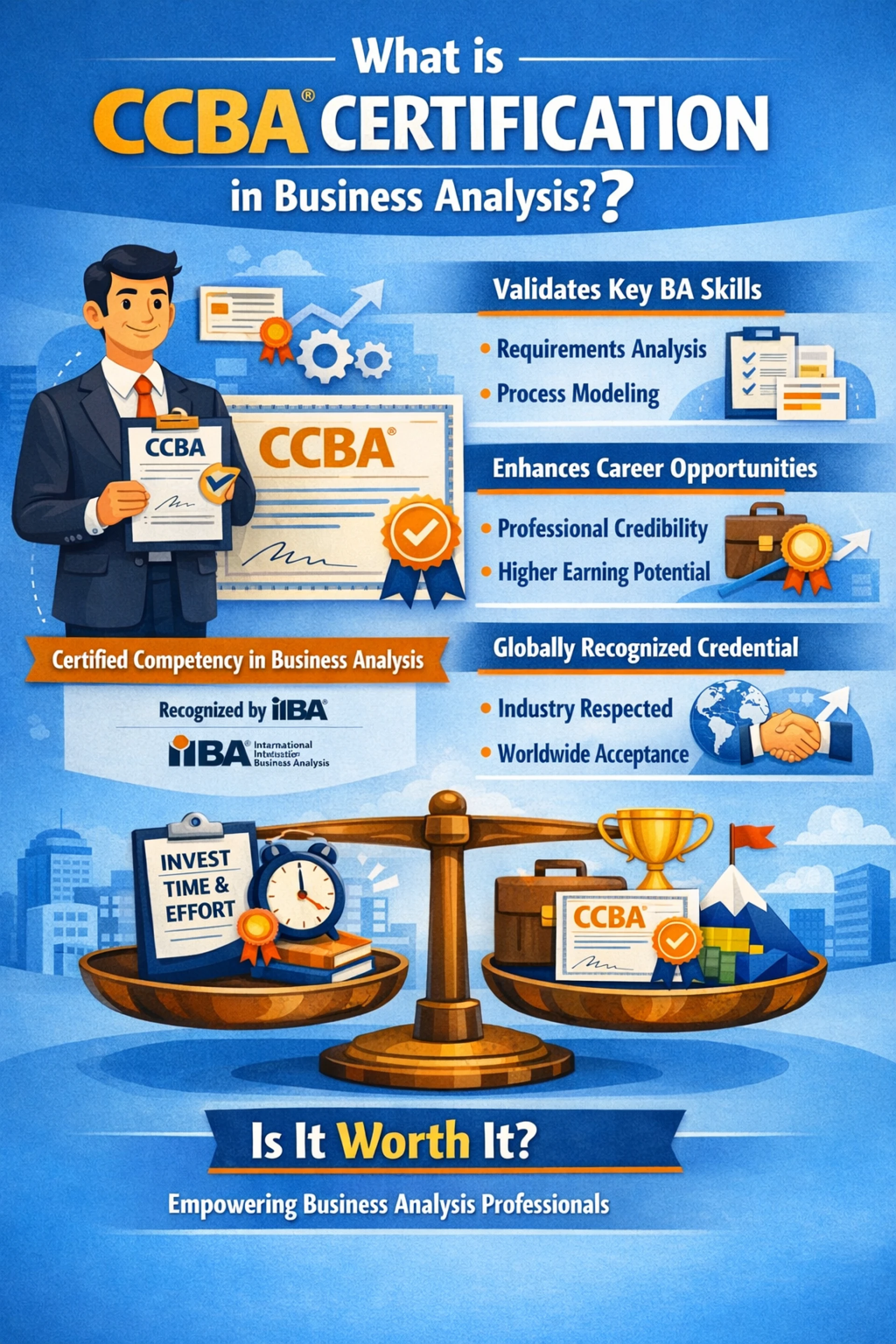
The CCBA (Certification of Capability in Business Analysis) is the global standard for mid-level business analysts. Offered by the International Institute of Business Analysis (IIBA®), it validates that a practitioner has the experience and "capability" to handle complex business analysis initiatives independently.
In 2026, the CCBA serves as a critical bridge for professionals with 2–3 years of experience who have outgrown the entry-level ECBA but do not yet meet the rigorous 5+ year requirements for the senior-level CBAP.
1. Core Eligibility Requirements (2026)
To qualify for the CCBA, you must prove both specialized training and substantial hands-on experience aligned with the BABOK® Guide v3.
- Work Experience: Minimum 3,750 hours of BA work experience in the last 7 years.
- Knowledge Area Depth: Within those 3,750 hours, you must meet one of these two criteria:
- 900+ hours in each of 2 Knowledge Areas.
- 500+ hours in each of 4 Knowledge Areas.
- Professional Development (PD): At least 21 hours of formal training completed in the last 4 years.
- References: Two professional references (manager, client, or a current CBAP).
2. The 2026 Exam Blueprint
The CCBA exam is a 3-hour, 130-question multiple-choice test. Unlike the recall-based entry-level exams, CCBA questions are scenario-based, requiring you to analyze a situation and select the best technique or task to apply.
Knowledge Area
Exam Weight
Strategic Focus
Requirements Analysis & Design
32%
Highest Priority. Focus on modeling and design options.
Elicitation & Collaboration
20%
Techniques for stakeholder workshops and engagement.
Requirements Life Cycle
18%
Governance, traceability, and change impact.
Strategy Analysis
12%
Defining current vs. future states and assessing risks.
Planning & Monitoring
12%
Selecting the BA approach and planning activities.
Solution Evaluation
6%
Measuring ROI and identifying solution limitations.
3. CCBA vs. ECBA vs. CBAP
The IIBA uses a tiered certification model to reflect a professional's career trajectory.
Feature
Level 1: ECBA
Level 2: CCBA
Level 3: CBAP
Experience
0 years
2–3 years (3,750 hrs)
5+ years (7,500 hrs)
Target
Entry-level / Juniors
Mid-level / Hybrid BAs
Senior Leaders / Experts
Question Type
Knowledge recall
Scenario-based
Case-study based
Exam Length
1.5 hours (50 Qs)
3 hours (130 Qs)
3.5 hours (120 Qs)
4. Financial Investment
In 2026, membership remains the most cost-effective path, as member discounts typically cover the membership fee itself.
- Application Fee: $145 USD (Non-refundable).
- Exam Fee (Member): ~$325 USD.
- Exam Fee (Non-Member): ~$450 USD.
- Membership Fee: ~$55–$155 USD (Varies by geographic region).
5. Professional Impact
- Salary Advantage: CCBA-certified professionals in 2026 earn an average of 15–20% more than non-certified peers.
- Standardized Skills: It proves you use industry-standard methodologies, making you highly desirable to global organizations.
- Career Advancement: It is often a prerequisite for roles like Senior Business Analyst, Product Owner, or Transformation Lead.