
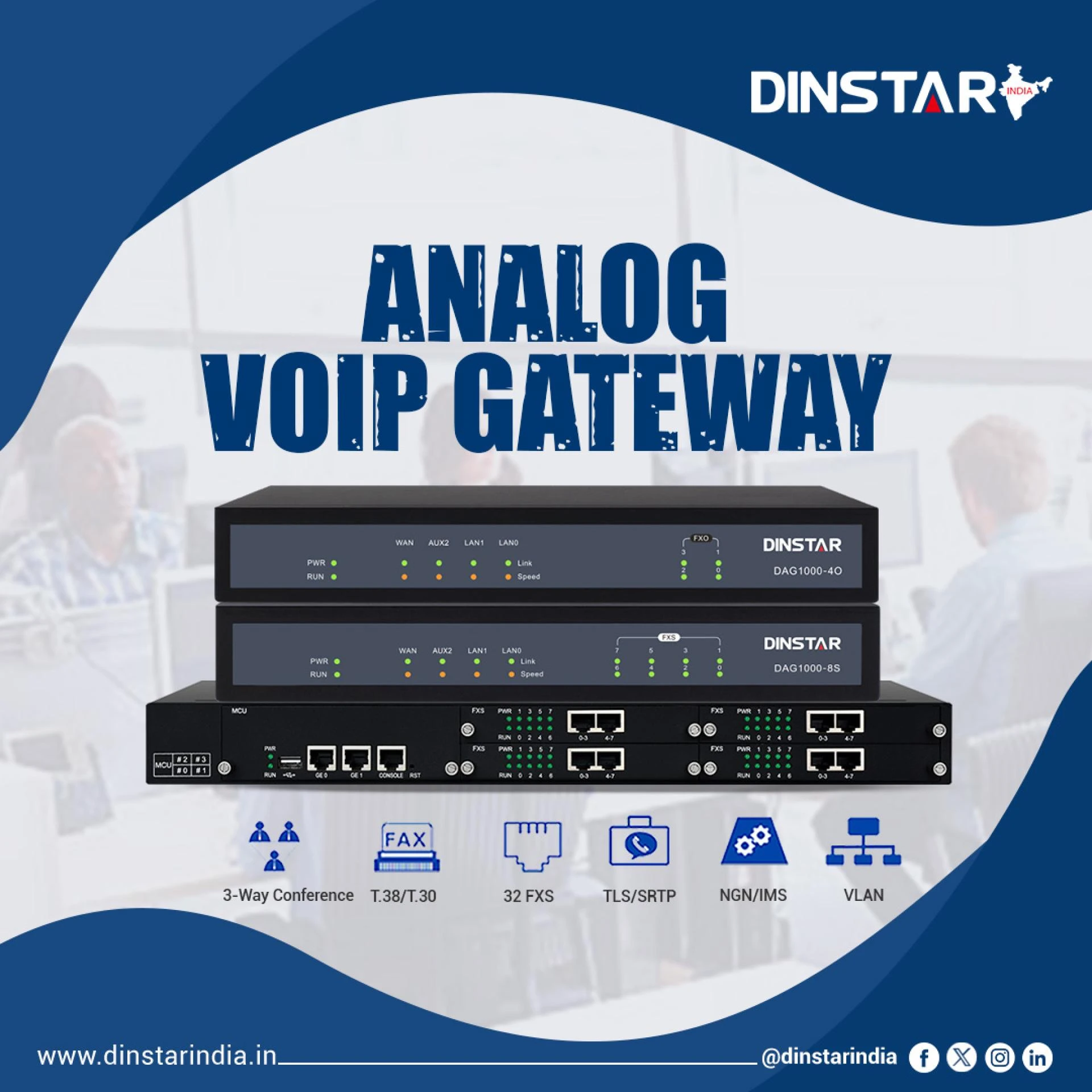
In the era of digital transformation, businesses are constantly upgrading their communication systems to stay competitive. While VoIP and cloud-based solutions are dominating the telecom space, many organizations still rely on traditional analog phones for various reasons—cost efficiency, existing infrastructure, or regional limitations. This is where Analog Gateways come into play.
In this blog, we’ll explore what an Analog Gateway is, how it works, and why it remains a crucial component in hybrid telephony setups.
What is an Analog Gateway?
An Analog Gateway, also known as an Analog VoIP Gateway, is a network device that connects traditional analog telephones and fax machines to modern VoIP (Voice over IP) networks. It acts as a bridge between the analog and digital world—enabling organizations to use their legacy telephone equipment with IP-based telephony systems like IP PBX, SIP servers, or hosted VoIP services.
There are two common types of analog gateways:
- FXS Gateway (Foreign Exchange Subscriber): Connects analog phones or fax machines to a VoIP network.
- FXO Gateway (Foreign Exchange Office): Connects analog trunk lines from the PSTN (Public Switched Telephone Network) to a VoIP network.
How Does an Analog VoIP Gateway Work?
At its core, an Analog VoIP Gateway converts voice signals from analog devices into digital packets and transmits them over an IP network. Similarly, it decodes incoming VoIP calls into analog signals for legacy devices. This two-way conversion ensures seamless communication between analog hardware and IP-based systems.
For example, if your business uses analog phones but wants to adopt a VoIP PBX, an FXS Gateway will connect those phones to your VoIP infrastructure. On the other hand, an FXO Gateway is ideal when you want your IP PBX to interface with analog trunk lines.
Key Features of Analog Gateways
Modern analog gateways are feature-rich and designed to support a wide range of business use cases. Some of the core features include:
1. Multiple Port Options
Analog gateways come in various port configurations such as:
- 2 Port Analog Gateway
- 4 Port FXS Gateway
- 8 Port FXS Gateway
- 16 Port FXS Gateway
- And beyond, depending on your requirements.
2. SIP Protocol Support
Most analog gateways support Session Initiation Protocol (SIP) for interoperability with various VoIP platforms and IP PBX systems.
3. High Voice Quality
Equipped with voice compression codecs like G.711, G.729, and echo cancellation features, analog gateways ensure crystal-clear audio quality.
4. Flexible Deployment
Whether you're operating from a small office or a large enterprise with branch offices, analog gateways can be deployed centrally or remotely for better scalability.
5. Security Features
Many analog VoIP gateways support TLS, SRTP, and VPN passthrough for secure voice transmission across IP networks.
Benefits of Using an Analog Gateway
Cost-Effective Migration
Analog gateways allow businesses to leverage their existing analog phones and fax machines without investing in new IP hardware—saving significant capital.
Simplified Integration
No need to replace your entire telephony system. Analog gateways make it easy to integrate legacy devices with modern VoIP systems.
Scalable Solution
From 2-port gateways to large 32 or even 48-port gateways, businesses can scale up as needed, depending on the number of analog endpoints.
Redundancy and Failover
Some advanced analog gateways offer PSTN failover features to ensure business continuity during network outages.
Remote Management
Many analog gateways support web-based management interfaces or TR-069 protocols for easier remote configuration and monitoring.
Common Use Cases for Analog VoIP Gateways
- Hotels and Hospitality
- Most hotels still use analog phones in guest rooms. Analog gateways help connect those phones to modern IP PBX systems for efficient internal communication.
- Healthcare Institutions
- Hospitals often rely on analog nurse-call systems or fax machines. An analog gateway enables VoIP integration without hardware replacement.
- Manufacturing Units
- Remote or industrial sites may use analog intercoms or paging systems. Analog gateways ensure these are VoIP-ready.
- Educational Institutions
- Schools and universities can retain their analog infrastructure and gradually migrate to VoIP using analog gateways.
- SMBs
- Small businesses with limited resources can enjoy the benefits of VoIP while using their existing analog phones, thanks to FXS gateways.
Choosing the Right Analog Gateway
When selecting an analog gateway for your business, consider the following factors:
Number of Ports
Choose based on how many analog endpoints you plan to connect. Common options include 2, 4, 8, 16, or 32-port models.
VoIP Compatibility
Ensure the gateway supports SIP and is compatible with your IP PBX or hosted VoIP provider.
Quality of Service (QoS)
Look for QoS support to prioritize voice traffic and maintain audio clarity during peak network usage.
Network Integration
Some gateways support dual Ethernet ports for better network integration and redundancy.
Brand and Support
Opt for reputable brands like Dinstar, which offer reliable hardware, firmware updates, and customer support.
Dinstar Analog Gateways: A Trusted Choice
Dinstar offers a wide range of Analog VoIP Gateways tailored for businesses of all sizes. Whether you need a 4 FXS Port Gateway for your small office or a 32 FXS Port Gateway for a hotel or enterprise, Dinstar ensures superior voice quality, robust performance, and seamless VoIP integration.
Popular Dinstar Analog Gateways:
- DAG1000 Series: Ideal for SOHO and small businesses
- DAG2000 Series: Designed for SMEs with higher port density
- DAG3000 Series: High-capacity gateways for large enterprises and call centers
Final Thoughts
Analog Gateways continue to play a vital role in today’s hybrid communication landscape. They bridge the gap between traditional telephony and modern VoIP systems, offering businesses a cost-effective, flexible, and scalable way to upgrade their communication without discarding legacy equipment.